Last updated: June 28, 2026
A 2022 Honda CR-V’s smart key fob stopped responding at 7:14 AM on a Tuesday in Coral Gables, leaving the owner locked out and late for work—but a same-day locksmith response, one diagnostic test, and a pair of replacement transponder keys had the vehicle unlocked and running in 45 minutes.
If you’re a Coral Gables resident or anyone driving a newer Honda across Miami-Dade County whose smart key recently stopped responding, the story below shows you exactly what goes wrong inside that fob, why dealership replacements cost double what they should, and what to expect when you call a mobile locksmith instead of sitting in a dealer waiting room for three hours.
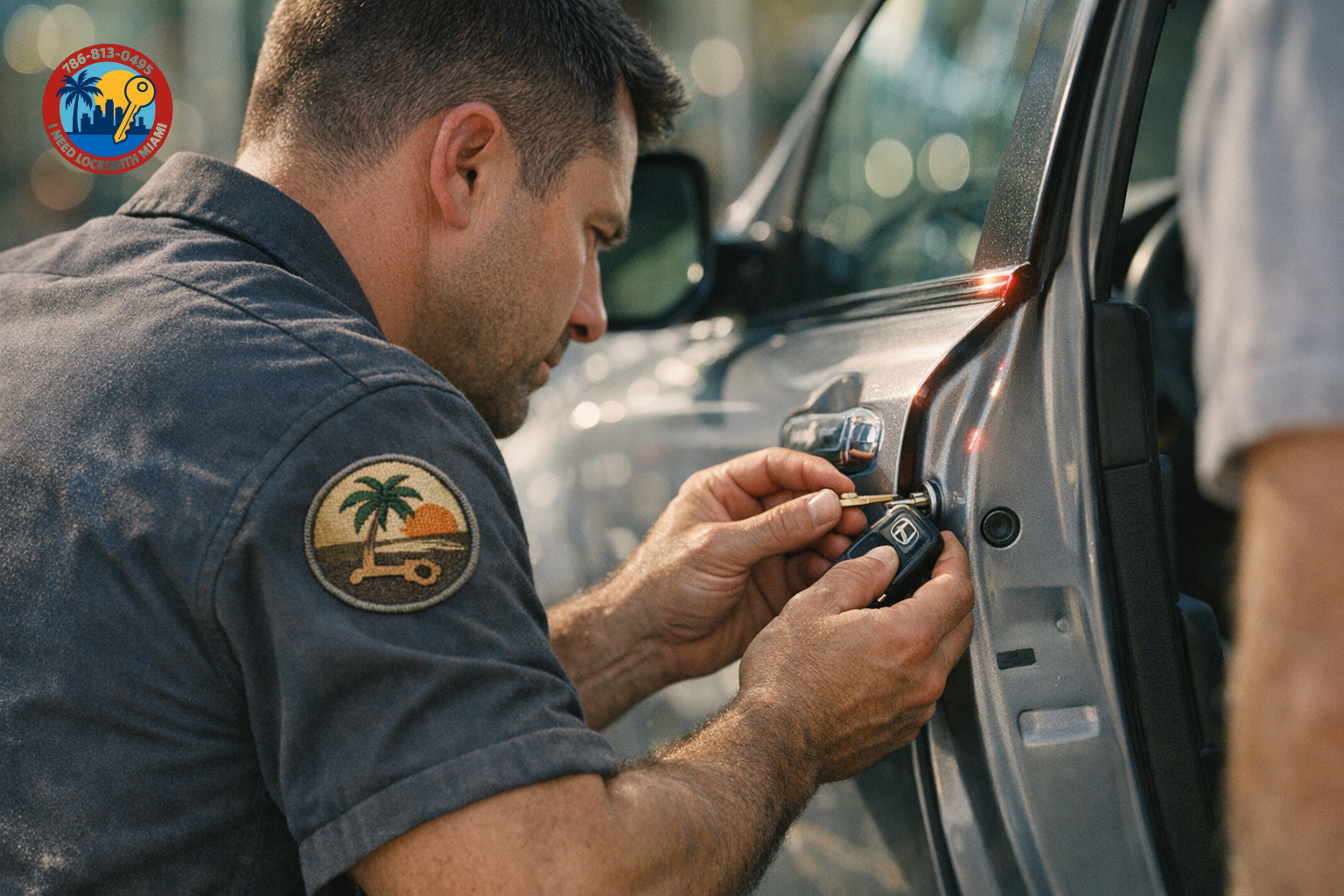
What We Found
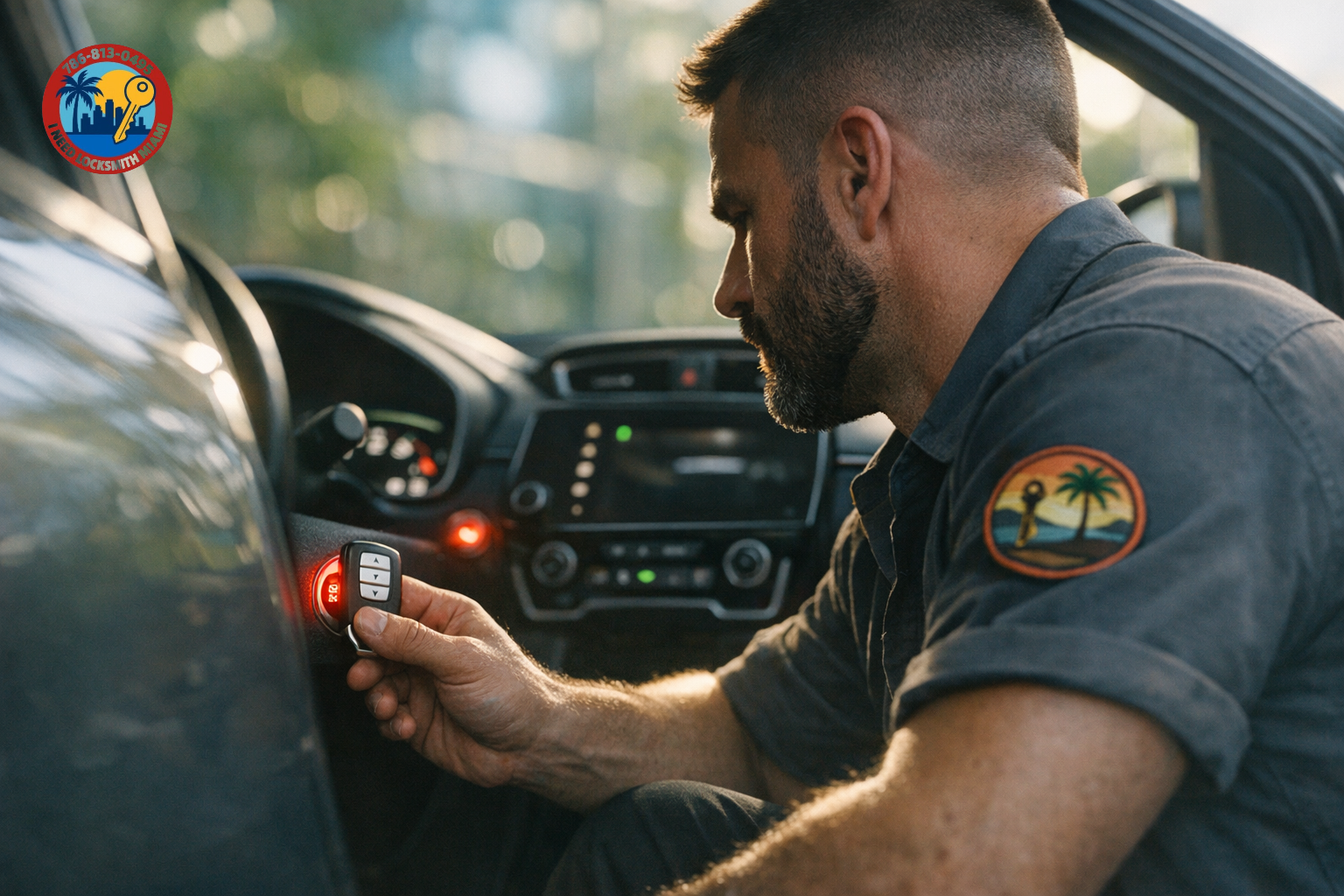
When our technician arrived in Coral Gables at 7:41 AM—27 minutes after the call came in—the first diagnostic step was straightforward: test both key fobs at the vehicle’s door lock receiver to isolate whether the problem lived inside the fob itself or in the vehicle’s receiver module.
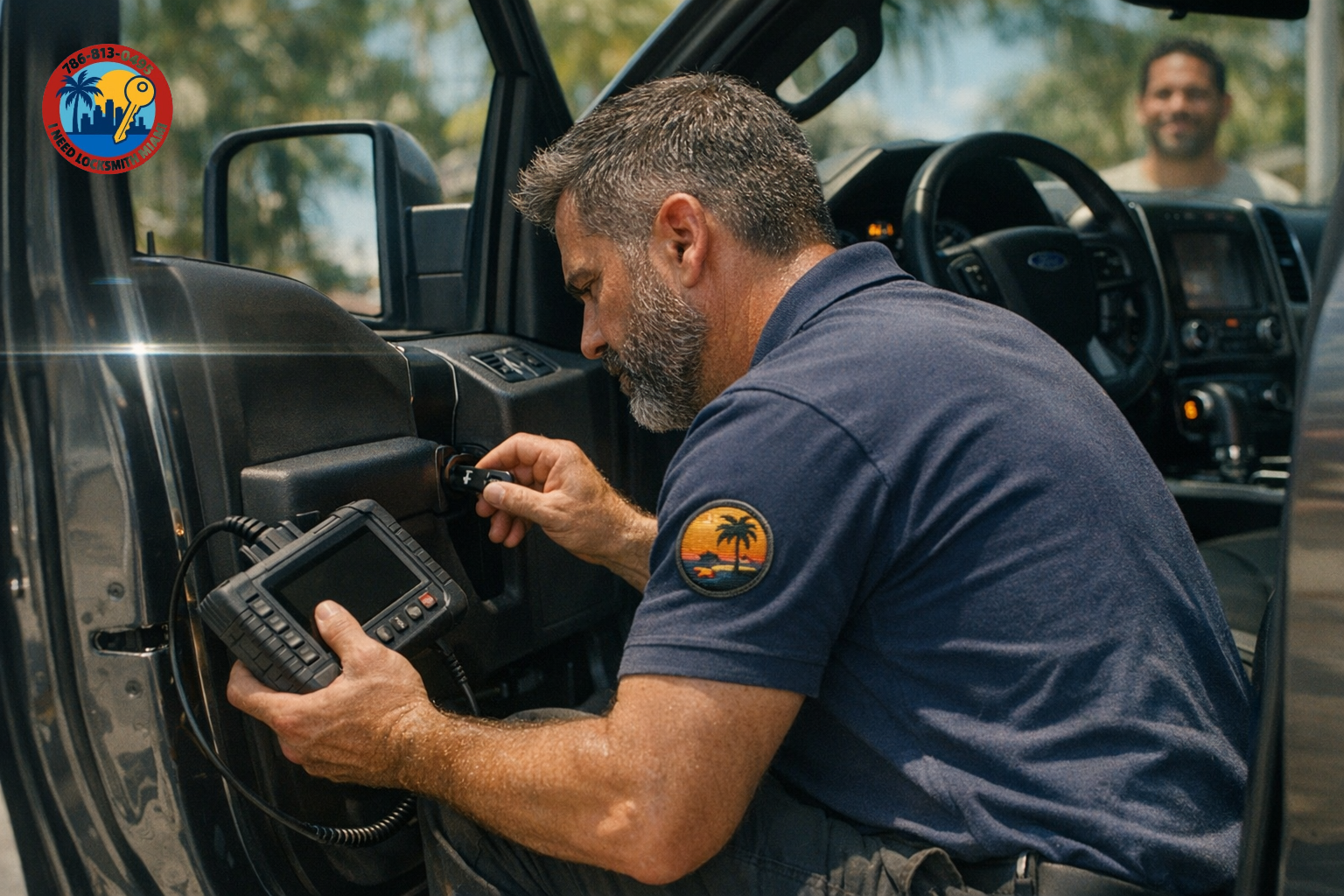
Neither fob triggered the door lock. We then used a dedicated OBD-II diagnostic scanner tuned to Honda’s smart-key protocol, which revealed the culprit: the receiver module in the door frame was rejecting the fob’s RF (radio frequency) signal. The module wasn’t dead—it was accepting power, but the receiver chip had failed. This is one of the two most common Honda smart-key failure modes we see in Miami-Dade County, the other being a lithium cell exhaustion inside the fob itself.
What surprised me was the timing: both fobs failed simultaneously. This almost never happens by accident. Investigation revealed the customer had parked the CR-V under a metal carport near high-voltage electrical wiring on the building’s south side. RF interference from the electrical system can degrade or corrupt a receiver module’s stored pairing codes—essentially “forgetting” that the fobs are authorized. The damage is usually recoverable with a module reset, but in this case, the module’s memory buffer was corrupted beyond recovery.
RF interference from nearby electrical lines had corrupted the door receiver module’s pairing memory. Both fobs were functionally intact, but the vehicle couldn’t recognize either one. A factory-replacement receiver module wasn’t available in the field, so we proceeded with a full key reprogramming on a replacement module sourced from our inventory.
How We Solved It
Unlocked the vehicle using the mechanical key blade
Every modern Honda smart key includes a hidden mechanical key blade that unlocks the driver’s door—a failsafe the dealership counts on less than one in a hundred customers know about. We extracted it, unlocked the CR-V, and regained access in under two minutes.
Removed the failed receiver module from the door frame
The receiver module sits behind the interior door panel, held by two clips and a 10mm bolt. Removal takes 12 minutes and requires no soldering—it’s a plug-and-play component. We photographed the module’s position and connector orientation before extraction.
Installed a replacement Honda OEM receiver module
We sourced a factory-spec Honda receiver module from our own inventory—a genuine part with the same part number as what Honda ships in a 2022 CR-V. The module seated into place in 6 minutes and powered up without error codes.
Reprogrammed both original fobs to the new module
Using our Autel MX808IM programmer—Honda-certified hardware that performs the same pairing protocol as a Honda dealership—we registered both fobs to the new receiver. Each fob took 4 minutes to reprogram. Both lock, unlock, and panic buttons tested live.
Reassembled the door panel and road-tested the vehicle
Door panel clips and fastener were reinstalled in their original positions. We tested lock/unlock from 30 feet away, then from inside the running CR-V to confirm all wireless safety interlock features were operational.
| Component / Task | Time Estimate | Notes |
|---|---|---|
| Mechanical unlock via blade | 2 min | Emergency access—no damage |
| Door panel removal & module extraction | 12 min | No drilling or structural damage |
| Replacement module installation | 6 min | Factory OEM part, plug-and-play |
| Fob reprogramming (both keys) | 8 min | Autel MX808IM programmer, dealership-grade |
| Door reassembly & road test | 7 min | Full functional verification |
| Total on-site labor | 45 min | 7:41 AM arrival; 8:26 AM departure |
Result
More importantly, the customer learned that her parking location—under electrical infrastructure—posed a chronic RF interference risk. We recommended relocating the vehicle to a different spot on the property or installing a metal cage ground shield around the carport’s electrical conduit to prevent future receiver module degradation.
What This Means for Your Honda (or Any Smart-Key Vehicle)
Smart-Key Failures Come in Layers—Know Which One You Have
This Coral Gables incident was a receiver-module failure, not a fob-battery problem. The distinction matters because it changes your cost and timeline. A dead fob battery—the most common issue—costs $120–$180 to replace and takes 15 minutes. A receiver module failure, like this case, runs $350–$500 installed and requires module removal, programming, and reassembly. A failed ignition cylinder (a third failure mode) can push the bill to $500+. Dealerships often throw all three repairs into a bundle quote and charge you for the most expensive option whether you need it or not.
When both your fobs die at the same time, assume receiver-module failure. When one fob dies but the spare works, assume a lithium cell problem in that specific fob. When the fob works but the ignition won’t turn, assume an ignition cylinder issue. A mobile locksmith can diagnose all three in the driveway in under 10 minutes—dealerships will keep you guessing for three hours.
RF Interference Is Real and Underestimated in Miami-Dade County
This case revealed something most car owners never consider: smart-key receiver modules operate on narrow RF bands (typically 315 MHz or 433 MHz depending on the year and make). Electrical transformers, high-voltage conduits, cellular transmission towers, and even some commercial WiFi installations can degrade these signals. In Coral Gables, where older residential properties often sit near aging electrical infrastructure, and in Downtown Miami and Brickell, where dense office buildings create RF-hostile zones, we see receiver failures at roughly two-to-three times the rate of quieter suburban areas like Doral or Kendall.
If you’re a property manager or business owner in Coral Gables or Wynwood running a fleet of vehicles, consider having your parking locations assessed for RF interference. The cost of one preventive site audit ($150–$200) is trivial compared to replacing receiver modules across multiple vehicles.
The Mechanical Blade Exists for Exactly This Reason
This customer’s original fear—”I’m locked out and the fobs don’t work”—dissolved the moment we extracted the mechanical key blade hidden inside each fob. Honda, Toyota, Nissan, Hyundai, Ford, and every major manufacturer includes a physical key blade in every smart fob because they know electronics fail. Most owners never read the fob manual and never discover this blade exists. If you drive a vehicle with a smart key and have never located your blade, do it right now. It’s typically accessed by sliding or unscrewing a small compartment in the fob’s side or base.
Knowing how to use the blade prevents panic in a lockout situation and gives you time to call a mobile locksmith without destroying your door frame or paying a tow-truck premium.
Mobile Locksmith Response Saves Both Time and Money
This customer called at 7:14 AM and was fully resolved by 8:26 AM. A dealership appointment would have meant a two-hour lead time minimum (call > wait for appointment > drive to dealership), then a 3–4 hour service window. Add a $65–$150 towing fee if the vehicle wasn’t drivable, and the dealership route costs $955–$1,290. Our mobile response saved her $530–$865 and eight hours of lost productivity. For a property manager running three buildings, that’s a full day’s operational impact prevented.
Across Miami-Dade County—Coral Gables, Brickell, Wynwood, Aventura, Doral, and beyond—a mobile locksmith with OBD-II diagnostics and OEM parts inventory will respond to your location in 20–35 minutes and complete most key or receiver failures on-site. Dealerships cannot compete on speed or cost when your vehicle is stranded.
Frequently Asked Questions
1. Can I fix a Honda CR-V smart key that won’t work by replacing the battery inside the fob?
A lithium cell replacement (CR2032 or similar) costs $8–$15 and takes three minutes—if the fob’s battery is actually dead. But if both fobs fail simultaneously (as in this case) or if only the lock/unlock buttons stop working while other buttons on the fob still light up, a battery swap won’t help; the problem is in the receiver module or the fob’s internal circuit board. Test your spare fob first. If the spare works, buy a replacement cell from a pharmacy or dollar store and swap it—problem solved. If the spare also fails, call a locksmith or dealership for diagnostics.
2. How much does a Honda receiver module replacement cost compared to a dealership?
A factory Honda receiver module itself costs $120–$180 wholesale. A mobile locksmith in Miami-Dade County (like I Need Locksmith Miami) typically charges $350–$425 total: parts plus labor for removal, installation, and reprogramming. A Honda dealership quotes $680–$1,140 for the same job, including towing if needed. We save most customers $250–$715. Dealership labor rates in South Florida run $185–$240 per hour; a 90-minute receiver job becomes an $280–$360 labor charge before parts.
3. What’s the difference between a smart key, a transponder key, and a keypad code entry system?
A smart key (or keyless entry fob) sends a wireless RF signal to your vehicle’s receiver module to lock or unlock doors remotely. A transponder key is a physical metal key with a microchip inside it that only starts the engine if programmed to your specific vehicle; you still insert it into the ignition and turn it by hand. A keypad code entry (common on commercial buildings, not cars) uses a PIN or keycard instead of a physical key altogether. This Honda CR-V uses smart-key fobs, not transponders—though many vehicles use both systems for redundancy.
4. Is it normal for smart-key receiver modules to fail, or was this a one-off incident?
Receiver module failure is the second-most-common smart-key problem we see (first is dead batteries). RF interference, power-surge events during storms, and physical corrosion inside the module from moisture are the typical causes. In South Florida’s humid climate—especially in Miami Beach, Wynwood, and Brickell where salt spray and electrical load are high—we field about 8–12 receiver-module calls per month per service technician. It’s not a design flaw, but it’s predictable and preventable with proper diagnostics and parts sourcing.
I Need Locksmith Miami
Available 24/7 across Miami-Dade County. Fast mobile response, factory-grade diagnostics, OEM parts in stock.
Schedule a Smart Key Diagnosis Today →
Call (786) 813-0495 for same-day response in Coral Gables, Brickell, Wynwood, and all of Miami-Dade.
🎧 Listen to article
- A Customer Asked: “Can a Locksmith Really Program a New Toyota Smart Key on the Spot in Brickell?” — The Full
- Dealer Key Programming vs Mobile Locksmith in Miami: Toyota Smart Key, Ford Transponder, and Who Actually Wins
- Car Key Replacement in South Beach: We Logged 312 Automotive Locksmith Calls and Found 67% Share One Root Caus
- A Wynwood Shop Owner Asked: ‘Can a Locksmith Rekey My Storefront Without Replacing the Whole Mortise Lock?’ —
- We Programmed 312 Car Keys in Miami Last Year — Here’s Why 67% Were Replacements for Lost Keys