Last updated: October 27, 2026
Published October 27, 2026 · Updated October 27, 2026
Behind almost every commercial locksmith in Miami Edgewater multi tenant office supply room lock stays unlocked request is a lock function problem, not a broken lock. The shared door has a classroom or office function lever that stays unlocked after a key turns it, when it needs a storeroom function lever (ANSI/BHMA F86) that relocks the moment the door latches. The three practical ways to get there are a Schlage ND Series storeroom lever, a Yale storeroom lever, or a storeroom lock fitted with a Medeco or Mul-T-Lock high-security cylinder. The right pick depends on which keyway the building’s master key system already uses.
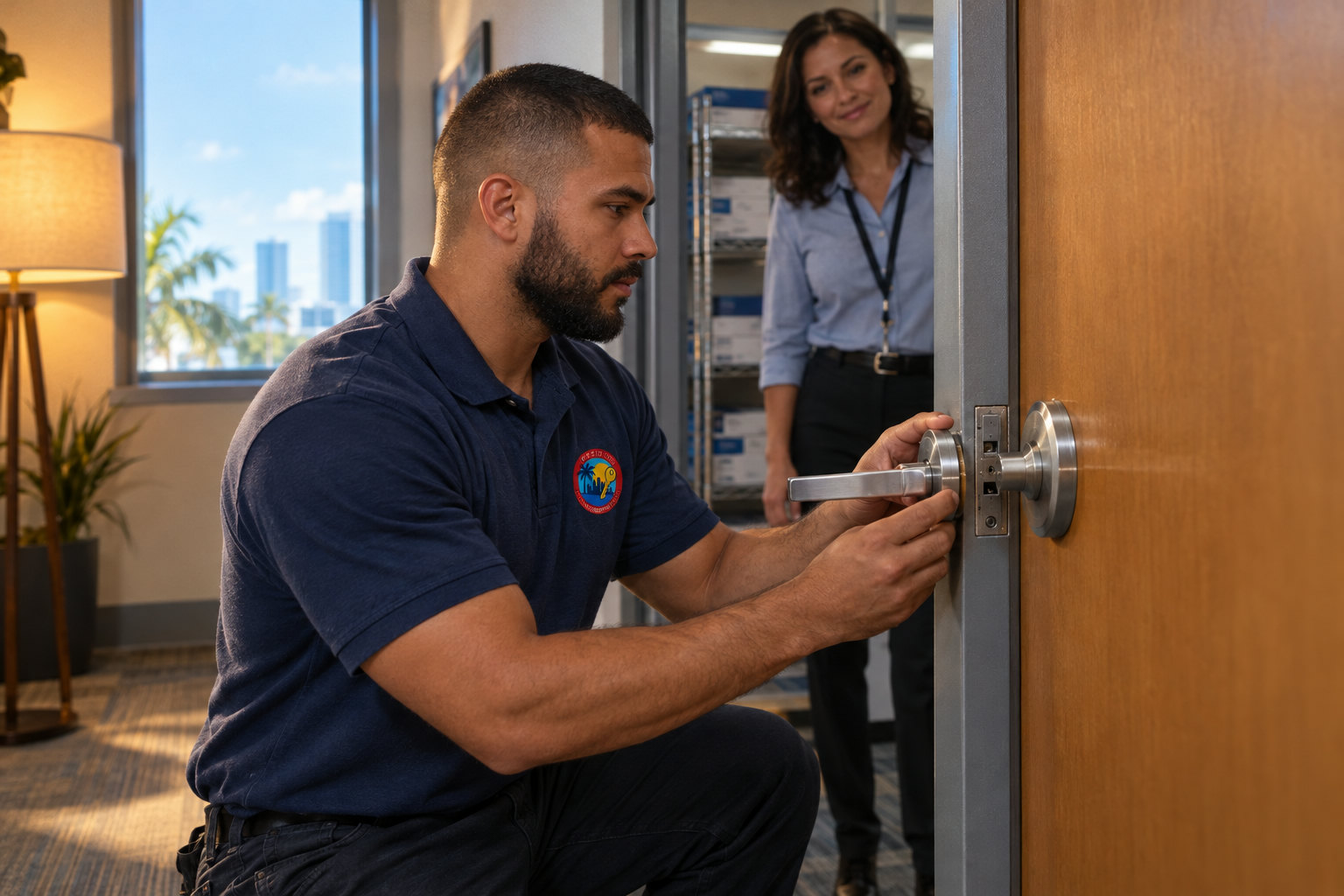
If you’re an office manager or property manager on a shared floor who keeps finding the common supply room open after hours, with toner, paper and spare laptops on the shelves, this breakdown is for you. It is not about a lock that refuses to open. It is about a lock that opens fine and then never closes the loop.
- A classroom function lever (ANSI F84) stays unlocked after a key unlocks it from the outside, and it only relocks when someone turns the key back.
- A storeroom function lever (ANSI F86), such as the Schlage ND80 cylindrical or the Schlage L9080 mortise, keeps the outside lever locked at all times, so the door relocks every time it closes and latches.
- A storeroom function lock never traps anyone inside, because the inside lever always turns freely, which keeps the door consistent with the free-egress principle in NFPA 101.
- Yale, Medeco and Mul-T-Lock are ASSA ABLOY brands, while Schlage belongs to Allegion, and a single master key system normally runs on one manufacturer’s keyway.
- Changing the lock function only works if the door latches: a weak door closer, a sagging door or a misaligned strike leaves even a storeroom lock sitting open.
- Rekeying after a tenant moves out or an employee leaves is the step that keeps a shared supply room key from walking out the door with them.
The three storeroom options compare like this. Every one of them fixes the core problem, because every one uses the storeroom function. They differ in key control, master key fit and what they demand from the building’s existing hardware.
| Attribute | Schlage ND Series storeroom (ND80) | Yale storeroom lever | Storeroom lock + Medeco or Mul-T-Lock cylinder |
|---|---|---|---|
| Stops the stays-unlocked problem? | Yes, outside lever always locked | Yes, outside lever always locked | Yes, if the host lock is a storeroom chassis |
| Standard and grade | ANSI/BHMA A156.2 Grade 1 cylindrical | Sold in Grade 1 and Grade 2 lines; confirm per series | Set by the host lock; the cylinder adds pick and drill resistance |
| Key control | Standard keyways or Everest 29 restricted keyway | Standard Yale keyways are widely duplicated | Patented keys, duplication through authorized channels with an ID card |
| Master key fit | Best when the building already runs Schlage | Best when the building already runs Yale | Best when the building runs a Medeco or Mul-T-Lock system |
| Cost tier | Mid-range commercial | Mid-range commercial | Premium tier |
| Mortise version | Schlage L9080 storeroom | Yale mortise storeroom function | Mortise cylinders for both host brands |
| Best fit | General office supply closets on a Schlage system | Floors already standardized on Yale hardware | Rooms holding electronics, records or high-value stock |
Commercial Locksmith in Miami Edgewater: Why Does a Multi Tenant Office Supply Room Lock Stay Unlocked After a Key?
A multi tenant office supply room lock stays unlocked after someone uses a key because the lock’s function tells it to. Nothing is broken. The lock is doing exactly what its chassis was built to do.
Commercial lever locks are sold in named functions, and the ANSI/BHMA A156.2 standard for bored and preassembled locks gives each function a designation. Three of them show up on shared office doors, and only one of them relocks on its own.
Classroom function (F84)
A classroom function lever, such as the Schlage ND70 or the L9070 mortise, is locked and unlocked by a key on the outside. Once unlocked, the outside lever stays free until someone turns the key back. On a shared supply room, every tenant who unlocks it is supposed to relock it, and in practice the last person rarely does.
Office or entrance function
An office or entrance function lever, such as the Schlage ND50, locks with a push-button on the inside. Turning the key outside, or turning the inside lever, releases the button, and the door then stays unlocked until someone pushes the button again. That works for a private office. It fails on a room shared by four companies.
Storeroom function (F86)
A storeroom function lever, such as the Schlage ND80 or the L9080 mortise, keeps the outside lever locked permanently. The key retracts the latch only while it is held turned, and the door relocks as soon as it swings shut and latches. The inside lever always opens, so nobody gets locked in.
When it is not the lock at all
A supply room door can also sit unlocked because it never latches. A door closer from LCN, Norton or Dorma with its latch speed set too slow, a door that sags on worn hinges, or a strike plate that no longer lines up with the latch will all leave the door resting against the frame instead of locked into it. Tape over the latch and a wedge under the door are the other usual suspects.
Classroom (F84) and office function levers stay unlocked after a key is used; storeroom (F86) levers like the Schlage ND80 relock every time the door latches. If the door does not latch, the closer, hinges or strike need attention before any lock change will help.
How can you tell which lock function the supply room door has?
The lock function on a supply room door can be identified in about the time it takes to walk to it, using only the key you already have. Run these five checks in order.
Try the outside lever with no key
Close the door fully and push down on the outside lever. If it opens, the lock is currently unlocked, whatever its function.
Turn the key, remove it, try the lever again
If the lever still opens after the key comes out, you have a classroom or office function. On a storeroom lock the lever goes rigid the moment you release the key.
Look at the inside lever
A push-button or turn-button on the inside rose usually means an office or entrance function. A plain inside lever with nothing to press points to classroom or storeroom.
Let the door close on its own
Open the door fully and let go. It should swing shut and click into the strike without a push; if it stops short, the closer needs adjusting.
Check the strike and the gap
Look for fresh scrape marks on the strike plate or an uneven gap along the top of the door. Both signal sag or misalignment that keeps the latch from seating.
A common mistake at this stage is trying to force a fix: filing the strike, shimming the latch or prying the frame to make the door catch. Once the frame or jamb is damaged, the job grows from lock work into structural door repair, so it pays to stop and call before the pry bar comes out.
Is a Schlage ND Series storeroom lever the right supply room fix?
The Schlage ND Series storeroom lever, model ND80, is the most direct fix for a supply room door that stays unlocked, especially in buildings already keyed to Schlage. It is an ANSI/BHMA A156.2 Grade 1 cylindrical lock, the heaviest commercial grade, and its storeroom function relocks every time the door latches. For mortise-prepped doors, the Schlage L9080 delivers the same function in a mortise body.
Key control is where Schlage gives you a real choice. Standard Schlage keyways are easy to copy at almost any hardware counter. The Everest 29 restricted keyway uses patented key blanks that only authorized dealers can cut, which matters when several tenants hold supply room keys.
The weaknesses are about fit, not function. If the rest of the floor runs on Yale or Medeco keyways, a Schlage ND80 cannot join that master key system without a different cylinder or a separate key. Everest 29 keys also take longer to replace, because copies come through the dealer that holds the keyway authorization. That is the point of a restricted key.
For a deeper side-by-side of cylinders on the same kind of door, see this comparison of Schlage AD, Yale AU and Mul-T-Lock Interactive mortise cylinders for office master key systems.
When does a Yale storeroom lever make more sense?
A Yale storeroom lever makes more sense than a Schlage ND80 when the building’s suite doors, stairwell doors and closets already run on Yale hardware and Yale keyways. Yale is an ASSA ABLOY brand, and its commercial lever locks are offered in a storeroom function that behaves exactly like the Schlage version: outside lever always locked, key retracts the latch, door relocks on closing. Mortise-prepped doors can take a Yale mortise lock in the same function.
The main strength is continuity. A Yale storeroom lever can be pinned into an existing Yale master key system, so the property manager’s master and each tenant’s sub-master keep working without a new key on anyone’s ring. The lever styles and finishes also match the rest of the floor.
The weaknesses deserve a look before ordering. Yale sells both Grade 1 and Grade 2 commercial levers, so the grade has to be confirmed on the specific series rather than assumed. Standard Yale keyways are also widely duplicated. If the stays-unlocked problem comes with a suspicion that extra keys are circulating, a Yale lever on a standard keyway solves only half of it.
That second half is a key control question. It is covered in more depth in this guide to restricted key locks for multi-tenant offices.
Should the supply room get a Medeco or Mul-T-Lock high-security cylinder?
A Medeco or Mul-T-Lock high-security cylinder is worth adding to a storeroom function lock when the supply room holds electronics, records or stock that would be expensive to lose. Both are ASSA ABLOY brands, and both are known for patented keys that can only be duplicated through authorized channels, typically with a key ID card. Medeco’s M4 and Mul-T-Lock’s Interactive+ and MT5+ are current examples.
The important detail is that the cylinder does not change the function. A Medeco cylinder in a classroom lever is still a classroom lever that stays unlocked. The fix is a storeroom chassis, such as a Schlage ND80 or a Yale storeroom lever, with the high-security cylinder retrofitted into it.
The strengths are key control and physical resistance. High-security cylinders are designed to resist picking, bumping and drilling far better than standard pin-tumbler cylinders, and the patented key stops a tenant’s employee from copying the supply room key on the way to lunch. The weaknesses are cost, which sits in the premium tier, and administration: someone has to manage the authorization card and approve each new key.
For a closer look at how one of these cylinders performs on a shared office floor, read about Medeco M4 cylinders for multi-tenant office key control.
How does a new supply room lock fit the building’s master key system?
A new storeroom lock fits the building’s master key system when it uses the same keyway and is pinned to the system’s existing bitting chart. On a typical shared floor, the property manager holds a grand master, each tenant holds a sub-master for its own suite, and the shared supply room is keyed so that every tenant’s key, plus the building master, operates it. A commercial locksmith in Miami can pin a Schlage, Yale, Medeco or Mul-T-Lock cylinder into that structure as long as the keyway matches.
A common mistake is not rekeying after a tenant moves out or an employee leaves. Every departing key that still opens the supply room is a security gap and a liability exposure for the landlord. Rekeying the storeroom cylinder at each turnover is the routine step that keeps the shared room’s key list matching the people actually on the floor.
Fire-rated corridor and suite doors bring their own rules on labeled hardware. Those are covered in this guide to fire-rated suite door locks in multi-tenant offices.
Finish choice close to the bay
Edgewater sits on the western shore of Biscayne Bay, just north of Downtown Miami, so salt air reaches hardware on breezeways, exterior corridors and doors near loading areas. For a supply room door exposed to that air, a BHMA 630 satin stainless steel finish generally holds up better than BHMA 626 satin chrome. Fully interior doors can stay with whatever finish matches the floor.
- Choose the Schlage ND80 (or L9080 mortise) when the building already runs a Schlage master key system and the supply room holds everyday office stock. Add the Everest 29 restricted keyway if tenants turn over often.
- Choose a Yale storeroom lever when suite doors and closets on the floor are already Yale, so the new lock joins the existing master key system without new keys for anyone. Confirm the grade on the series you order.
- Choose a storeroom lock with a Medeco or Mul-T-Lock cylinder when the room holds laptops, records or inventory, or when there is reason to think unauthorized copies of the current key are circulating.
- Choose none of them yet if the door fails the close-and-latch test. Adjust the closer, hinges or strike first, then decide on the lock.
Our Verdict
Our verdict on a shared supply room lock that stays unlocked is simple: the storeroom function is non-negotiable, and the brand should follow the keyway the building already uses. Changing brands for its own sake breaks the master key system and puts a separate key on every ring. That is a step backward.
For the property manager running a Schlage-keyed floor with routine supplies behind the door, the Schlage ND80 is the pick. For the facilities lead on a floor standardized on Yale hardware, a Yale storeroom lever wins on continuity. For the office manager whose supply room doubles as the place spare laptops and client files live, a storeroom chassis with a Medeco M4 or Mul-T-Lock cylinder is the one worth the premium.
No single brand wins every building. The office supply room lock stays unlocked problem is solved by function. Brand choice decides how well the fix fits everything else on the floor.
Our view
In our opinion, building managers tend to overweight the brand and underweight the function when a shared door keeps getting left open. A premium cylinder in the wrong chassis still leaves the door unlocked. A mid-range Grade 1 storeroom lever on a door that latches properly fixes the problem the day it goes in.
The other thing that matters more than it looks is the door itself. A storeroom lock on a door with a tired closer is an expensive decoration. Checking that the door swings shut and latches on its own should come before any hardware order.
Finally, we think key policy beats key hardware for most shared rooms. A written rule that the supply room cylinder is rekeyed at every tenant move-out does more over time than any single lock upgrade. Hardware handles the door. The policy handles the people.
Frequently Asked Questions
Will a storeroom function lock trap someone inside the supply room?
A storeroom function lock does not trap anyone inside, because the inside lever on locks like the Schlage ND80 and L9080 always turns freely. Only the outside lever stays locked. That one-way behavior is consistent with the free-egress principle in NFPA 101, which Florida applies through its Fire Prevention Code.
Can the existing supply room lock just be rekeyed instead of replaced?
Rekeying the existing supply room lock changes which keys open it, but not its function, so a classroom (F84) or office lever will still stay unlocked after a key is used. The chassis that sets the function has to change. The existing cylinder can often be re-pinned and reused in the new storeroom lock when the keyway matches.
Can a new storeroom lock join the building’s existing master key system?
A new storeroom lock can join the existing master key system when it uses the same keyway, for example a Schlage ND80 on a Schlage-keyed floor or a Yale storeroom lever on a Yale-keyed floor. Restricted systems such as Schlage Everest 29, Medeco or Mul-T-Lock require the cylinder to come through an authorized dealer. Mixing manufacturers usually means a separate key for the supply room.
Does the door closer matter if the lock is switched to storeroom function?
The door closer matters as much as the lock, because a storeroom function lever only relocks once the latch fully seats in the strike. Closers from LCN, Norton and Dorma typically have adjustable closing and latch speeds that can be tuned so the door finishes its swing. If the door sags or the strike is misaligned, that has to be corrected in the same visit.
Sources
- Lock grades and function designations under ANSI/BHMA A156.2 and BHMA finish codes: Builders Hardware Manufacturers Association (BHMA)
- Schlage ND Series and L9000 storeroom, classroom and office functions, and the Everest 29 keyway: Allegion, parent company of Schlage
- Yale, Medeco and Mul-T-Lock as ASSA ABLOY group brands: ASSA ABLOY
- Free egress from the egress side of a door: National Fire Protection Association, NFPA 101 Life Safety Code
If your shared supply room in Edgewater keeps ending up open, I Need Locksmith Miami can identify the lock function, check whether the door latches, and recommend the storeroom option that fits the master key system you already have. Call (786) 813-0495 any hour, or request service online and ask for pricing on the storeroom lock that suits your door.
I Need Locksmith Miami
I Need Locksmith Miami is a Miami-Dade locksmith and door specialist serving residential, commercial, and automotive customers.
 Listen to this articleAudio version
- A Medley Office Manager Asked a Commercial Locksmith in Miami: “What Type of Lock Is Best for a Multi-Tenant Office When Tenants Keep Copying Shared Keys?”
- A Hialeah Office Manager Asked: “Will Our Multi Tenant Door Unlock During a Power Outage?” What Maglock and Electric Strike Wiring Means for Access Control
- A Brickell Office Manager Asked a Locksmith in Miami: “Who Should Be Able to View Card Reader Entry Logs in a Multi Tenant Office?”
- A Coral Gables Office Manager Asked a Commercial Locksmith in Miami: “When a Tenant Moves Out, Should We Rekey or Replace the Office Locks?”
- Commercial Locksmith in Miami for Downtown Miami Offices: Can a Battery Powered Keypad Lock Keep an Existing Mechanical Master Key?

2 Responses