Last updated: November 3, 2026
Published November 3, 2026 · Updated November 3, 2026
 Listen to this articleAudio version
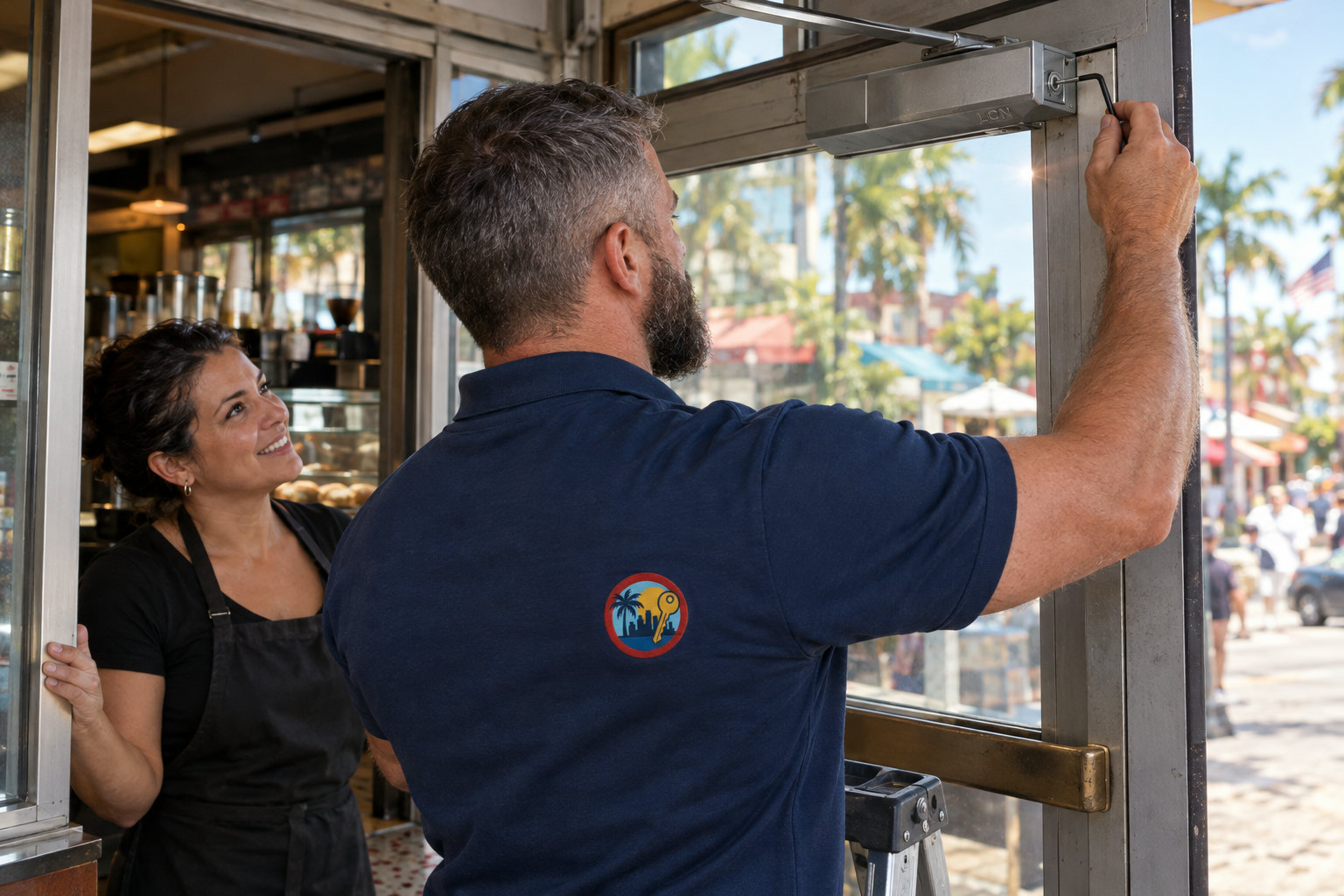
If your locksmith in Miami is quoting a high-traffic Little Havana entrance with the LCN 4011 vs Norton 1600 vs Dorma TS83 door closer choice on the table, the LCN 4011 is the safest default: it is a cast-iron, heavy-duty surface closer from LCN’s 4010/4110 series, built for doors that cycle from opening to closing time. The Norton 1600 is a close second and the better pick in buildings already standardized on ASSA ABLOY hardware. The Dorma TS83 earns its place as a like-for-like retrofit and on lighter interior doors.
- The LCN 4011 belongs to LCN’s 4010/4110 heavy-duty series, and LCN is an Allegion brand, the same parent company as Schlage.
- The Norton 1600 is a heavy-duty cast-iron surface closer from Norton Door Controls, an ASSA ABLOY company.
- The Dorma TS83, now sold under the dormakaba name, is the easiest swap when the door already carries a Dorma closer and its mounting holes.
- Under the 2010 ADA Standards (section 404.2.8), a door closer must take at least 5 seconds to move a door from 90 degrees open to 12 degrees from the latch.
- Miami-Dade County sits inside Florida’s High-Velocity Hurricane Zone, so backcheck adjustment matters on outswing doors exposed to gusts.
- Backcheck cushions a door near the end of its opening swing, but it is not a door stop: high-traffic doors still need a stop or a stop arm.
The LCN 4011, Norton 1600 and Dorma TS83 are all sold as commercial surface-mount closers, but they come from three different hardware families. The table below compares them on the points that decide a high-traffic installation. Pricing depends on the arm, finish and door condition, so ask for a quote on the specific door.
| Attribute | LCN 4011 | Norton 1600 | Dorma TS83 |
|---|---|---|---|
| Parent company | Allegion (also parent of Schlage) | ASSA ABLOY | dormakaba |
| Product family | 4010/4110 heavy-duty series | 1600 heavy-duty series | TS line, European-style design |
| Body | Cast iron | Cast iron | Compact rectangular body; confirm material on the current spec sheet |
| Arm options | Regular, parallel, hold-open and stop-arm variants across the series | Regular, parallel and hold-open arms | Regular and parallel arm; slide-track look lives in the separate TS93 family |
| Hydraulic adjustments | Closing speed, latch speed, backcheck | Closing speed, latch speed, backcheck | Closing speed, latch speed, backcheck |
| Best fit | Heaviest-use exterior doors: restaurants, retail, lobbies | Heavy-use doors in ASSA ABLOY-standardized buildings | Like-for-like Dorma retrofits, interior corridors |
| Retrofit ease | Easy on doors with an existing LCN; drop or adapter plate otherwise | Easy on doors with an existing Norton; plate otherwise | Easiest when replacing an existing Dorma |
Which door closer should a locksmith in Miami pick for a high-traffic Little Havana entrance?
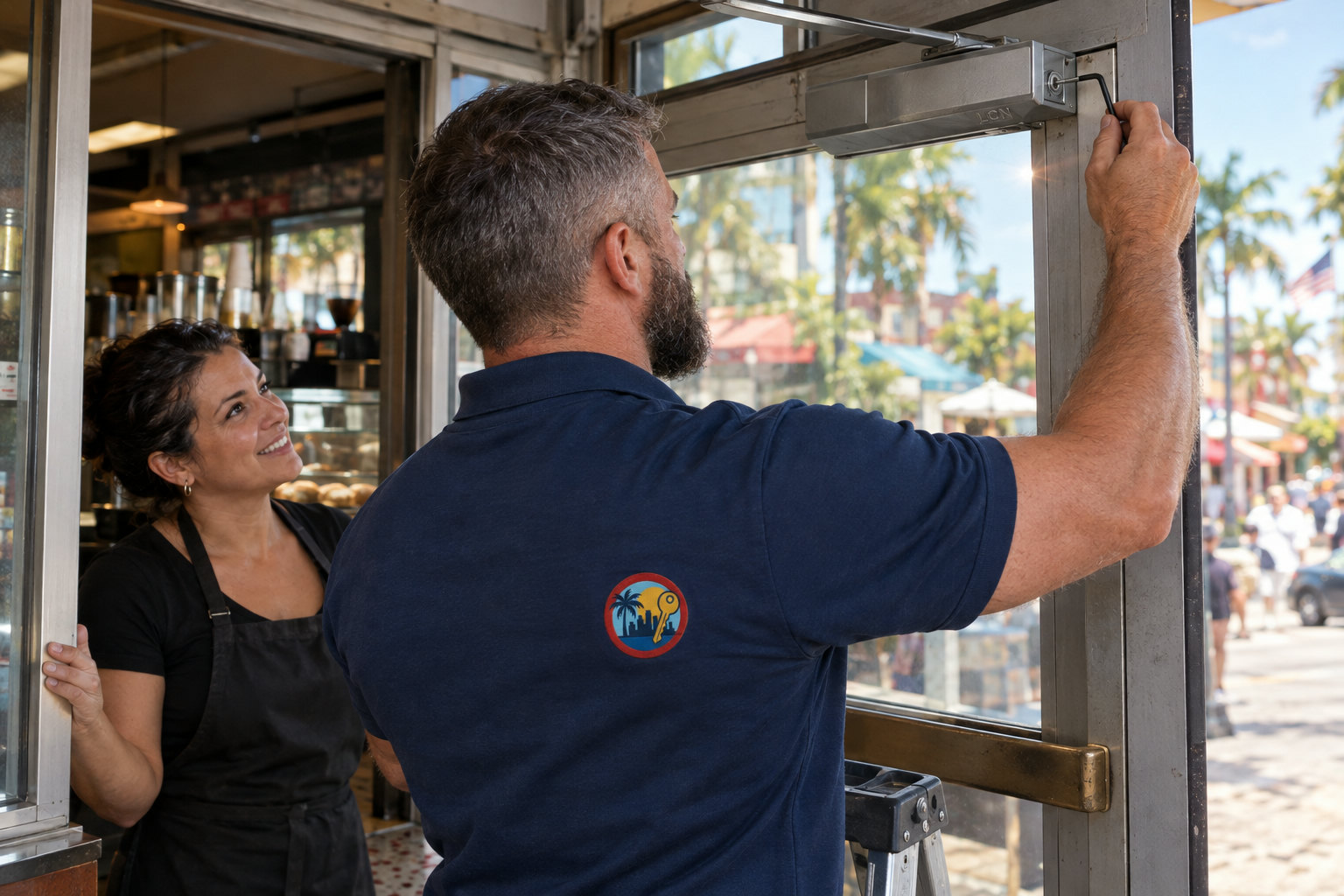
The best heavy-duty door closer for a busy storefront is the one built for constant cycling and mounted on the correct side with the correct arm, and among these three the LCN 4011 sets that bar most consistently. The Norton 1600 matches it closely in build. The Dorma TS83 is a capable closer that shines in narrower roles.
Location shapes the job. Little Havana’s commercial spine, SW 8th Street (Calle Ocho), is lined with restaurants, cafés, cigar shops and galleries whose doors open straight onto the sidewalk. The side streets hold older multi-unit apartment buildings with shared entry doors that every resident, courier and visitor uses.
If you manage a mixed-use building or run a restaurant whose front door never rests between lunch and close, this comparison is for you. It is not for a homeowner with a light interior door, where a residential closer does the job. A high-traffic door punishes weak hardware fast.
High traffic changes three things about closer choice. The body has to tolerate constant heat from hydraulic work, the arm has to survive people shoving the door open, and the adjustments have to stay put. Those three points decide the comparison below more than any brand reputation does.
Why is the LCN 4011 the default for the hardest-working doors?
The LCN 4011 is a cast-iron surface closer from LCN’s 4010/4110 series, a family specified for schools, hospitals and busy public entrances. LCN is part of Allegion, the same company behind Schlage, so the closer sits naturally in buildings that already run Schlage locks and exit hardware. That shared ecosystem simplifies ordering and matching finishes.
The strength is mass and control. A cast-iron body handles the heat that builds in hydraulic fluid on a door cycling all day, and separate valves for closing speed, latch speed and backcheck let the door be tuned precisely. The series also offers stop arms and hold-open arms, which matter on doors that get kicked or propped.
The weaknesses are practical. In LCN’s numbering, the 4010 and 4110 halves of the series broadly separate pull-side regular-arm mounting from push-side parallel-arm mounting, so the exact model on a quote must match the side of the door it goes on. Swapping from another brand often needs a drop plate or adapter plate because mounting patterns differ.
It is also more closer than a light interior door needs. On a storage room or a quiet office suite, the LCN 4011 is overkill. On a restaurant entrance facing the sidewalk, it is the right tool. For a related repair where an LCN closer and the frame both needed work, see this LCN door closer replacement with frame repair.
When does the Norton 1600 beat the LCN 4011?
The Norton 1600 beats the LCN 4011 when a building already standardizes on ASSA ABLOY hardware, because Norton Door Controls is an ASSA ABLOY company alongside lock brands such as Yale and Medeco. Keeping the closer in the same family as the locks and exit devices keeps finishes, documentation and parts sourcing consistent. Consistency is worth a lot to a property manager.
Build quality is close to the LCN. The Norton 1600 is a heavy-duty cast-iron closer with adjustable spring power and the same core hydraulic adjustments: closing speed, latch speed and backcheck. Hold-open arm options make it practical for doors that must stay open during deliveries without a wedge jammed under them.
Where it trails is perception and footprint rather than function. The LCN 4010/4110 series has a longer track record as the reference closer on institutional specs, so architects and facility teams often name LCN by default. If a building spec names LCN, a Norton substitution usually needs approval.
The Norton 1600 is the smart pick for a multi-tenant building with Yale or Medeco cylinders throughout and several entrances to equip. It handles heavy traffic well. The choice between it and the LCN 4011 is closer to a tie than a contest.
Where does the Dorma TS83 fit best?
The Dorma TS83 fits best as a like-for-like replacement on a door that already carries a Dorma closer, and on interior doors with moderate traffic. Now sold under the dormakaba name, the TS83 is a compact, European-style surface closer with a clean rectangular body. Its look suits modern interiors.
The retrofit advantage is real. When the existing closer is a Dorma, a TS83 can often reuse the mounting position and avoid new holes in an aluminum or hollow-metal door. Every avoided hole is one less weak point in a frame that has already taken years of slamming.
The weakness on a punishing exterior door is margin. Against the cast-iron LCN 4011 and Norton 1600, the TS83 has less of the brute heavy-duty reputation that busy exterior entrances call for, and its arm options are narrower. For a sidewalk-facing restaurant door that takes abuse all day, it is not the first choice.
Readers who like the Dorma look but want a slide-track arm should look at the TS93 family instead. This Dorma TS93 closer setup for an ADA-compliant entry shows how that track-style closer handles accessibility timing.
What does South Florida weather do to a surface-mount door closer?
South Florida weather stresses a surface-mount door closer through wind, heat and humidity, and wind is the one that breaks hardware. The Florida Building Code places Miami-Dade County inside the High-Velocity Hurricane Zone, and gusts do not need to reach hurricane strength to rip an outswing door from a hand. A door flung open by wind loads the arm, the closer body and the frame all at once.
Backcheck is the defense. All three closers, the LCN 4011, Norton 1600 and Dorma TS83, offer a backcheck valve that slows the door near the end of its opening swing. Set correctly, it cushions a wind-driven door before it hits the stop.
Heat is the quieter factor. Closer fluid thins as it warms, so a closer on a door that bakes in afternoon sun can run faster than it did when it was set on a cool morning. Speeds should be checked at the hour the door works hardest.
Humidity and rain attack the exposed parts: the arm, the shoe and the fasteners. Parallel-arm mounting on the push side keeps the closer body on the interior face of an outswing door, away from rain and tampering. That is one reason parallel arms are common on exterior commercial entrances.
Miami-Dade sits in Florida’s High-Velocity Hurricane Zone, so backcheck on an outswing closer protects the arm and frame from wind-driven openings. Warm fluid makes closers run faster in afternoon sun. Parallel-arm mounting keeps the closer body inside, away from rain.
How should a high-traffic door closer be set up so it lasts?
A high-traffic door closer lasts when the door is sound, the arm matches the mounting side and the hydraulics are tuned to the door rather than left at factory settings. The brand matters less than these six steps. They apply equally to the LCN 4011, Norton 1600 and Dorma TS83.
Fix the door before the closer
A sagging door or worn hinge makes any closer fight the frame. Hinges, pivots and jamb alignment come first.
Match the arm to the mounting side
Regular arms mount on the pull side, parallel arms on the push side. Ordering the wrong configuration means a return or a compromised install.
Set spring power to the door
Spring power should match the door’s width and weight, not sit at maximum. Too much power makes the door hard to open for children and older visitors.
Dial in backcheck for wind
Backcheck should cushion the door before it reaches full open. On an exposed outswing door, set it on a breezy day if possible.
Time the closing and latch speeds
The 2010 ADA Standards require at least 5 seconds from 90 degrees open to 12 degrees from the latch. Latch speed should be just enough to overcome the latch and weatherstrip.
Add a real stop
Backcheck slows the door but does not stop it. A wall stop, overhead stop or stop arm takes the final impact off the closer.
A common mistake is waiting to call until a failing closer has let the door slam or blow open long enough to crack the frame or tear the arm bracket loose. At that point, frame and jamb repair joins what would have been a straightforward closer swap, and the job grows. Oil on the floor or door face is the early warning sign.
When the door itself has dropped, read about sagging pivot door and continuous hinge repair first. And note that frameless glass and many aluminum storefront doors use concealed overhead closers instead of surface-mount units, which is a separate job covered in this glass storefront door rail replacement write-up.
- Choose the LCN 4011 for a sidewalk-facing restaurant, café or retail entrance that cycles all day, takes rough handling and catches wind, especially in a building already using Schlage locks.
- Choose the Norton 1600 for a multi-tenant building or office property standardized on ASSA ABLOY hardware such as Yale or Medeco, where several heavy-use doors need matching closers.
- Choose the Dorma TS83 when replacing an existing Dorma closer without drilling new holes, or for interior corridor and suite doors with moderate traffic.
- Choose none of them for a frameless glass or center-hung aluminum storefront door that was designed for a concealed overhead closer or floor closer.
Our Verdict
In the LCN 4011 vs Norton 1600 vs Dorma TS83 comparison for high-traffic doors, the LCN 4011 wins for the single hardest-working exterior entrance. Its cast-iron 4010/4110 platform, arm options and place in the Allegion family make it the lowest-risk choice. Few doors work harder than a restaurant door on a busy sidewalk.
For the property manager running a building with Yale or Medeco hardware across several entrances, the Norton 1600 is the better buy. It matches the LCN on the work that matters and keeps the building in one hardware family. That simplicity pays off on every future service call.
The Dorma TS83 is the right answer more often than its third place suggests: any door already wearing a Dorma, and most interior doors with moderate traffic. Picking it for a punishing exterior door is where it falls short.
For a busy entrance in Little Havana, the next step is an on-site look at the door, frame and existing mounting holes before choosing a closer. Call I Need Locksmith Miami at (786) 813-0495, available 24/7 across Miami-Dade, to ask about pricing for the specific door.
Our view
This is opinion, plainly labeled. Owners tend to overweigh the brand name on a door closer and underweigh installation. A correctly sized, correctly armed and correctly adjusted Norton 1600 will outlast a badly set LCN 4011, and the reverse is just as true.
What actually matters on a heavy-use door is how it gets abused. Wedges jammed under a door to prop it open fight the closer with every push, so a hold-open arm is a better investment than a pricier closer body. A missing door stop turns the backcheck valve into a crash barrier it was never designed to be.
The frame is the other blind spot. A closer bolted to a loose or cracked frame will pull its own fasteners out no matter who made it, so frame reinforcement belongs in the same conversation as the closer choice.
- How We Cut and Programmed a New Transponder Key for a 2019 Ford F-150 in Little Haiti — After the Original Was Snapped in the Door Lock
- LiftMaster 8500W vs ASSA Abloy SW200: Which Wall-Mount Operator Fits a Doral Warehouse’s Heavy Roll-Up Door
- How We Replaced a Broken LCN Door Closer on a Coral Gables Law Firm’s Front Entry — and Why the Frame Was the Real Problem
- The Aventura High-Rise That Had 3 Herculite Glass Door Hinges Fail During Peak Season — How We Fixed All Three Same Day
- How We Installed a Dorma TS93 Door Closer on a Kendall Pediatric Office’s ADA-Compliant Entry — and Adjusted the Sweep Speed to Code
FAQ
Can a leaking door closer be repaired, or does it need replacing?
A leaking door closer body, whether an LCN 4011, Norton 1600 or Dorma TS83, generally needs replacing because the internal seals are not a field repair on most surface closers. Arms, shoes, covers and fasteners can usually be replaced separately. Oil on the floor or door face means the hydraulic control is already fading.
Does an ADA-compliant entrance need a specific closer brand?
An ADA-compliant entrance does not need a specific brand: the 2010 ADA Standards set performance, not a manufacturer. Section 404.2.8 requires at least 5 seconds from 90 degrees open to 12 degrees from the latch, and section 404.2.9 limits interior hinged doors to 5 pounds of opening force, excluding fire doors. The LCN 4011, Norton 1600 and Dorma TS83 can all be adjusted to meet the timing.
Can a Dorma TS83 be swapped for an LCN 4011 using the same holes?
Swapping a Dorma TS83 for an LCN 4011 usually means new mounting holes or an adapter plate, because closer brands use different mounting patterns. A drop plate or adapter plate can avoid drilling into an already weakened door or frame. A like-for-like replacement within the same brand is the simplest route.
When should a high-traffic closer be checked and adjusted?
A high-traffic closer should be checked every few months and before the Atlantic hurricane season, which runs June 1 to November 30. The check covers closing speed, latch speed, backcheck, arm fasteners and any sign of oil. A door that has started slamming or drifting open needs attention right away.
Sources
- Door closer timing (404.2.8) and opening force (404.2.9) requirements – 2010 ADA Standards for Accessible Design, U.S. Department of Justice
- High-Velocity Hurricane Zone provisions covering Miami-Dade County – Florida Building Commission, Florida Building Code
- LCN and Schlage as Allegion brands – Allegion
- Norton Door Controls, Yale and Medeco as ASSA ABLOY brands – ASSA ABLOY
I Need Locksmith Miami
I Need Locksmith Miami is a Miami-Dade locksmith and door specialist serving residential, commercial, and automotive customers.
Book an LCN, Norton or Dorma Closer Assessment for Your Entrance