Last updated: July 17, 2026
A full card-reader access control system for 40 units in Doral typically takes 10-14 business days with a two-person crew, assuming standard deadbolts and no structural obstacles. The actual timeline depends on your building layout, whether you’re retrofitting existing doors or starting fresh, and how many access points require networked integration.
A 40-unit card-reader retrofit in Doral runs 10-14 days with two technicians. Installation cost ranges $250 – $400 per door. Network setup and integration testing can add 2-3 days. Planning the sequence upfront cuts delays in half.
The Short Answer
For a property manager in Doral running a 40-unit residential building, expect 10-14 business days to complete a full card-reader access control system installation. Each door takes 45-90 minutes depending on whether you’re replacing an existing lock or retrofitting a new one. At $250 – $400 per card-reader unit (hardware + labor), a full retrofit lands in the $10,000 – $16,000 range, before network integration.
The real timeline killer isn’t installation – it’s planning and coordination. A building manager who knows which doors go live when, and who has arranged access for technicians, cuts the job down by 2-3 days. A property manager who doesn’t coordinate unit access or building-entry timing will watch the timeline stretch to 16-18 days.
The Full Answer
Why a 40-Unit Doral Condo Card-Reader System Takes Longer Than Most People Think
Most property managers assume that a card-reader access control system installation for 40 units is just “40 times the work of one door.” That math breaks down fast. A single card-reader installation is 45-90 minutes. Forty of them back-to-back would suggest a 30-60 hour job, or 4-8 days. The real number is 10-14 days. Here’s why.
First, unit access in a Doral residential tower is chaotic. Residents are home at different times. Some units are vacant. Some doors have security chains, multiple locks, or deadbolts installed at angles that don’t line up with standard card-reader strike plates. When we arrive at a unit and find that the existing deadbolt sits ½ inch off-center, we can’t just drill a new hole in the frame – that risks frame damage and a $200 – $400 callback to repair. Instead, we align the new card-reader to match the existing hardware hole, which adds 15-20 minutes per unit.
“Most builders assume all 40 units are identical. They’re not. In a 2008-built Doral mid-rise, we found six different deadbolt models across the first floor alone. That variation isn’t a setback – it’s the job.” – I Need Locksmith Miami Team
Second, building code compliance and access patterns add overhead. Every main entry, package room, and fitness center needs its own card-reader configuration. A main lobby might need one reader tied to the main access log. Guest suites might need temporary override codes. The mechanical room might need a separate access level tied to a keypad, not a card. That’s five different access-control logic chains, each requiring 2-4 hours of planning and networking.
Breaking Down the Timeline: Installation Phase
Here’s how a two-person crew (which is the standard for Doral residential jobs) schedules a 40-unit card-reader rollout:
Site Survey and Planning (Day 1, 4-6 hours)
Walk all 40 units, document existing deadbolt models, check frame integrity, measure strike-plate alignment, identify any non-standard doors (angled frames, recessed pockets, storm doors). Create a spreadsheet categorizing units by install complexity.
Hardware Staging and Ordering (Days 1-2, 2 hours + lead time)
Order card-reader units (typically Schlage, ASSA Abloy Aperio, or Yale Nexis models – $250 – $400 each). Stock templates, strike plates, wiring, and failsafe modules. If hardware isn’t on-site, the job stalls.
Unit Installations (Days 2-10, 35-40 hours crew time)
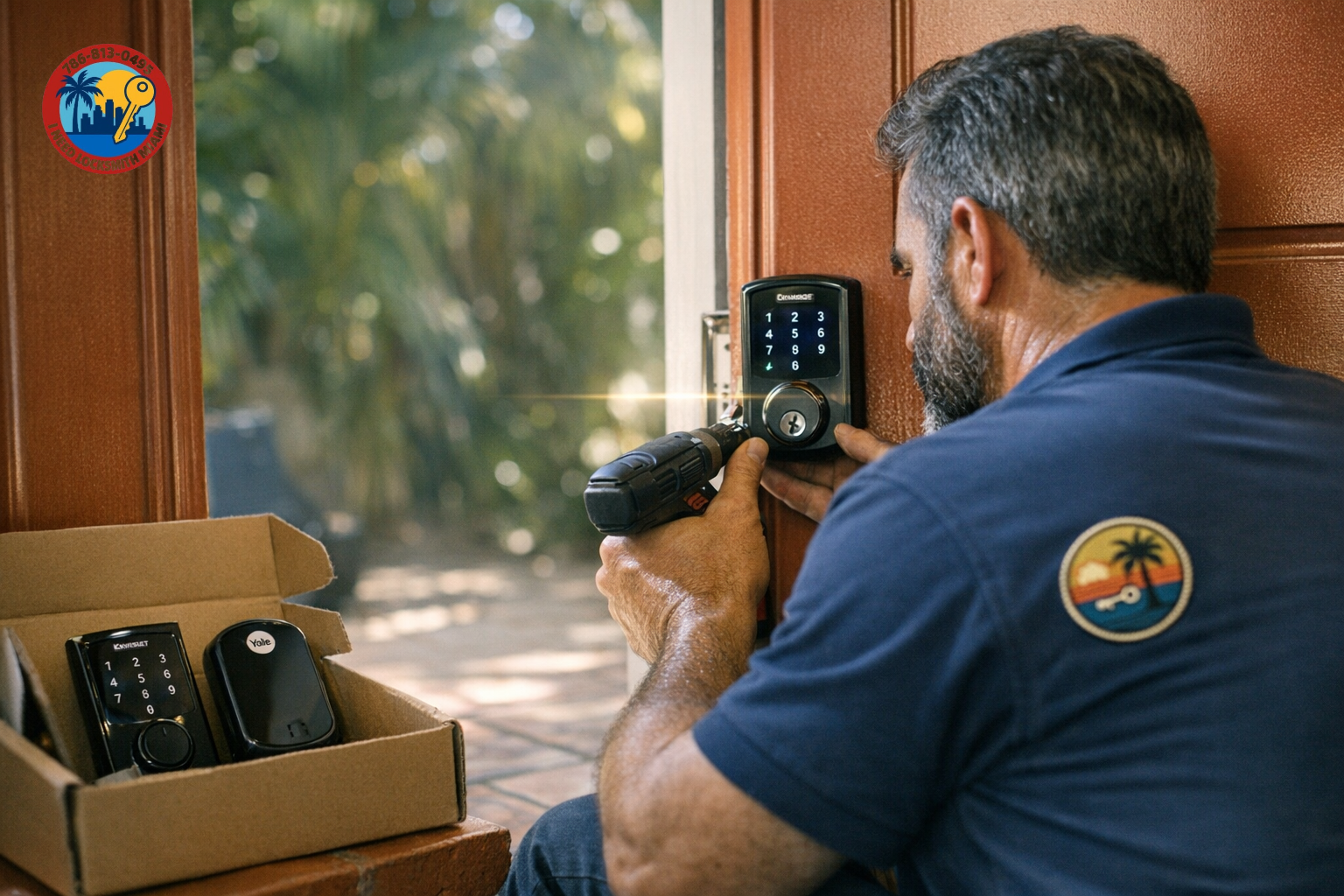
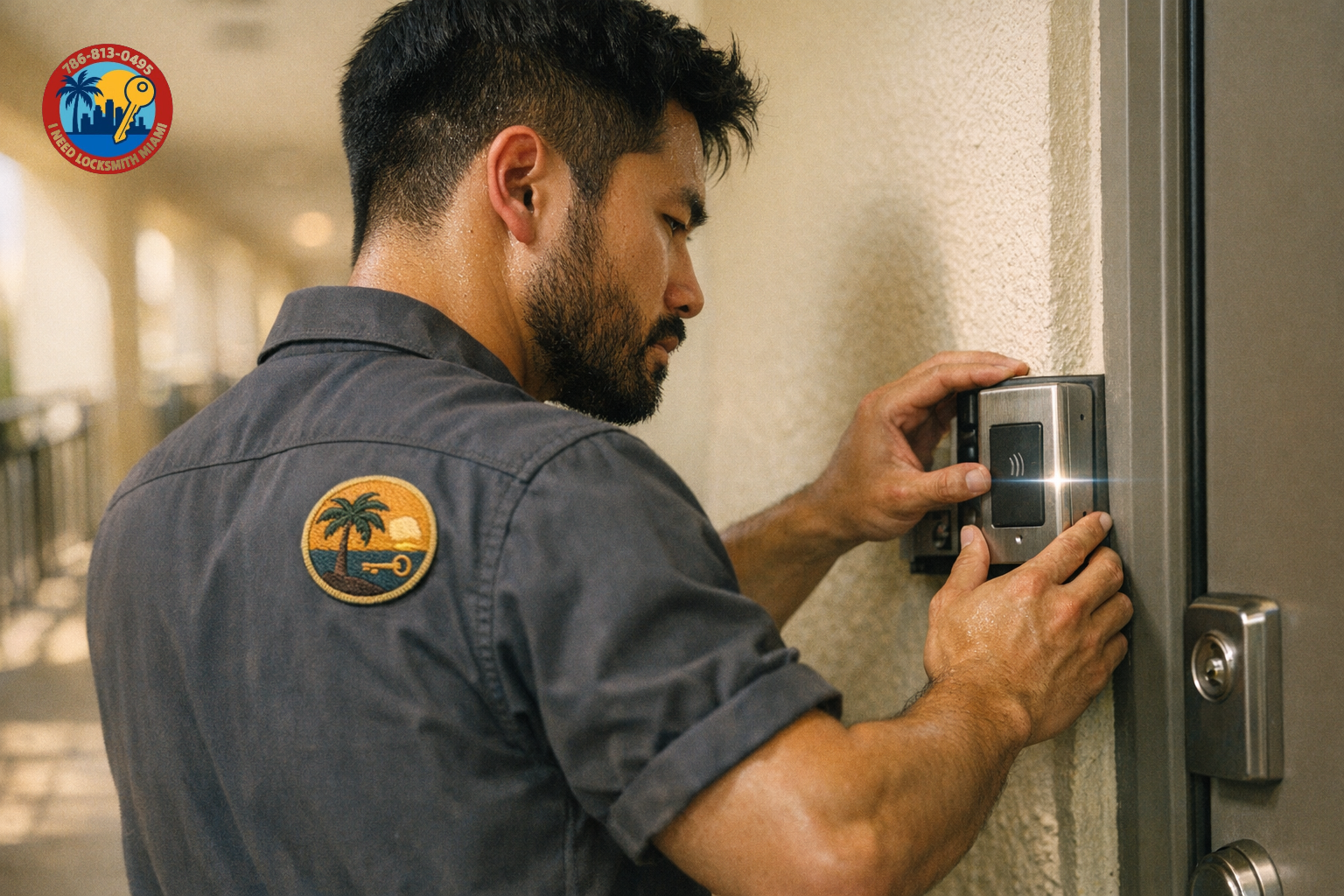
Two technicians install 4-5 units per day (45-90 min each). Typical sequence: remove old deadbolt, install new card-reader strike plate, route wiring (surface-mounted or in-wall), test failsafe operation, issue temporary card codes.
Common Area Integration (Days 8-11, 8-12 hours)
Lobby, package room, fitness center, and roof access get their own card-reader or keypad. Configure access levels, set override schedules, integrate with building entry logs.
Network Setup and System Testing (Days 10-14, 10-16 hours)
Connect all readers to the central access-control software (usually cloud-based), test card encoding, confirm failsafe behavior, train property staff, document emergency override procedures.
A two-person crew can install 4-5 card-readers per day safely. Pushing to 6+ per day cuts corners on failsafe testing and wiring cleanup, which creates callbacks. A single “we’ll rush it” job typically adds 2 callbacks at 3-4 hours each.
Where Doral Building Specifics Change the Timeline
If you’re a property manager in Doral running a 40-unit residential or mixed-use tower, three building characteristics will push your timeline up or down:
| Building Factor | Impact on Timeline | Mitigation |
|---|---|---|
| Concrete frame (post-1995 Doral buildings) | In-wall wiring adds 15-25 min per unit; drilling through concrete requires a hammer drill and two passes. | Plan for surface-mounted conduit to save 40% of wiring time. Costs $15 – $25 more per unit but cuts timeline by 2-3 days. |
| Occupied vs. vacant units | Occupied units require coordination; some residents won’t grant access. Vacant units: install in 45 min. Occupied: 75-90 min (scheduling buffer, explanations). | Schedule vacant units first (Days 1-3). Add 1-2 days for occupied units spread across 8+ days to allow resident notice. |
| Power proximity to entry doors | Card-readers need 12V power. If panel is 50+ feet away, we run conduit in walls or use wireless battery-powered readers ($100 – $150 more per unit). | Wireless readers eliminate wiring delays. Upfront cost is 15% higher, but labor time drops 20%. |
The Cost Breakdown for a 40-Unit Card-Reader System in Doral
A realistic budget for a Doral property manager planning a 40-unit card-reader access control installation:
| Line Item | Unit Cost | 40-Unit Total |
|---|---|---|
| Card-reader unit (Schlage/ASSA Abloy/Yale) | $120 – $180 | $4,800 – $7,200 |
| Installation labor (45-90 min per unit) | $130 – $220 | $5,200 – $8,800 |
| Wiring, conduit, strike plates, misc hardware | $15 – $40 per unit | $600 – $1,600 |
| Central access-control software setup (1-5 year license) | $300 – $500 annually | $300 – $2,500 (5-year) |
| Staff training and documentation | Included in labor | $0 |
| Project Total (hardware + labor) | $10,400 – $17,900 + software |
That’s roughly $260 – $450 per unit installed. For a Doral mid-rise, that’s a reasonable line item for a property budget (often spread over 2-3 quarters to avoid cash-flow shock).
What Cuts Your Timeline (and What Stretches It)
We’ve completed dozens of multi-unit card-reader retrofits across Doral, Coconut Grove, and Coral Gables. Here are the real patterns we see:
What cuts 2-4 days: A property manager who pre-coordinates with residents 2 weeks in advance, supplies a master key to vacant units, and designates one staff member as the point of contact. A building with all units built in the same year (fewer deadbolt variants). Pre-staged hardware delivered to a ground-floor prep room so technicians don’t chase parts.
What stretches it 3-6 days: A property manager who won’t grant technician access until 8 AM and blocks us at 5 PM (cutting available install hours by 35%). Multiple non-standard door types requiring custom strike-plate modifications. A network administrator who isn’t assigned until Day 9 to configure the central cloud system (so we finish hardware installation on Day 10 but software isn’t live until Day 14).
I’ve seen a 40-unit job complete in 8 days when everything aligned. I’ve also seen a 12-day job turn into 18 days when a property manager didn’t tell residents we were coming and half the units stayed locked.
Network Integration and Testing (Often Forgotten, Always Critical)
Here’s where most Doral property managers underestimate the timeline: network setup and testing. Installing the physical card-readers is 60% of the work. Making them talk to each other and to the building’s access-control software is the other 40%.
For a 40-unit system, you’ll typically need:
- Cloud-based access management software (Schlage Sense, ASSA Abloy Aperio Cloud, Yale Nexis Cloud). Setup: 2-4 hours to configure access rules, door permissions, override codes, and reporting schedules.
- Card encoding and testing (making sure a resident’s card opens their door, the lobby, and the parking level, but NOT the roof). Testing: 4-6 hours for 40 units across multiple access tiers.
- Failsafe behavior and emergency protocols (card-readers must unlock on fire alarm; override codes must work if system fails). Testing: 2-3 hours including fire alarm simulation.
- Staff training and documentation (property manager, leasing, maintenance staff). Training: 1-2 hours on access provisioning, card replacement, and emergency procedures.
All of this happens after the hardware is installed. If your network administrator is busy or unavailable, these 9-15 hours get pushed to Days 12-14, which is why the timeline stretches from 10 days to 14.
Related Question We Often Hear
Yes. Surface-mounted conduit and wireless (battery-powered) card-readers eliminate most drilling. This cuts installation time by 20-30% per unit and avoids any risk of frame damage. The trade-off is slightly higher upfront cost ($1,200 – $1,600 more for 40 units) and battery replacement every 2-3 years ($50 – $80 per reader). For Doral properties concerned about concrete integrity, wireless is worth the premium.
When the Timeline is Different
Smaller Buildings (8-15 Units)
A smaller Doral building with 8-15 units can complete a card-reader retrofit in 4-6 business days. One technician can handle the job. Network setup is simpler (fewer access tiers). Common areas are fewer. The math: hardware placement (1 day) + unit installations (2-3 days) + network/testing (1 day).
Large Complexes (60+ Units) or Multi-Building Campuses
A 60-80 unit project typically adds 5-7 days (scaling isn’t linear because network complexity and coordination overhead multiply). A three-person crew works better here. Budget 16-18 days, plus 2-3 days for inter-building system integration (tying parking and fitness together across two properties).
Retrofit vs. New Construction
If you’re a property manager retrofitting an existing building (removing old locks and installing card-readers), add 1-2 days for old-lock removal and frame prep. If you’re a general contractor on a new build, card-reader installation happens after drywall is hung but before occupancy, and the timeline compresses to 6-8 days because all doors are identical and accessible.
Frequently Asked Questions
1. Can card-readers be installed one building at a time instead of all 40 units at once?
Absolutely. A phased rollout (Phase 1: Units 1-10 in Week 1, Phase 2: Units 11-20 in Week 3, Phase 3: Units 21-40 in Week 5) allows you to spread costs across two or three budgets and test the system before full deployment. Each phase takes 5-7 days. The downside: you pay full setup and staff-training costs for each phase, which adds 10-15% to total labor. A single 40-unit project is more cost-efficient ($10,400 – $17,900 total) than three separate phases ($12,500 – $20,500 total).
2. What happens if residents refuse access to their unit during the 10-14 day window?
If a resident denies access after 72-hour notice, that unit is skipped during the general installation. You typically circle back in a second phase (Days 15-20) when that resident agrees to access, or you use a lockout clause in the lease (“Property may require 72-hour access notice for security system upgrades”). In practice, fewer than 2-3 residents per 40 units refuse access when proper notice is given.
3. Do I need a separate cloud-based access control license for each unit, or is one license for the whole building?
One cloud license covers the entire building. Pricing is typically per-door (e.g., $50 – $100 per month for 40 doors) or per-building (flat $300 – $500/month). You assign unlimited user cards and codes within that license. Add $300 – $500/year for support and software updates.
4. What brands of card-readers work best for a Doral residential building?
Schlage (S-Series and Sense lines), ASSA Abloy Aperio, and Yale Nexis are the industry standards for residential multi-unit buildings. Schlage is the most common in Miami-Dade properties because it’s retrofit-friendly and cloud management is straightforward. ASSA Abloy Aperio is favored for aesthetics (sleeker design) and integration with third-party building systems. All three range $250 – $400 per installed unit (hardware + labor).
Sources
- Real pricing and labor estimates for card-reader access control installation in Doral, Miami-Dade County – I Need Locksmith Miami operational records (2024-2026).
- Schlage Access Control Systems and Installation Guidelines – Allegion.com
- ASSA Abloy Aperio Cloud Setup and Deployment Timeline – ASSA Abloy Smart Access
- Residential and Commercial Door Hardware Installation Standards (ANSI A156 series) – Builders Hardware Manufacturers Association (BHMA) technical documentation.
I Need Locksmith Miami
I Need Locksmith Miami is a Miami-Dade locksmith and door specialist serving residential, commercial, and automotive customers.
Get a Card-Reader Retrofit Quote for Your Doral Building →
Call (786) 813-0495 for a same-day site survey in Doral, Coral Gables, Coconut Grove, or anywhere in Miami-Dade. 24/7 mobile service.
🎧 Listen to article
- Car Key Replacement in South Beach: We Logged 312 Automotive Locksmith Calls and Found 67% Share One Root Caus
- A Customer Asked: “Can a Locksmith Really Program a New Toyota Smart Key on the Spot in Brickell?” — The Full
- A Wynwood Shop Owner Asked: ‘Can a Locksmith Rekey My Storefront Without Replacing the Whole Mortise Lock?’ —
- A Customer Asked: “Can You Program a New Toyota Smart Key in Doral Without Towing My Car to the Dealership?” —
- A Wynwood Business Owner Asked: “Can You Rekey My 6 Office Locks Without Replacing the Hardware?” — The Full A