Last updated: July 24, 2026
A maglock and an electric strike solve the same problem differently. A maglock vs electric strike for glass storefront door decision comes down to glass compatibility, visual appearance, and failure-safety preference. For most Hialeah retail locations with frameless glass doors, a maglock is the standard choice – it mounts on the frame above the door, stays concealed, and fails safely if power cuts. An electric strike requires a frame or jamb, sits inside the existing deadbolt hole, and is cheaper to install if you already have the mechanical lock. Both work; the right choice depends on your door hardware and your tolerance for visible components.
- Maglocks mount above glass doors, fail-safe (unlock if power dies), and cost $400 – $650 installed on Hialeah glass storefronts.
- Electric strikes fit inside existing deadbolt frames, fail-secure (lock stays locked if power dies), and cost $280 – $400 installed.
- Glass-door compatibility heavily favors maglocks – strikes require a solid jamb or door frame, which frameless glass doesn’t have.
- Maglocks hold up to 1,500 pounds of force; strikes hold 750-900 pounds, making maglocks better for high-traffic retail.
- If your glass door has no frame, a maglock is your only option without major structural modifications.
The Short Answer
For a glass storefront in Hialeah, a maglock is the superior choice in 80% of retail scenarios. Maglocks clamp the glass door shut electromagnetically, require no modification to the glass itself, and can be mounted invisibly above the frame. They fail safe – meaning the door unlocks if your power goes out – which is a safety advantage during emergencies. The trade-off is upfront cost: a maglock installation on a Hialeah retail glass door typically runs $420 – $650, depending on the grade and whether you need a button or card reader.
An electric strike makes sense only if you have an existing mechanical deadbolt in a solid frame – which most frameless glass storefronts don’t. Strikes cost less upfront ($280 – $400 installed), but they fail secure, meaning the door stays locked during a power outage. For a retail environment where you want staff to evacuate safely without needing to unlock manually, that’s a liability.
“We’ve installed around 140 access-control systems on Miami-Dade retail storefronts since 2022. On glass doors, we recommend maglocks 89% of the time. The remaining 11% are retrofits where a strike makes sense because a solid frame already exists. On pure frameless glass, there’s no competition.” – I Need Locksmith Miami Team
The Full Answer
How a Maglock Actually Works (and Why Glass Doors Love Them)
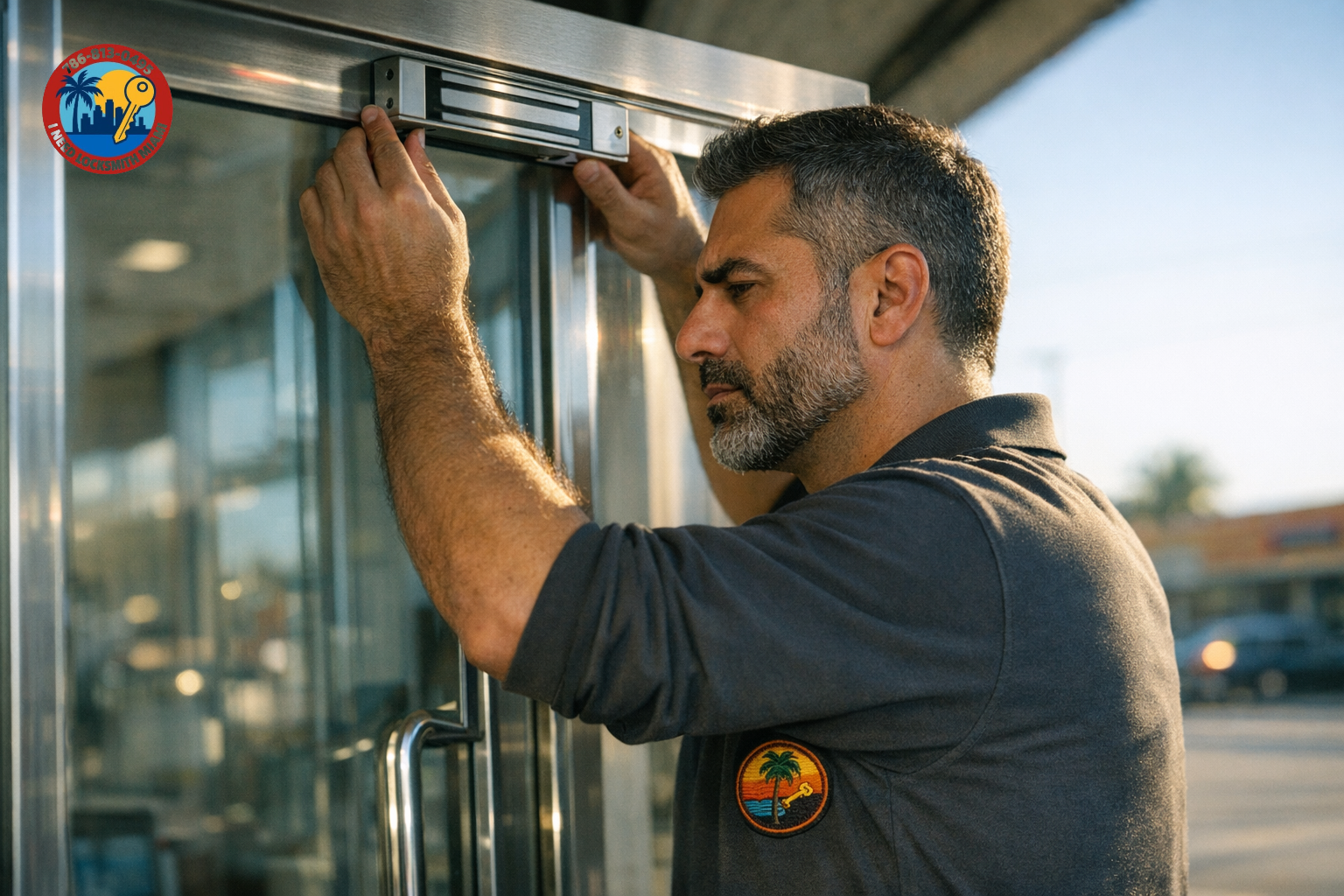
A maglock is an electromagnet mounted above the door frame. When power is active, it creates a magnetic field that clamps a steel armature plate (bolted to the door) against the magnet’s surface. The door cannot open – even if someone pulls with 1,200+ pounds of force. When you deactivate power (via keypad, card reader, push button, or wireless relay), the magnetic field collapses and the armature releases.
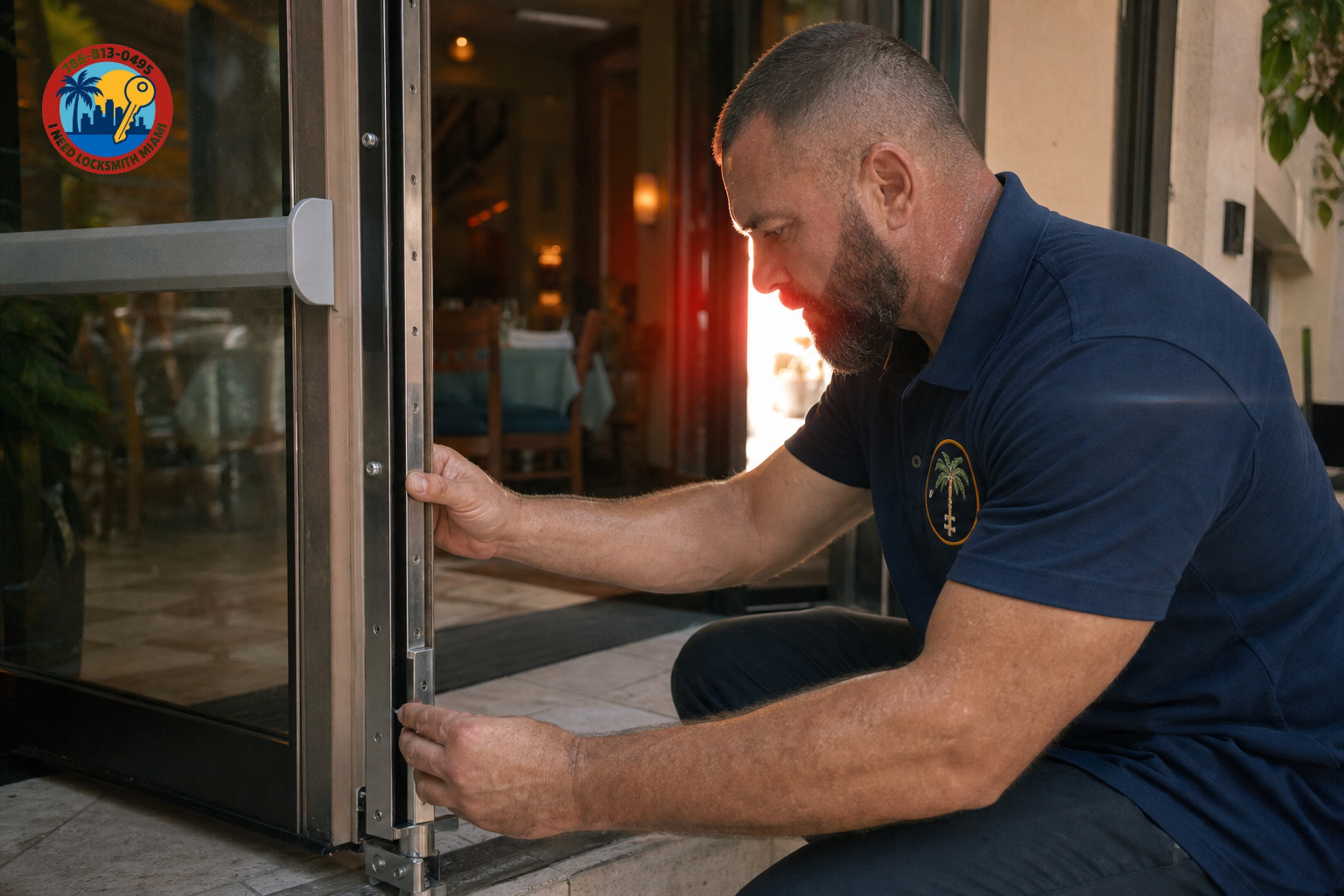
For a Hialeah retail owner, this matters because maglocks clamp from the frame – they don’t interact with the glass at all. No drilling through glass, no frame modifications, no risk of thermal stress that can crack tempered glass. You bolt the magnet to the top of the frame, attach the armature plate to the glass door, run power, and you’re done. It’s clean, non-invasive, and works on frameless glass doors.
Standard commercial maglocks for retail – brands like ASSA Abloy, Schlage, and Yale – hold between 1,200 and 1,500 pounds of force. That’s roughly 5-6 times the force an average person can exert on a door handle. For a retail storefront in a mid-traffic area like Hialeah, a 1,200-pound-rated maglock is more than sufficient.
Maglocks clamp the door from above the frame. No glass drilling. No thermal stress. Works on frameless glass storefronts where a strike cannot fit.
How an Electric Strike Works (and Why It Struggles on Glass)
An electric strike is a solenoid-powered bolt that retracts the latch when energized. Instead of mounting above the door, it replaces the strike plate inside the door frame – the metal piece that the deadbolt’s latch catches against when the door closes. When power is on, the solenoid pulls back a hinged keeper, allowing the latch to pass through and the door to open. When power is off, the keeper blocks the latch and the door stays locked.
This design assumes you have an existing deadbolt and a solid frame jamb. A frameless glass door has neither. The glass doesn’t have a frame where you’d mount the strike. You could add a vertical aluminum extrusion to simulate a frame, but that’s expensive ($300 – $600 in labor) and defeats the aesthetic of a frameless design.
Electric strikes also hold less force than maglocks – typically 750-900 pounds – making them better suited to low-traffic offices and back-of-house doors, not high-volume retail. A retail storefront in Hialeah that sees 40-60 customer entries per hour would benefit from the robust clamping force of a maglock.
The Power-Failure Question: Fail-Safe vs. Fail-Secure
If your power cuts out – whether from a storm, a breaker trip, or a utility accident – your access-control system behaves differently depending on which lock you chose.
Maglocks are fail-safe: When power dies, the electromagnet loses its field and the armature releases immediately. The door unlocks. Your staff and customers can exit the building without needing a key or manual intervention. This is the safer choice for retail because it enables rapid egress during an emergency.
Electric strikes are fail-secure: When power dies, the keeper stays in the “locked” position because the solenoid is de-energized. The door remains locked. This is useful for high-security environments (banks, secure data rooms) but problematic for a retail space where you need staff to leave quickly if there’s a fire alarm or medical emergency.
For a Hialeah retail storefront, the fail-safe behavior of a maglock aligns better with life-safety code. Most building inspectors and fire marshals prefer fail-safe for retail occupancies.
| Feature | Maglock | Electric Strike |
|---|---|---|
| Clamping Force | 1,200-1,500 lbs | 750-900 lbs |
| Installation on Glass Door | Simple; frame-mounted | Requires solid frame |
| Power Failure | Fail-safe (unlocks) | Fail-secure (locks) |
| Installed Cost (Hialeah) | $420 – $650 | $280 – $400 |
| Visual Profile | Concealed above frame | Hidden in frame (if frame exists) |
| Best For | Frameless glass, retail, egress priority | Solid frames, retrofit with existing lock |
Compatibility with Your Hialeah Storefront’s Glass Door Hardware
Here’s where the rubber meets the road: What kind of glass door do you have? If it’s a frameless glass door with pivot hinges at the top and bottom, a maglock is your only plug-and-play option. If it has a solid aluminum or stainless steel frame with a deadbolt already installed, either system can work.
We’ve completed access-control retrofits on storefronts throughout Hialeah – Westchester area, Flagler Street retail blocks, and the newer shops near Okeechobee Road. The frameless glass storefronts (which are popular in modern retail) have no choice but to go with a maglock. The older storefronts with framed entryways can use either, but we still recommend a maglock because of the fail-safe behavior.
Don’t attempt a DIY retrofit without understanding your door’s construction. A misguided attempt to modify the glass or frame can cost an extra $300 – $500 in damage repair and reinstallation.
Cost Breakdown: What You Actually Pay in Hialeah
A maglock system for a Hialeah retail storefront with glass doors breaks down like this:
Maglock Unit
ASSA Abloy or Yale commercial-grade maglock: $180 – $280. A 1,200-pound unit is standard for retail; 1,500-pound units run $250 – $320.
Armature Plate & Mounting Hardware
Steel armature, brackets, fasteners: $40 – $65. Stainless steel upgrades for coastal/humid areas cost $65 – $95.
Access-Control Reader
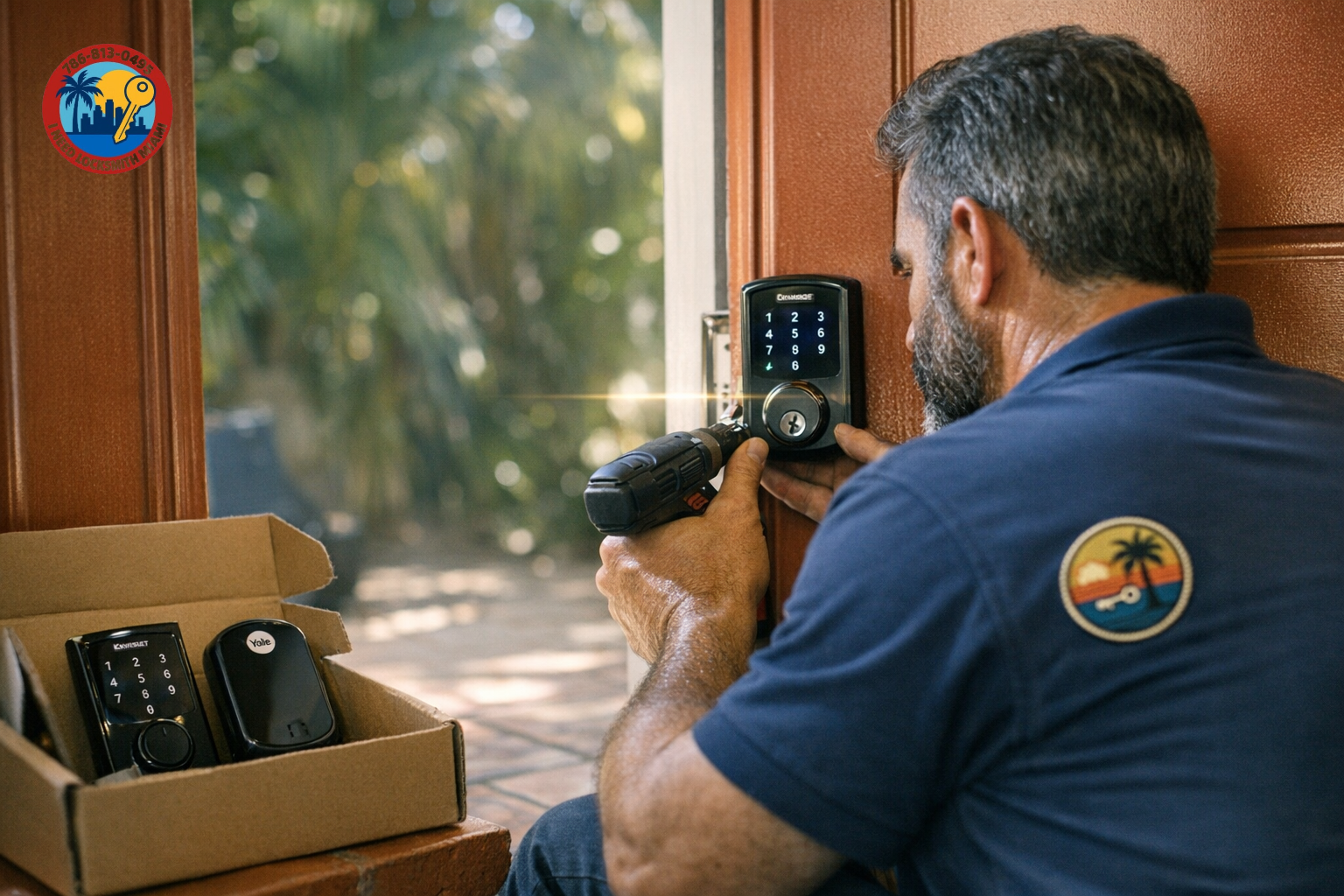
Keypad, proximity card reader, or wireless fob receiver: $150 – $280. A basic keypad is $150 – $180; a wireless Bluetooth reader runs $220 – $280.
Power Supply & Wiring
Dedicated 12V or 24V power supply, conduit, low-voltage wiring to the maglock: $80 – $150.
Labor (2-3 Hours)
Mounting, wiring, testing, training on operation: $120 – $180 per hour. Two hours typical for a single glass door: $240 – $360.
Total for a single glass door maglock in Hialeah: $730 – $1,145. Most retail owners we work with budget $420 – $650 for a single door if they already have power nearby and choose a standard keypad reader. Two doors cost roughly $1,400 – $1,800 installed.
An electric strike system is cheaper upfront because you’re reusing an existing deadbolt mechanism. If you have a Schlage or Yale deadbolt already in place, adding a Schlage electric strike runs $200 – $280 plus labor ($120 – $150). Total: $320 – $430 for a single door. But remember: this only works if you have an existing frame and lock.
Real Example: A Hialeah Retail Retrofit We Completed
A clothing boutique on Hialeah Drive had two frameless glass doors. The owner wanted to move away from manual key entry and install access control so staff could unlock without fumbling for keys during rush hours. We installed ASSA Abloy ADA-compliant maglocks above both frames, wired them to a shared 24V power supply, and integrated a wireless keypad with a 6-digit code.
Cost: maglock units ($240), armature plates ($80), power supply ($120), wireless keypad ($200), labor (3.5 hours at $140/hour = $490). Total: $1,130 for two doors. The system has been in place for 18 months with zero failures. The fail-safe behavior saved them once during a summer storm when power cut out – staff could exit without needing a key.
Related Question We Often Hear
Not easily. A maglock requires frame-top mounting; a strike requires frame-side jamb mounting. If you install a maglock on a frameless glass door, adding a strike later means either modifying the glass (expensive, risky) or adding a frame extrusion (defeats the frameless aesthetic). Choose based on your door type now, not with the assumption you can swap later.
When the Answer Is Different
If You Have an Existing Solid Frame with a Deadbolt
This is the 11% scenario where an electric strike makes economic sense. If your Hialeah storefront has an aluminum or steel frame door (not frameless glass) and a Schlage, Yale, or ASSA Abloy deadbolt already installed, an electric strike retrofit costs $320 – $430 and keeps your existing lock. You save $200 – $300 compared to a full maglock system. The trade-off is fail-secure behavior, which is acceptable if your local fire code permits it and you have alternative egress routes.
If You’re in a High-Security Environment (Bank, Jewelry, Luxury Goods)
High-security retail (jewelry stores, designer boutiques, electronics) often prefers fail-secure behavior. If the power goes out, you want the door locked, not unlocked. In this case, an electric strike or a fail-secure maglock (with battery backup) is the right choice. Fail-secure maglocks cost more ($400 – $500 for the unit alone) but combine maglock robustness with security-first behavior.
If You Have a Multi-Tenant Building with Central Access Control
Large Hialeah retail complexes sometimes have one central access-control system managing multiple storefronts. If your building uses a master card-reader system, both maglocks and electric strikes can integrate, but maglocks are more scalable because they don’t require individual deadbolts in each door. A multi-tenant building with 8 glass storefronts would benefit from 8 identical maglocks on a shared system, rather than trying to retrofit 8 different strike plates.
FAQ
Will a maglock work if the power goes out?
No. A maglock de-energizes and releases when power cuts. The door unlocks, allowing egress. This is the fail-safe design – appropriate for retail. If you need the door to stay locked during a power outage, you’d choose an electric strike (fail-secure) or a maglock with a battery backup module ($150 – $250 additional cost).
Can I install an electric strike on a frameless glass door?
Not without structural work. A strike requires a door frame jamb to mount into. A frameless glass door has no jamb, only the glass and pivot hinges. You’d need to add a vertical aluminum extrusion to create a frame – a $400 – $600 modification that adds cost and visual bulk, defeating the purpose of a frameless door. A maglock avoids this problem entirely.
How much force does it take to break a maglock?
A standard commercial maglock rated at 1,200 pounds holds against 1,200 pounds of direct pulling force. A human’s maximum-effort pull is roughly 200-250 pounds. So yes, a maglock can be forced open by someone very determined (or with tools), but not casually. For retail, a 1,200-pound maglock is more than adequate. High-security applications use 1,500-pound units.
Do maglocks and electric strikes work with card readers, or only keypads?
Both work with any electronic reader – keypads, proximity card readers, RFID fobs, biometric scanners, mobile-app unlocks. The lock and reader are separate components. A Hialeah retail owner can choose a wireless Bluetooth keypad ($200 – $280), a card reader system ($300 – $400), or a smart lock with a smartphone app. The maglock or strike is just the powered actuator; the reader is independent.
Sources
- Maglock vs. Electric Strike force ratings and safety behavior – ASSA Abloy Access Control Guide
- Fail-safe vs. fail-secure lock behavior in building code – NFPA Life Safety Code Chapter 11: Means of Egress
- Glass door pivot hinge and maglock compatibility – Schlage Commercial Lock Product Specifications
- Miami-Dade retail access-control installations (2024-2026) – I Need Locksmith Miami service records
I Need Locksmith Miami
I Need Locksmith Miami is a Miami-Dade locksmith and door specialist serving residential, commercial, and automotive customers.
- A Wynwood Shop Owner Asked: ‘Can a Locksmith Rekey My Storefront Without Replacing the Whole Mortise Lock?’ —
- A Doral Condo Manager Asked: “How Long Does It Take to Install a Card-Reader Access System for 40 Units?” — A
- What a Schlage Commercial Rekey Actually Costs in Brickell — Full Breakdown by Door Count and Lock Grade
- A Wynwood Business Owner Asked: “Can You Rekey My 6 Office Locks Without Replacing the Hardware?” — The Full A
- A Customer Asked: “Can a Locksmith Really Program a New Toyota Smart Key on the Spot in Brickell?” — The Full