Last updated: August 4, 2026
If you’re managing a Wynwood co-working space with rotating tenants, contractor access, and the constant pressure to avoid re-keying costs, the choice between ASSA Abloy Aperio vs Schlage AD-Series wireless lock systems vs Yale Real Living can mean the difference between seamless daily operations and costly lockouts, credential management headaches, and security gaps that open your building to liability.
The short answer: ASSA Abloy Aperio is the easiest to scale across multiple doors and integrates best with card readers and mobile credential systems typical of co-working environments; Schlage AD-Series offers rock-solid reliability and lower upfront hardware cost; Yale Real Living wins on aesthetics and residential-grade simplicity if your co-working space skews boutique. But each system has operational trade-offs that matter in the Wynwood ecosystem – where tenant turnover, after-hours access requests, and inventory tracking directly hit your bottom line.
This comparison walks you through real installation costs, integration headaches, and the hidden labor expenses that most blog posts skip.
Comparison Table: Aperio vs Schlage AD-Series vs Yale Real Living
| Attribute | ASSA Abloy Aperio | Schlage AD-Series | Yale Real Living |
|---|---|---|---|
| Hardware Cost (per lock) | $280 – $380 | $200 – $320 | $240 – $350 |
| Installation (per door) | $150 – $200 | $150 – $200 | $150 – $200 |
| Mobile Credential Support | Native (iOS/Android) | Limited (requires third-party hub) | Partial (iOS only, Bluetooth) |
| Card Reader Integration | Seamless via Aperio system | Requires separate wiegand controller | Not standard; aftermarket solution |
| User Capacity | Unlimited via cloud | Up to 950 PIN codes per lock | Up to 250 PIN codes per lock |
| Offline Backup | Mechanical override; limited sync | Full PIN/mechanical backup | Bluetooth range-dependent |
| Audit Trail / Reporting | Cloud-based, real-time log | In-lock memory; manual export | Mobile app log (requires Bluetooth) |
| Warranty | 2 years manufacturer | 3 years manufacturer | 1 year manufacturer |
| Best For | Multi-tenant, high turnover | Reliability-first, PIN-heavy | Design aesthetic, boutique space |
ASSA Abloy Aperio: Scalability and Mobile-First Integration
ASSA Abloy Aperio locks are wireless, battery-powered cylinders that communicate via a dedicated 916 MHz radio protocol to a cloud-based access management platform. For a Wynwood co-working operator managing 8-15 suites across a single floor or multiple buildings, Aperio eliminates the need to physically re-key or change PIN codes each time a tenant exits and a new one arrives.
The strength of Aperio lies in credential delivery. You can issue a temporary mobile credential (iOS or Android) to a new tenant contractor within minutes – directly through the cloud platform – without touching the lock. The credential auto-expires after a set date and time, so no manual credential recovery is needed. This alone saves 5-8 hours per month in admin labor at a typical Wynwood co-working space running 12+ tenant doors.
Card reader integration is native. If you’re running a visitor badge system or a keycard entry point for the building lobby, the Aperio wireless hub talks directly to a card reader without a separate wiegand bridge. One integrated audit trail across all credential types – mobile, card, PIN – makes compliance reporting straightforward.
Hardware cost sits at $280 – $380 per lock, with installation adding $150 – $200 per door. The wireless hub and cloud platform subscription run $800 – $1,200 annually for a multi-lock system. If you’re retrofitting a 10-door co-working suite, expect total first-year outlay of roughly $4,200 – $5,500. But the labor savings in year two typically offset that premium.
In our experience working with Wynwood co-working spaces, property managers who adopted Aperio saw credential turnaround drop from 2-3 hours (manually coordinating with a locksmith, waiting for availability) to 15 minutes (cloud portal + tenant download). That’s a direct revenue multiplier when you’re managing tight onboarding windows.
Schlage AD-Series: Mechanical Reliability and PIN-Code Simplicity
The Schlage AD-Series is a hardwired (AC or 9V battery backup) electronic deadbolt with a motorized bolt and a full keypad interface. Unlike Aperio’s wireless-only design, the AD-Series requires a hardwired connection to a central system hub – or runs as a standalone unit with PIN codes stored in the lock’s onboard memory.
For a Wynwood co-working space operator who wants to avoid cloud dependencies and prefers a simple, mechanical fallback, Schlage AD-Series is a practical choice. Each lock can store up to 950 unique PIN codes. You program them directly into the lock via a manager PIN, or push updates through a facility access management software (SAM) hub. The lock has zero wireless communication – security camera feeds don’t interfere, IoT networks don’t overload it, and a network outage never locks tenants out.
The physical build quality is excellent. Schlage locks are standard in commercial office buildings across Miami-Dade County because they survive heavy use, tolerate humidity swings, and respond reliably in the 90°F+ summers and salt-air coastal regions like Wynwood’s warehouse-to-lofts corridor. If a door hardware failure ever happens, a Schlage lock typically fails in a locked (safe) state, not open.
Schlage AD-Series costs $200 – $320 per lock installed, handles up to 950 PIN codes, and works perfectly offline. No subscriptions, no cloud platform, no network dependency. Trade-off: each tenant gets a unique PIN code; you can’t issue temporary time-limited credentials or mobile access.
Hardware pricing runs $200 – $320 per lock; installation is $150 – $200 per door. A hardwired multi-lock hub (if you want centralized management) adds $600 – $1,000. Unlike Aperio, there’s no per-lock annual subscription. Total first-year cost for a 10-door suite: $3,500 – $4,200. Year two costs drop to battery replacements ($40 – $60 per lock, every 2-3 years) and occasional PIN resets.
Warranty is three years, the longest of the three options. Schlage’s service support in Miami-Dade is also mature – parts are stocked locally, and technician familiarity reduces troubleshooting time.
Yale Real Living: Aesthetics and Entry-Level Smart Access
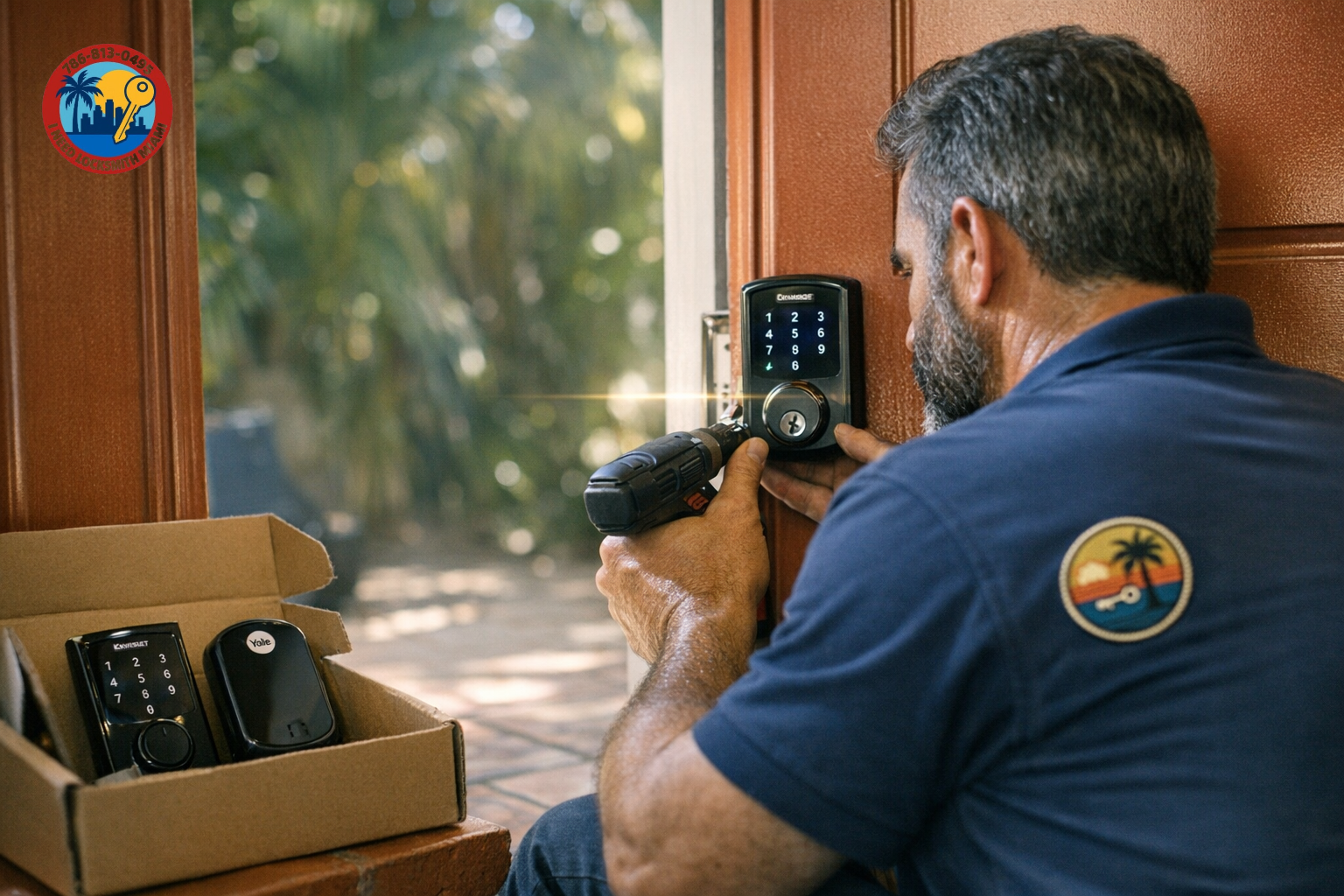
Yale Real Living locks (including the Yale Connect and Yale Assure models) are designed for residential and light-commercial appeal. They blend smart home ecosystem integration (Z-Wave, Bluetooth) with a contemporary keypad and mechanical override. For a boutique Wynwood co-working space that prioritizes design consistency with its brand, Yale locks look less “security-grade industrial” and more like upscale residential finishes.
Yale Real Living systems support up to 250 PIN codes per lock and can issue Bluetooth mobile credentials, but only to iOS devices. Android support is limited and carrier-dependent. If your tenant base is predominantly iOS (as is common in Wynwood’s creative and tech sectors), Bluetooth mobile access works smoothly. The lock pairs directly with the tenant’s phone; no cloud platform required. But if you have mixed Android and iOS tenants, you’re back to PIN codes and physical keys for Android users – which reintroduces the credential management friction you’re trying to avoid.
Card reader integration is not standard. Yale Real Living is not built with wiegand or RFID readers in mind, so if your building lobby uses a badge system, you’ll need an aftermarket bridge or separate access control for different entry points. This adds complexity and cost if you’re trying to unify your access control strategy.
Hardware cost: $240 – $350 per lock; installation $150 – $200 per door. There’s no mandatory cloud subscription for basic PIN + mechanical operation. If you want remote access management (smartphone credential issuance), you’ll pair the locks with a Yale Connect hub, adding $200 – $300. Total first-year cost for a 10-door suite: $3,700 – $4,300 (comparable to Schlage, but with lower multi-user scalability).
“I’ve seen Wynwood property managers choose Yale for the look and then regret it when tenant turnover spiked and they couldn’t issue temporary credentials fast enough. It works great for boutique, low-turnover spaces. But if your space turns over every 3-6 months, Aperio or Schlage will save you hours in administrative coordination.”
– I Need Locksmith Miami Team
Warranty is one year, the shortest of the three. Yale Real Living locks are also newer to the commercial market, so parts availability and technician familiarity lag behind Schlage and ASSA Abloy in the Miami-Dade area.
When to Choose Which System
Installation and Integration: Hidden Labor Costs
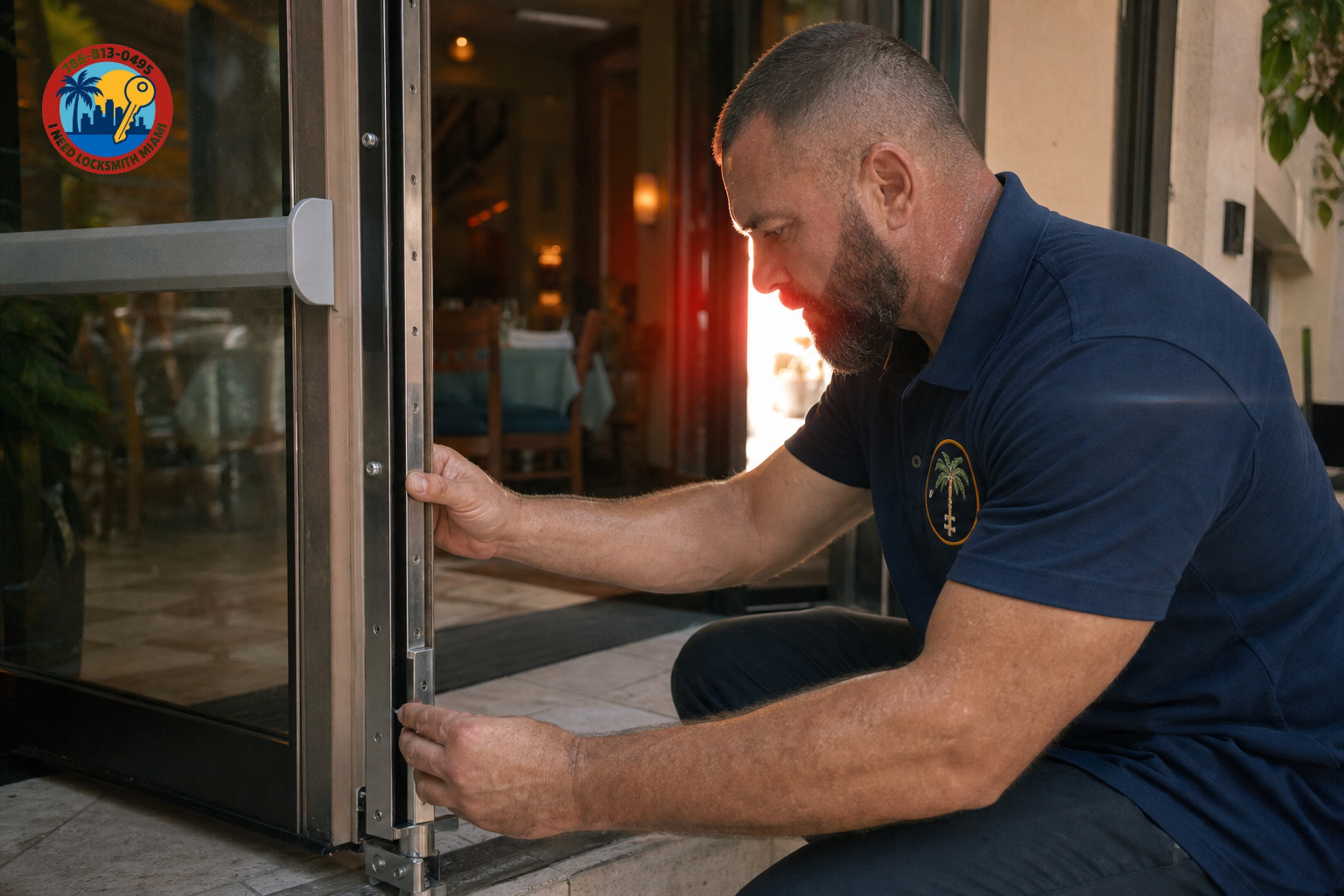
Most Wynwood building owners underestimate integration labor. The lock itself is $200 – $380, but the real cost emerges when you’re retrofitting an existing co-working space with multiple suites, exit alarms, and a building-wide access management hub.
Hardwire / Power Prep
Aperio locks run on batteries (18-24 month life); Schlage AD-Series can run hardwired (AC) or battery backup. If you’re retrofitting, running conduit or power lines to each door adds $100 – $300 per door in labor. Yale Real Living is battery-powered and requires no hardwiring.
Network / Hub Installation
ASSA Abloy Aperio requires an ethernet-connected wireless hub in a secure location. Schlage AD-Series may benefit from a hardwired SAM (Security Access Management) hub for centralized PIN programming. Both add $400 – $800 in hub hardware + $200 – $400 in installation/configuration labor.
Lock Replacement / Frame Work
Older Wynwood building doors often have worn frames, misaligned strikeplate, or exterior door leaf damage. Replacing a lock may require frame repair ($80 – $150 per door) or even full door replacement ($400 – $800). This gets added as contingency labor during the site survey.
Staff Training & Credential Issuance
After installation, your property management team needs training on credential issuance, PIN programming, and emergency overrides. A half-day on-site training session is typically $300 – $500. Aperio training takes longer (cloud platform navigation) than Schlage (PIN codes) or Yale (Bluetooth pairing).
For a typical 10-door Wynwood co-working retrofit, expect:
- Aperio: $4,500 – $6,500 all-in (locks + hub + hardwire preps + training + 1-year cloud subscription)
- Schlage: $3,800 – $5,200 all-in (locks + SAM hub + hardwire preps + training, no subscriptions)
- Yale: $3,500 – $4,800 all-in (locks + optional hub + training, no subscriptions if using PIN only)
Our Verdict
For most Wynwood co-working spaces, ASSA Abloy Aperio is the recommended choice – but only if you meet three criteria: (1) tenant turnover exceeds 30% annually, (2) you’re willing to budget for the cloud platform subscription, and (3) your building has functional internet and IT infrastructure.
The reason is operational leverage. In year one, Aperio costs more. But by month six, the time savings in credential issuance, the elimination of callback locksmith visits for PIN resets, and the audit trail for compliance reporting start compounding. A property manager running 12+ co-working suites with monthly tenant changes saves roughly 8-12 hours per month using Aperio. At a typical $40/hour admin labor rate, that’s $3,840 – $5,760 annually – which pays for the platform subscription and exceeds the first-year premium over Schlage within 18 months.
Schlage AD-Series is the best choice if you operate a stable, low-turnover co-working environment or if your Wynwood building’s internet is unreliable. Schlage’s offline PIN-code model means zero downtime dependency, and the lack of cloud subscriptions lowers total cost of ownership over 5+ years. The trade-off: you’re bound to manual PIN programming and credential recovery for each tenant – no temporary mobile access, no time-limited credentials. For a 4-6 suite operation with the same tenants for 12+ months, Schlage is simpler and cheaper.
Yale Real Living is the choice only for a niche profile: a boutique, design-forward Wynwood co-working space with iOS-dominant tenants, infrequent turnover, and no card-reader integration. Yale’s aesthetics and smart-home integration are genuine strengths, but the one-year warranty, limited Android support, and lack of badge-system integration make it risky for high-throughput facilities. If your space is curated for creative professionals who value design and stay 18+ months, Yale is defensible. Otherwise, avoid it.
Frequently Asked Questions
Can I mix locks from different systems on the same co-working floor?
Technically, yes – you can install Aperio on one suite door, Schlage on another. But operationally, it’s a nightmare. You’d have two separate credential management systems, two audit trails, two training protocols for staff, and incompatible backup procedures if one system fails. If you’re retrofitting, pick one system and commit. If budget forces a phased rollout, use the same system for the first phase and defer the rest.
What happens if the battery dies in one of these locks?
All three systems have mechanical override. Aperio includes a manual key override (though Aperio keys are less common and must be stored securely). Schlage AD-Series has a backup keyway and can run on an external 9V battery if the internal battery depletes unexpectedly. Yale Real Living also has a mechanical key backup. In practice, battery replacement happens on a scheduled 18-24 month cycle (Aperio and Yale) or every 3+ years (Schlage, if hardwired). Schedule replacements proactively and you’ll never hit a dead-battery lockout.
How do I integrate these locks with a building-wide card reader system?
Aperio integrates natively – the wireless hub communicates with an RFID/wiegand reader via a standard controller. Schlage requires a separate controller and some custom programming; integration cost is $400 – $600. Yale doesn’t support card readers out of the box and would require a third-party gateway (not reliable for commercial use). If badge integration is a requirement for your Wynwood space, Aperio is the clear winner. Schlage is viable if you’re willing to add integration cost. Yale is off the table.
Which system provides the best audit trail for compliance?
Aperio’s cloud-based audit trail is real-time and exportable; you can pull detailed reports on every access event, credential issuance, and override. Schlage stores access logs in the lock’s memory; you must physically visit the lock or retrieve the hub to export a report (manual, slower). Yale’s audit trail is phone-based and only captures Bluetooth events, not PIN entries. For co-working spaces subject to industry compliance, insurance audits, or corporate access policies, Aperio’s reporting is substantially better. Wynwood properties with sensitive creative agencies or tech startups often need third-party compliance reporting – Aperio supports this natively.
Sources
- ASSA Abloy Aperio wireless lock specifications and mobile credential architecture – ASSA Abloy Official Aperio Page
- Schlage AD-Series deadbolt specifications, PIN code capacity, and offline operation – Schlage AD-Series Product Page
- Yale Real Living smart lock user capacity and iOS/Android credential support – Yale Real Living Official Product Page
- I Need Locksmith Miami commercial access control and smart lock installation experience in Miami-Dade County co-working facilities – internal client data and case studies
I Need Locksmith Miami
I Need Locksmith Miami is a Miami-Dade locksmith and door specialist serving residential, commercial, and automotive customers.
- ASSA Abloy vs Medeco vs Mul-T-Lock: Which High-Security Lock Fits a South Beach Storefront in 2026
- Schlage Encode Plus vs Yale Assure Lock 2 vs Kwikset Halo: Which Keypad Deadbolt Holds Up in Miami Beach Humid
- Schlage Encode vs Mul-T-Lock MT5+: Which High-Security Lock Fits a Brickell Condo Door
- Schlage B60N vs Mul-T-Lock MT5+: Which Deadbolt Actually Protects a Brickell Condo Door
- Schlage vs Mul-T-Lock vs Medeco: Which High-Security Lock Actually Holds Up in Brickell’s High-Rise Condos