Last updated: September 18, 2026
Published September 18, 2026 · Updated September 18, 2026
A Schlage Encode Plus can secure multiple condo doors just fine, but it cannot manage them as a system: each lock stays its own island with its own codes, its own app pairing, and its own audit trail. Once you are past two doors, or once anyone other than you needs to issue and revoke access, a cloud access control platform is the right call. Below is the line we draw in the field, and why.
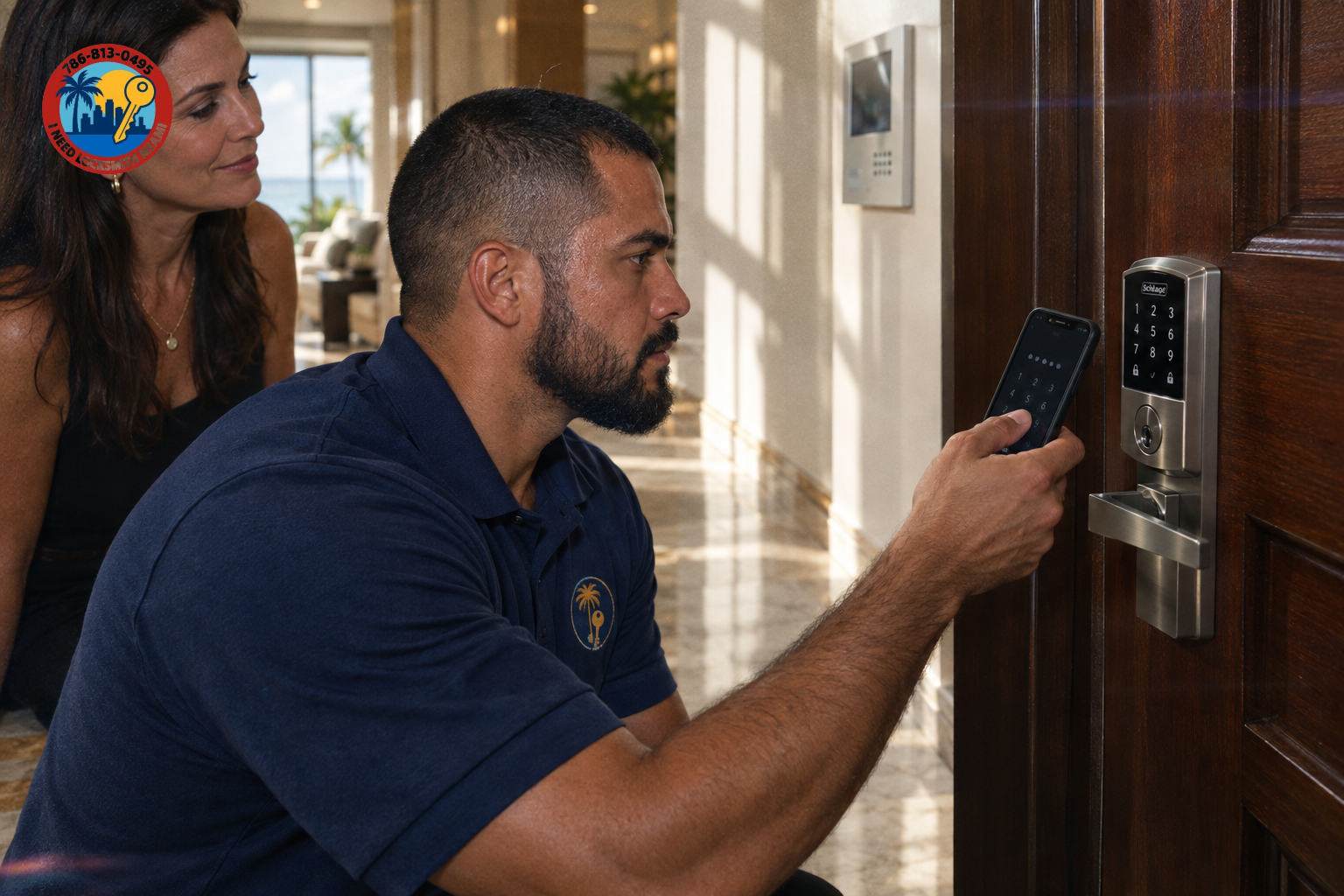
- The Schlage Encode Plus is a standalone Wi-Fi and Bluetooth deadbolt with Apple Home Key support; it manages access per lock, not per portfolio, so three doors means three separate setups.
- A cloud access control system centralizes credentials across doors, which is what matters once you have two or more units on Fisher Island or hand keys to a cleaner, a dockmaster errand, or a rental guest.
- Fisher Island’s salt-air environment is the single most underrated factor: exterior-facing electronic hardware near open-air corridors corrodes faster than the same lock installed inland in Doral or Westchester.
- Assuming every smart lock drops into an existing deadbolt prep is the most common and most expensive mistake we see; many require new drilling and added labor.
- Not rekeying or purging codes after a tenant or staff change creates a real liability gap, and it is the number one security hole we find in multi-unit condo ownership.
- I Need Locksmith Miami installs and services Schlage, Yale, Kwikset, ASSA Abloy, Mul-T-Lock and Medeco hardware 24/7 across Miami-Dade, including Fisher Island.
The Short Answer
In the cloud access control system vs Schlage Encode Plus multiple condo doors Fisher Island Miami question, the deciding factor is not door count, it is who needs to grant and revoke access. If you are the only person who ever unlocks those doors, a Schlage Encode Plus on each one is perfectly adequate. The moment a housekeeper, a property manager, a contractor, or a short-term guest enters the picture, you need a cloud platform that manages all doors from one dashboard.
Here is the part people miss. The Encode Plus does not talk to other Encode Plus locks. There is no parent-child relationship, no shared user directory, no single revoke button. Schlage’s own app handles multiple locks in a list, and that list is genuinely convenient, but it is a list, not a system. Delete a code and you delete it on one lock. Three doors, three deletions, three chances to forget one.
The Full Answer
What the Schlage Encode Plus Actually Does Well
The Schlage Encode Plus is a built-in-Wi-Fi smart deadbolt with Bluetooth and Apple Home Key support, meaning a resident can tap an iPhone or Apple Watch to the lock and walk in without opening an app. For an owner-occupied Fisher Island unit, that is a genuinely excellent front-door experience. No hub, no bridge, no panel in a closet.
It also stores access codes locally, so if the building’s Wi-Fi drops, the keypad still works. That matters here. Condo Wi-Fi in older towers is uneven, and an access method that dies with the router is not an access method.
So the answer is not that the Encode Plus is the wrong lock. It is often the right lock. It is the wrong management layer once the doors multiply.
Where It Breaks Down Across Multiple Condo Doors
Running multiple condo doors on standalone Schlage Encode Plus locks creates four specific friction points that show up within the first month, not the first year. Credential sprawl is the first: every person who needs two doors needs two codes, and people reuse the same four digits across both, which quietly halves your security.
The second is revocation. When a cleaning service changes staff, you must remember every lock that person touched. The third is audit reporting: you can see history per lock, but you cannot answer “who entered any of my three units on Tuesday” in one view. The fourth is delegation. Handing your Schlage account to a property manager hands them your locks, your home, and your personal Apple Home setup. There is no clean “manager, these three doors only” role.
That last one is the dealbreaker for most owners we talk to. It is not about technology at all. It is about who holds the keys.
A Schlage Encode Plus manages one door beautifully and three doors awkwardly. The failure mode is not lock performance, it is credential sprawl, per-lock revocation, and the lack of a limited manager role. A cloud access control system fixes exactly those four things and nothing else.
What a Cloud Access Control System Adds That a Standalone Lock Cannot
A cloud access control system gives you one user directory across every door, role-based permissions, scheduled access windows, and a single unified audit log. You create a user once, assign them to Unit A and the storage room, set an expiry date, and the platform pushes those rules to every lock or reader in the group.
It also lets you mix hardware types. On a real Fisher Island job, the front door might be a smart deadbolt, the service entry might use a card reader on an electric strike, and a gate or storage door might need a maglock with a keypad. A cloud platform makes those behave like one system. Standalone locks cannot, because they were never designed to.
If you want the full picture of the hardware side, our access control and smart lock installation page covers keypads, card readers, biometric readers, electric strikes and maglocks in more detail.
The Fisher Island Factor: Salt Air, Wi-Fi Dead Spots, and Association Rules
Fisher Island is surrounded by water on every side, and that changes which hardware survives. Electronic locks and readers mounted where salt air reaches them, open-air corridors, catwalks, service entries facing the bay, corrode at the battery contacts and the exterior escutcheon long before the electronics themselves fail. You smell it before you see it: that faint metallic tang on the brass when you pull the cover.
We specify differently for a salt-exposed Fisher Island door than for the same door in Hialeah or Doral. Interior-corridor doors are a different conversation entirely, and most Fisher Island unit doors are interior, which actually works in your favor.
The second Fisher Island reality is the association. Before anyone drills anything, you need to know whether your building allows exterior-facing hardware changes on unit doors, and whether the corridor Wi-Fi reaches your threshold. Honestly, the Wi-Fi survey is the step people skip and regret. A Wi-Fi lock that reports offline half the time is worse than a mechanical deadbolt, because you stop trusting the log.
The Retrofit Trap: Not Every Smart Lock Fits Your Existing Prep
Assuming all smart locks drop into existing deadbolt holes is the single most common and most avoidable mistake we encounter, and it adds real drilling and labor to a job that was quoted as a swap. Condo doors are especially unforgiving: many are fire-rated, many use a mortise lock body rather than a bored cylindrical prep, and modifying a fire-rated door incorrectly can void its listing.
An Encode Plus needs a standard bored prep with a specific backset and door thickness. A mortise-prepped condo door needs an electrified mortise lock or a mortise-compatible electronic solution instead, which is a different product family and a different install. We measure before we quote. Every time.
The related mistake: calling a locksmith only after the door or frame has already been damaged by a DIY attempt. Lock work plus structural repair is a meaningfully bigger job than lock work alone, and on a fire-rated condo door the frame repair is the part that cannot be improvised.
Side-by-Side: Which Option Wins for Which Situation
Neither option is universally better. Each genuinely wins in a defined scenario, and the table below is how we sort it on a site visit.
| Your situation | Better fit | Why |
|---|---|---|
| One owner-occupied unit, you are the only user | Schlage Encode Plus | Apple Home Key tap-to-enter, no hub, no subscription, local codes survive a Wi-Fi outage |
| Two units, same owner, occasional housekeeper | Either, leaning standalone | Two locks is still manageable by hand if one person owns every credential decision |
| Three or more doors, or a property manager involved | Cloud access control | Role-based delegation, one revoke action across all doors, unified audit log |
| Short-term or seasonal rental turnover | Cloud access control | Time-limited credentials that expire automatically instead of relying on memory |
| Mixed hardware: deadbolt, card reader, electric strike, gate | Cloud access control | Standalone locks cannot be grouped with readers, strikes or maglocks |
| Fire-rated mortise-prepped condo door | Neither as-is | Needs an electrified mortise or mortise-compatible product, specified before any drilling |
When the Answer Is Different
There are four situations where the cloud access control system vs Schlage Encode Plus comparison flips, and Fisher Island owners hit at least one of them more often than mainland Miami owners do.
Your association controls the door hardware
Some condo associations standardize unit-door hardware for appearance and fire-code consistency, which can rule out both options and leave you with an interior-side solution or an approved product list. Ask the association first. It is a five-minute email that prevents a removal.
You only leave for the season
If you are a seasonal Fisher Island owner who is off-island for months and has a caretaker checking the unit, cloud access wins even at a single door, because remote revocation and a real audit trail are the entire point. Standalone locks let you see history when you get around to opening the app. A cloud system notifies you.
You need mechanical key override that actually holds up
If you want a high-security mechanical cylinder as backup, that pushes the conversation toward key systems from Mul-T-Lock, Medeco or ASSA Abloy rather than a consumer smart deadbolt. Plenty of owners want both: a restricted mechanical key for the owner and electronic credentials for everyone else. That is a hybrid design, and it is the one we build most often for multi-unit owners.
Somebody moved out and nothing was purged
Not rekeying or purging credentials after a tenant move-out or a staff change is the security gap we find most often, and it is pure liability exposure. If that describes your doors today, the comparison is academic. Fix the credentials first, then choose the platform. Our commercial rekeying and master key work covers the mechanical side of that cleanup.
What a Locksmith in Miami Checks Before Quoting Either Option
A locksmith in Miami who quotes a multi-door condo access system over the phone without seeing the doors is guessing. Here is the actual sequence we run on a Fisher Island site visit, and you can do the first three yourself before you call.
Identify the door prep
Bored cylindrical or mortise? Fire-rated label on the hinge edge? This decides the entire product family before anything else.
Count the people, not the doors
List every human and every service who needs entry, and how often each changes. Two doors with six rotating users needs cloud. Four doors with one user does not.
Confirm association approval
Get written clearance for hardware changes on unit doors and any shared-corridor device. On Fisher Island this is not optional.
Survey signal at the threshold
Test Wi-Fi strength at the lock face, not in the living room. Interior corridors and concrete cores kill signal. Weak signal means a hub, a gateway, or a different topology.
Check the door itself, not just the lock
A sagging door, a worn closer, or a misaligned strike will make any electronic lock look unreliable. We fix alignment before we blame electronics.
Decide the mechanical fallback
Every electronic door needs a defined way in when power, battery or network fails. Restricted keyway, mechanical override, or a documented onsite procedure.
Step five is the one that surprises owners. A misaligned strike plate produces intermittent lock failures that look exactly like a software problem, and people replace a perfectly good lock over it. If your door needs a shoulder to close, that is a door alignment and closer job first.
Our Take After Years of Access Control Work in Miami-Dade
Owners overweigh features and underweigh administration. We get asked about fingerprint readers and Apple Home Key constantly, and almost never asked the question that actually predicts satisfaction: who is going to manage this in eighteen months, when the cleaner changes and you are traveling? The lock that fails you is rarely the lock that broke. It is the lock whose code list nobody maintained.
The second thing we would tell a friend: buy fewer, better doors rather than more, cheaper hardware. A hybrid design, a restricted mechanical cylinder plus electronic credentials on the doors that turn over, outlasts a fleet of consumer smart locks every time. And on Fisher Island specifically, respect the salt. Hardware that lives near open air needs service intervals, not a set-and-forget mindset.
If you are a Fisher Island owner adding a third unit and you already like your Schlage Encode Plus, the unglamorous answer is: keep it where it serves you, and build the delegation layer separately. You are not replacing a good lock. You are adding the thing it was never built to do.
FAQ
Can one Schlage app manage Encode Plus locks on several Fisher Island condo doors?
The Schlage app can display several Encode Plus locks in one account, but it manages each lock independently: codes, users and history live per lock, not per group. For Fisher Island owners with three or more doors, that means three separate code lists and three separate revocations, which is exactly the administrative gap a cloud access control system closes.
Does a cloud access control system require a subscription and building Wi-Fi?
Cloud access control platforms are typically subscription-based and do require network connectivity, either building Wi-Fi at each door or a gateway that bridges locks back to a single connection. On Fisher Island we survey Wi-Fi signal strength at the lock face before specifying anything, because interior concrete corridors routinely read fine in the living room and poorly at the threshold. Contact I Need Locksmith Miami for current platform and service details.
Will a Schlage Encode Plus fit my existing condo deadbolt hole without drilling?
A Schlage Encode Plus fits a standard bored cylindrical deadbolt prep, but many Miami condo doors use a mortise lock body or are fire-rated, and those require a different product entirely. Assuming every smart lock drops into an existing hole is the most common mistake we see, and it adds drilling labor to a job quoted as a swap. Have the prep identified before you buy hardware.
How often should a multi-unit Fisher Island owner purge access codes?
Purge or rekey immediately after any tenant move-out, cleaning-service staff change, or contractor completion, and audit the full credential list at least twice a year. Skipping this is the most common security gap we find in multi-unit condo ownership across Miami-Dade, and it creates direct liability exposure. A cloud access control system automates the expiry so the audit becomes a review instead of a rescue.
Sources
- Schlage Encode Plus specifications, Wi-Fi and Apple Home Key support – Schlage
- ASSA Abloy access control and electronic lock product information – ASSA Abloy
- Mul-T-Lock high-security cylinder and key system information – Mul-T-Lock
- Service area, 24/7 mobile coverage and access control offerings – I Need Locksmith Miami
I Need Locksmith Miami
Have a similar question about multiple condo doors? We install and service Schlage, Yale, Kwikset, ASSA Abloy, Mul-T-Lock and Medeco hardware, plus cloud access control across Fisher Island and all of Miami-Dade, 24/7. Call (786) 813-0495 or request a site assessment.
- A Doral Condo Manager Asked: “How Long Does It Take to Install a Card-Reader Access System for 40 Units?” — A Tech’s Honest Timeline
- A Hialeah Retail Owner Asked: “Is a Maglock or an Electric Strike Better for My Glass Storefront Door?” — The Detailed Breakdown
- A Wynwood Shop Owner Asked: ‘Can a Locksmith Rekey My Storefront Without Replacing the Whole Mortise Lock?’ — The Full Answer
- A Wynwood Business Owner Asked: “Can You Rekey My 6 Office Locks Without Replacing the Hardware?” — The Full Answer
- Schlage Encode Plus vs Yale Assure Lock 2 vs Kwikset Halo: Which Keypad Deadbolt Holds Up in Miami Beach Humidity

2 Responses