Last updated: October 2, 2026
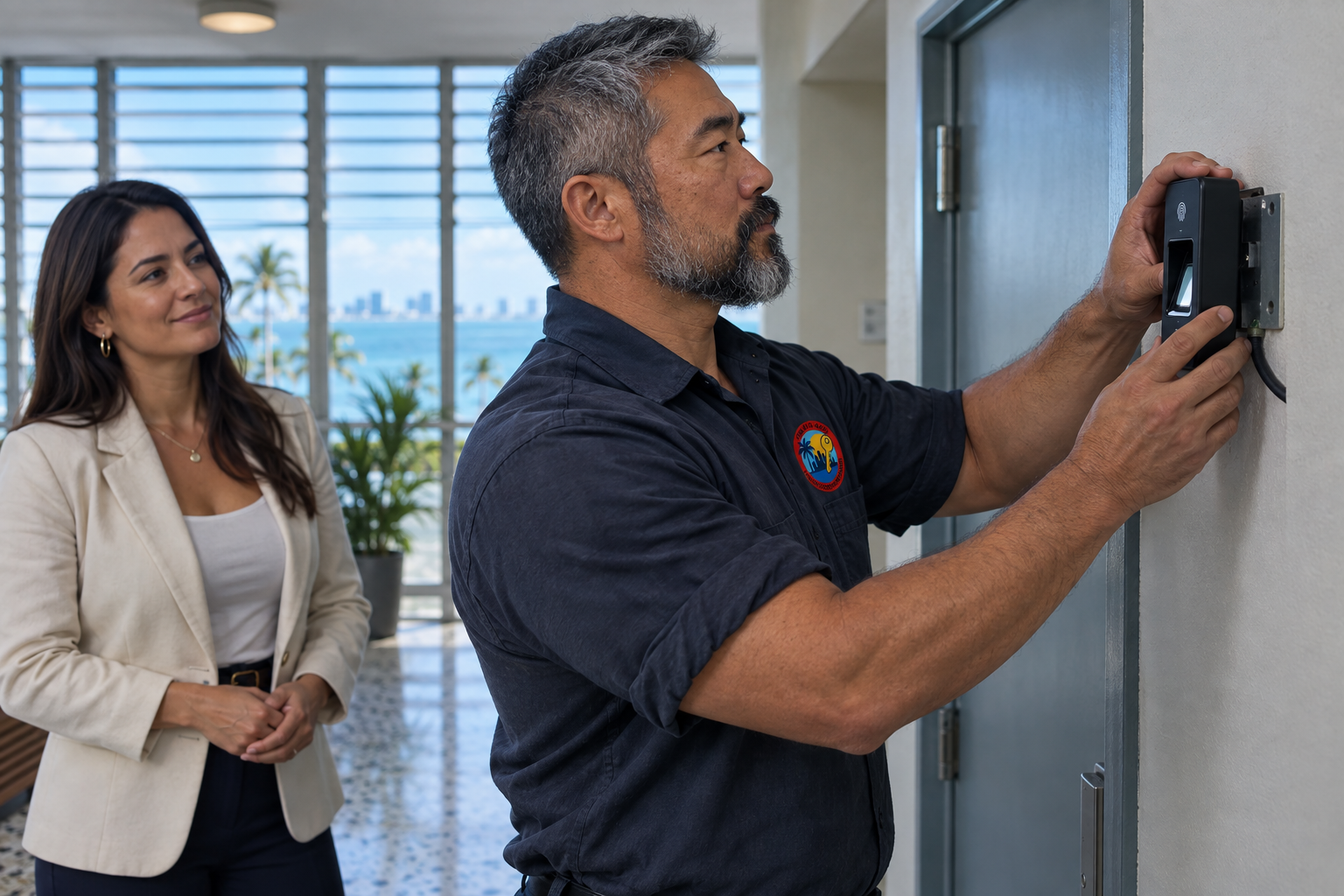
A locksmith in Miami installing a biometric reader on an existing commercial door frame in Bay Harbor Islands can almost always do it without replacing the frame. The fingerprint reader mounts on the wall or mullion beside the door, and only the locking device (an electric strike, a magnetic lock, or an electrified lever) touches the frame itself. What actually decides the job is the frame material, any fire-rating label, the power-loss plan for hurricane season, and the egress rules in NFPA 101 and the Florida Building Code. On these two islands, salt air off Biscayne Bay, mid-century steel and aluminum frames, and a compact commercial strip along Kane Concourse shape every one of those decisions.
- Biometric readers mount on the wall or mullion beside a door, so an existing commercial frame in Bay Harbor Islands rarely needs replacing; only the locking device touches the frame.
- Magnetic locks on egress doors need a sensor release plus a manual push-to-exit device mounted 40-48 inches above the floor, within 5 feet of the door, that unlocks it for at least 30 seconds under NFPA 101.
- Fail-secure electric strikes keep a door locked when power drops, which matters through the June 1 to November 30 Atlantic hurricane season.
- ADA reach range under the 2010 ADA Standards puts an accessible reader between 15 and 48 inches above the floor for an unobstructed forward reach.
- The mechanical override cylinder stays live after a biometric upgrade, so rekeying it with a Medeco, Mul-T-Lock or Schlage core after staff or tenant turnover closes the gap fingerprints leave open.
- Bay Harbor Islands is its own incorporated town made up of two islands in Biscayne Bay, a West Island and an East Island.
- The Broad Causeway links the town to North Miami on the mainland, and 96th Street (Kane Concourse) runs east toward Bal Harbour and Surfside.
- Much of the building stock dates to the post-war building boom, and the town is known for Miami Modern (MiMo) architecture alongside newer condo towers.
- All of Miami-Dade County falls within the Florida Building Code’s High-Velocity Hurricane Zone (HVHZ), the strictest wind provisions in the state code.
- The Atlantic hurricane season officially runs June 1 through November 30 each year.
Can a Locksmith in Miami Install a Biometric Reader on an Existing Commercial Door Frame in Bay Harbor Islands?
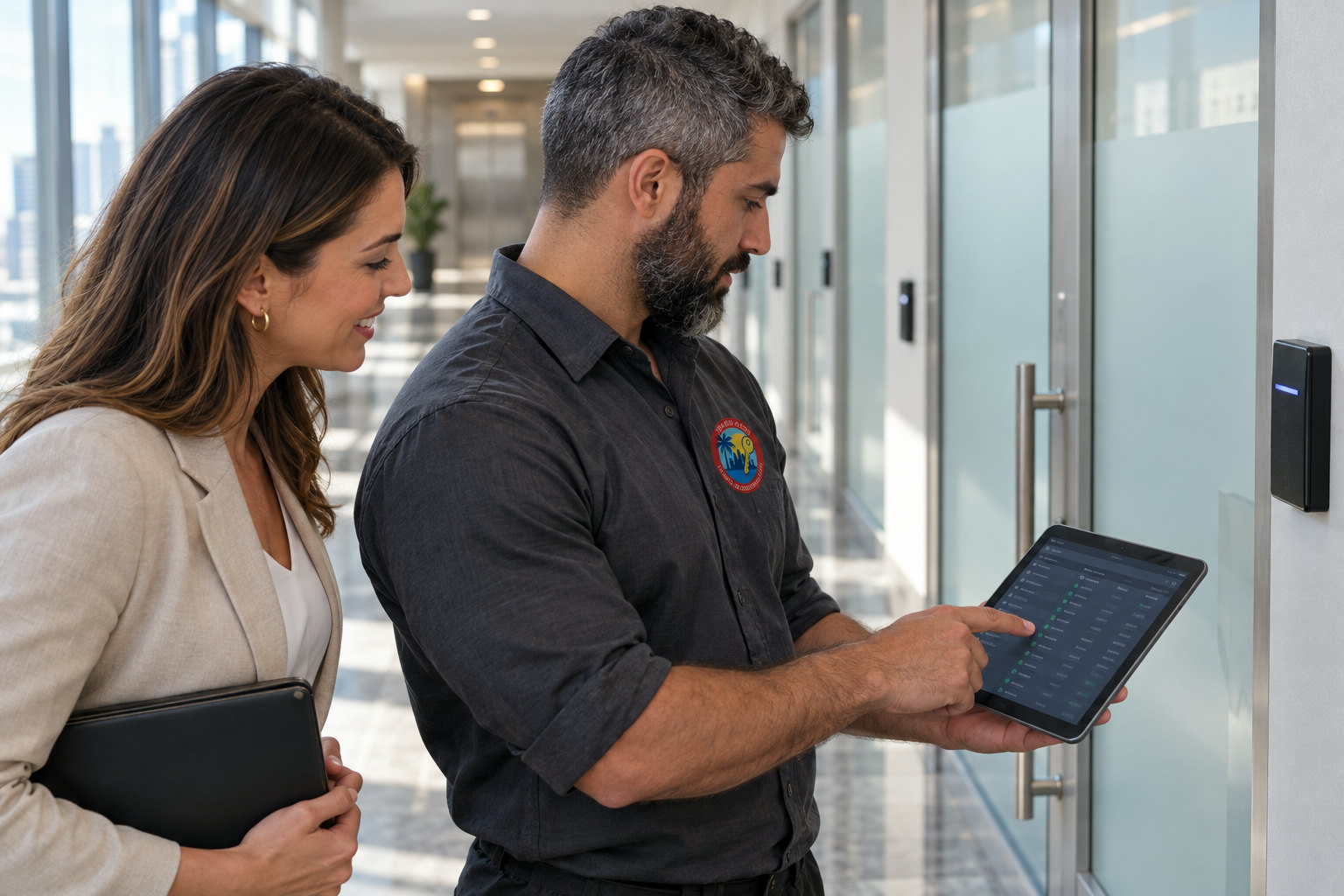
Yes. A biometric reader retrofit on an existing commercial door frame is routine work, because a fingerprint access system is really three separate parts: the reader, the controller with its power supply, and the locking device. The reader and controller live on the wall. Only the locking device has to work with your frame.
If you’re a property manager running a mid-rise condo, a small office building, or a storefront on the islands and you’ve been told you need a new door to go keyless, get a second look first. In most cases the frame stays. The real question is which locking device that frame can accept cleanly.
Honestly, the fingerprint reader is the easy part of this job. It’s a few screws, a low-voltage cable, and an enrollment session. The hours go into the frame: cutting a clean electric strike pocket in a hollow metal jamb, finding a cable path through a 1950s masonry wall, or making a narrow aluminum storefront stile accept hardware it was never drawn for.
When the existing frame is not the right answer
An existing commercial door frame fails the retrofit test in three situations: the frame is already bent, cracked or rusted through at the strike area; the door has sagged so far that the latch no longer lines up; or the opening is fire-rated and the needed modification isn’t permitted under NFPA 80. Each of those is fixable. None is fixed by a fingerprint reader alone.
Sagging doors are the quiet killer. An electrified lock is far less forgiving than a key, and a door dragging on its threshold will bind an electric strike keeper every single time. That’s when our commercial door alignment and closer repair work comes before any access control hardware goes on.
Why Bay Harbor Islands Is Different
Bay Harbor Islands is different from most of mainland Miami because nearly every door on both islands sits within a short walk of open saltwater, and much of the building stock went up in the post-war decades. That combination means older frames, original masonry walls, and hardware that has spent years breathing salt air off Biscayne Bay. A retrofit plan written for a new Brickell office tower doesn’t transfer.
Salt air changes the hardware list
Salt exposure on the islands attacks the exact spots an access control retrofit depends on: the strike pocket, the screw holes in the jamb, and the terminals where low-voltage wire meets the lock. You can see it on older frames, that chalky white crust around the strike plate and a faint orange bleed at the screw heads. A new electric strike set into a corroded pocket inherits the problem.
So we treat finish and enclosure rating as first-order decisions, not afterthoughts. Stainless or coated hardware, readers rated for outdoor use, and sealed cable entries matter more here than they would a few miles inland in Doral.
Mid-century frames and mixed construction
The town’s MiMo-era buildings often pair hollow metal frames grouted into concrete block with lobby storefronts in narrow-stile aluminum. Grouted frames make it hard to fish wire up the jamb. Narrow aluminum stiles leave very little room for an electrified lock body. Both are workable. Both change the method.
Storm season decides fail-safe versus fail-secure
Hurricane season runs June 1 through November 30, and a Florida Power & Light outage on the islands tests every electrified door at once. A fail-safe lock unlocks when power dies. A fail-secure lock stays locked and relies on the mechanical key. For a waterfront building that may sit empty during an evacuation, that choice carries more weight than which reader brand goes on the wall.
Common Problems We See Here: What Goes Wrong on Existing Frames?
The most common biometric retrofit problems on the islands are frame damage from a do-it-yourself attempt, magnetic locks installed without code-compliant egress release, consumer fingerprint locks forced onto commercial doors, and override cylinders that never get rekeyed. None of these is exotic. All of them are avoidable.
1. The frame was damaged before we were called
Calling a locksmith only after the door or frame is already damaged is the costliest mistake we see in access control work. A handyman cuts an oversized strike pocket in a hollow metal jamb, or splits an aluminum frame with a drill bit that walked. Now the job needs structural frame repair alongside the lock work, and the bill grows noticeably compared with what a clean first install would have run.
The fix is boring. Get the survey before anyone picks up a grinder.
2. A maglock with no legal way out
Magnetic locks are popular for retrofits because they mount on the header and barely touch the frame. The catch is egress. NFPA 101 sensor-release rules call for a motion sensor on the egress side, automatic release on power loss, and a manual release device mounted 40-48 inches above the floor within 5 feet of the door that unlocks it for at least 30 seconds. Where a fire alarm or sprinkler system exists, the lock also has to release when that system activates.
We regularly find maglocks with only a motion sensor and no button, or a button wired through the same controller it is supposed to bypass. That isn’t a security system. It’s a liability waiting for an inspection.
3. Residential fingerprint locks on commercial doors
Consumer fingerprint locks like the Yale Assure Lock 2 Touch and the Kwikset Halo Touch are good products for homes and some short-term rentals. They aren’t built for an office entry that cycles all day or a lobby door on a heavy closer. Managers also assume these locks will drop into the existing prep, and many need new drilling or a different bore and backset, which adds labor the quote never mentioned.
4. The override key nobody rekeyed
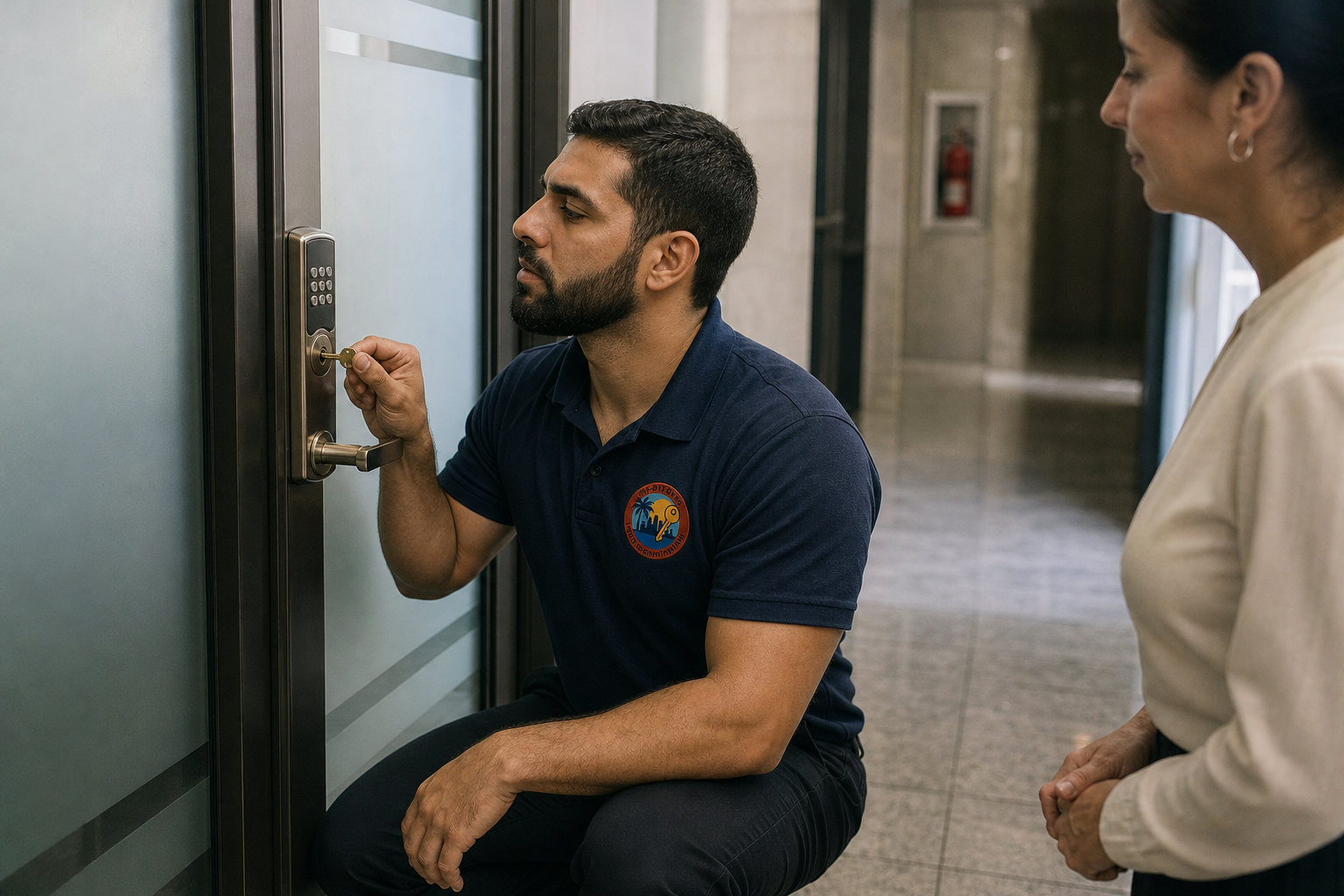
Almost every commercial biometric door keeps a mechanical override cylinder for emergencies and power loss. Not rekeying that cylinder after an employee leaves or a tenant moves out creates a serious security gap and real liability exposure, because the old brass key still opens the door that the deleted fingerprint no longer does. The reader looks modern. The weak point is the 30-year-old key in a former employee’s glovebox.
Most failed biometric retrofits in Bay Harbor Islands trace back to frame damage before the survey, maglocks missing the NFPA 101 manual release at 40-48 inches, residential fingerprint locks on commercial doors, or an override cylinder that was never rekeyed after turnover.
How We Approach This Area: What Does a Clean Retrofit Look Like?
A clean biometric retrofit on an island commercial door starts with the locking device and works outward to the reader, not the other way around. The reader brand gets picked last. The frame, the egress rules and the storm plan get picked first.
Matching the locking device to the frame
Each locking option wins in a specific situation, and none of them is right for every door. The table below is how we sort them on a typical survey.
| Locking device | What it does to the frame | On power loss | Wins when |
|---|---|---|---|
| Electric strike (for example, HES, an ASSA Abloy brand) | Replaces the strike plate; the jamb pocket is enlarged to fit the strike body | Fail-secure or fail-safe, field-selectable on many models | A sound hollow metal frame and an existing latching lever you want to keep |
| Magnetic lock (for example, Securitron, an ASSA Abloy brand) | Surface-mounts on the header; minimal cutting | Always releases (fail-safe by design) | Glass or narrow-stile doors with no room for a strike, and full NFPA 101 release hardware is installed |
| Electrified mortise or cylindrical lever (for example, Schlage L9000 electrified mortise) | Frame barely changes; wire runs through the door via a power transfer hinge | Fail-secure or fail-safe depending on the function ordered | The frame is grouted or fragile and the door can carry the electronics instead |
| Electrified exit device (panic bar with latch retraction) | Uses the existing exit device prep; strike side often unchanged | Latches mechanically; free egress always maintained | Required egress doors, assembly spaces, and lobby doors that already carry a panic bar |
Fire-rated openings narrow the list. NFPA 80 limits field modification of labeled doors and frames, and electric strikes on rated openings need to be listed for that use and fail-secure so the door keeps positive latching. We read the label on the hinge edge and frame before quoting anything.
Picking a reader that survives the islands
A fingerprint reader at a bay-facing door deals with problems an indoor office reader never sees: afternoon thunderstorms, wet fingers from the pool deck, and thumbs slick with sunscreen. What surprised us early on was how often the reader itself was fine and the read failures came from the finger. Multispectral sensors, such as HID’s Lumidigm line, are designed to read through moisture and surface contamination better than basic optical sensors.
We also spec readers that accept a card or PIN as a fallback, mount them under a hood or shroud out of direct western sun, and keep them inside the 15 to 48 inch forward-reach range from the 2010 ADA Standards. A reader nobody in a wheelchair can reach is a reader that fails the building.
Our retrofit sequence, start to finish
Survey the opening
Check frame material, fire label, door sag, closer condition, and corrosion at the strike pocket before any hardware is chosen.
Choose the locking device and power behavior
Match strike, maglock, electrified lever, or exit device to the frame, and decide fail-safe or fail-secure with storm season in mind.
Plan the cable path
Route low-voltage wire through the jamb, a power transfer hinge, or a surface raceway, with sealed entries against salt and rain.
Mount the reader at an accessible height
Place it within the 15 to 48 inch ADA reach range, shaded from direct sun, with card or PIN fallback enabled.
Install power, backup, and life-safety ties
Use a dedicated 12 or 24 VDC supply with battery backup, plus fire alarm release and request-to-exit devices where the code calls for them.
Enroll, test egress, rekey the override
Enroll users, pull power to test the failure mode, confirm free egress, and rekey the mechanical override cylinder so old keys are dead.
Step six is where most installers stop early. We pull power on purpose and listen: a strike should drop into its locked state with a crisp click, and a maglock should go silent, its faint hum gone, the moment the supply cuts. If the door doesn’t behave exactly as designed with the lights off, it isn’t finished.
For the override, we typically recommend a restricted keyway from Medeco or Mul-T-Lock on doors where key control matters, or folding the cylinder into an existing Schlage or ASSA Abloy master key system. Our commercial rekeying and master key system service handles that side, and our access control installation page covers keypad, card and fingerprint systems in more depth.
Our Take After Years of Access Control Work in Miami-Dade
Property managers overweigh the reader. They compare fingerprint templates, app dashboards and finishes, then accept whatever locking hardware comes in the box. In our experience the reader is rarely why a biometric door fails. The strike, the power supply and the door alignment are.
What actually matters is boring and physical: a frame that’s square, a closer that brings the door home every time, a power plan that matches how the building should behave in a storm, and an override key that only the right people hold. Get those right and almost any reputable reader will serve you for years.
The one thing we’d tell a friend managing a building near the water? Don’t let anyone cut your frame until someone has read the fire label and checked the door for sag. That ten-minute look saves more trouble than any feature on the spec sheet. If your building also has glass entry doors, our storefront glass door hardware service is a separate conversation worth having before you electrify them.
FAQ: Biometric Readers on Bay Harbor Islands Commercial Doors
Do I need a permit to add a fingerprint reader to a commercial door on the islands?
Permits for fingerprint reader installs on commercial doors depend on the scope, and electrified locking, magnetic locks, and anything tied to a fire alarm system are the items most likely to need building or fire review under the Florida Building Code. Check with the Town of Bay Harbor Islands building department before work starts. We flag permit-sensitive items during the survey so nothing gets installed that an inspector would make you remove.
Will a biometric reader hold up at a pool gate or lobby door facing Biscayne Bay?
Biometric readers at bay-facing doors hold up when they are rated for outdoor use, mounted under a hood out of direct sun, and paired with stainless or coated hardware and sealed cable entries. Wet or sunscreen-covered fingers are the bigger issue, so we favor multispectral sensors such as HID Lumidigm and always enable a card or PIN fallback. Salt-exposed terminals should be inspected at least once a year.
What happens to a fingerprint-controlled door when the power goes out in a hurricane?
A fingerprint-controlled door during a power outage behaves according to its locking device: a fail-safe lock or magnetic lock unlocks, while a fail-secure electric strike stays locked and opens only with the mechanical key. A battery backup on the 12 or 24 VDC supply buys time but not unlimited time. For the June 1 to November 30 hurricane season, decide door by door which behavior you want and confirm the override keys are where they need to be.
Can a biometric reader control a narrow aluminum storefront door on Kane Concourse?
Biometric readers can control narrow-stile aluminum storefront doors on Kane Concourse, because the reader mounts on the wall or mullion and the locking is handled by a narrow-profile electric strike, a header-mounted magnetic lock with NFPA 101 release hardware, or an electrified exit device. The aluminum frame needs careful cutting so it doesn’t crack. Frameless all-glass doors usually call for a different locking approach altogether.
Ready to find out what your door can take? Call (786) 813-0495 for a survey anywhere in Bay Harbor Islands, or request service online. We’ll read the frame, the label and the power plan before recommending a single piece of hardware.
Sources
- Accessible reach ranges (15 to 48 inches) and operable-part requirements for readers and door hardware: U.S. Department of Justice, 2010 ADA Standards for Accessible Design
- Sensor-release egress requirements for electrified locks (NFPA 101) and fire door field-modification rules (NFPA 80): National Fire Protection Association
- Florida Building Code and High-Velocity Hurricane Zone provisions covering Miami-Dade County: Florida Building Commission
- Atlantic hurricane season dates (June 1 to November 30): NOAA National Hurricane Center
I Need Locksmith Miami
I Need Locksmith Miami is a Miami-Dade locksmith and door specialist serving residential, commercial, and automotive customers.
 Listen to article
- A Doral Condo Manager Asked: “How Long Does It Take to Install a Card-Reader Access System for 40 Units?” — A Tech’s Honest Timeline
- A Fisher Island Condo Owner Asked: “Do I Need a Separate Cloud Access System or Can My Existing Schlage Encode Plus Handle Multiple Unit Doors?”, A Tech’s Direct Answer
- A Hialeah Office Manager Asked: “Will Our Multi Tenant Door Unlock During a Power Outage?” What Maglock and Electric Strike Wiring Means for Access Control
- How We Repaired a Sagging Pivot Door at a Miami Springs Restaurant — One Continuous Hinge and a Realigned Frame Later
- A Customer Asked: “Can a Locksmith Really Program a New Toyota Smart Key on the Spot in Brickell?” — The Full Answer


2 Responses