Last updated: October 23, 2026
Published October 23, 2026 · Updated October 23, 2026
The right call from a commercial locksmith in Miami after a Coral Gables office tenant moves out is to rekey or replace locks based on condition: rekey sound hardware, replace worn or failing hardware. Rekeying changes the pin combination inside your existing Schlage, Yale or Medeco cylinders, so every key the old tenant held stops working, including copies you never knew existed. You keep the doors, the finish and the lever sets, and the work usually fits into a single visit.
- Rekeying changes the pin combination inside the existing cylinder, so every key the departing tenant held stops working while the lockset, door and finish stay in place.
- Replacing makes sense when a cylinder is worn, damaged, corroded by South Florida humidity, or being upgraded to Medeco, Mul-T-Lock or ASSA Abloy high-security hardware.
- “Do Not Duplicate” stamps on standard keys are a request, not a control, so a returned key ring never proves that no copies exist.
- Master key systems need the building’s key schedule so a vacated suite can be rekeyed to a new change key without breaking the building master.
- The 2010 ADA Standards require door hardware that works without tight grasping, pinching or twisting, mounted 34 to 48 inches above the floor, so swapping old knobs for levers can belong in a turnover.
- I Need Locksmith Miami runs 24/7 mobile commercial service across Miami-Dade at (786) 813-0495, so a rekey can be booked for the day the suite is handed back.
The Short Answer: What a Commercial Locksmith in Miami Recommends When an Office Tenant Moves Out
After an office tenant moves out, rekeying is the default, and replacing locks is the exception. A rekey is the lowest-cost way to make every old key useless, because the locksmith only changes the small pins inside each cylinder. The lever, the mortise body, the exit device and the door prep all stay exactly where they are.
If you’re an office manager turning over a suite in one of the older buildings along Ponce de Leon Boulevard, with a lease handback date and a new tenant already signed, here is the practical version. Rekey every lock the old tenant could open. Replace only the hardware that is sticking, loose, corroded, damaged or not compliant. Then document who holds which key.
One thing never changes. Skipping the lock change entirely is the real mistake. Not rekeying after a tenant move-out or employee turnover leaves a serious security gap, and it creates liability exposure if something goes missing after the new occupant arrives.
The Full Answer
The decision to rekey or replace locks after an office tenant moves out depends on five things: the condition of the hardware, the type of cylinder, whether the building runs a master key system, which doors the tenant could reach, and what the lease says. Each one can shift the answer. The table lays out the realistic options side by side so you can weigh them yourself.
| Option | What changes | Wins when | Trade-off |
|---|---|---|---|
| Rekey existing cylinders | Pins inside the cylinder; old keys stop working | Hardware is sound, such as a working Schlage or Yale commercial lever | Does not fix wear and adds no key control |
| Replace cylinders only | New cylinder in the existing lever, mortise lock or exit device | Cylinders are worn, or you want a restricted keyway | Costs more than a rekey; the cylinder format must match the housing |
| Replace the full lockset | Lever, latch, chassis and cylinder | Latches fail, knobs need to become levers, or the lock was forced | Most labor; door prep and finish must match |
| Swap interchangeable cores | Core pulled with a control key and replaced | The building already uses Schlage or Medeco interchangeable cores | Only works if IC housings are already installed |
| Upgrade to Medeco or Mul-T-Lock high security | Patented cylinders with controlled key blanks | The suite turns over often or holds records and equipment | Premium tier; duplicates go through an authorized dealer |
What rekeying actually changes, and what it leaves alone
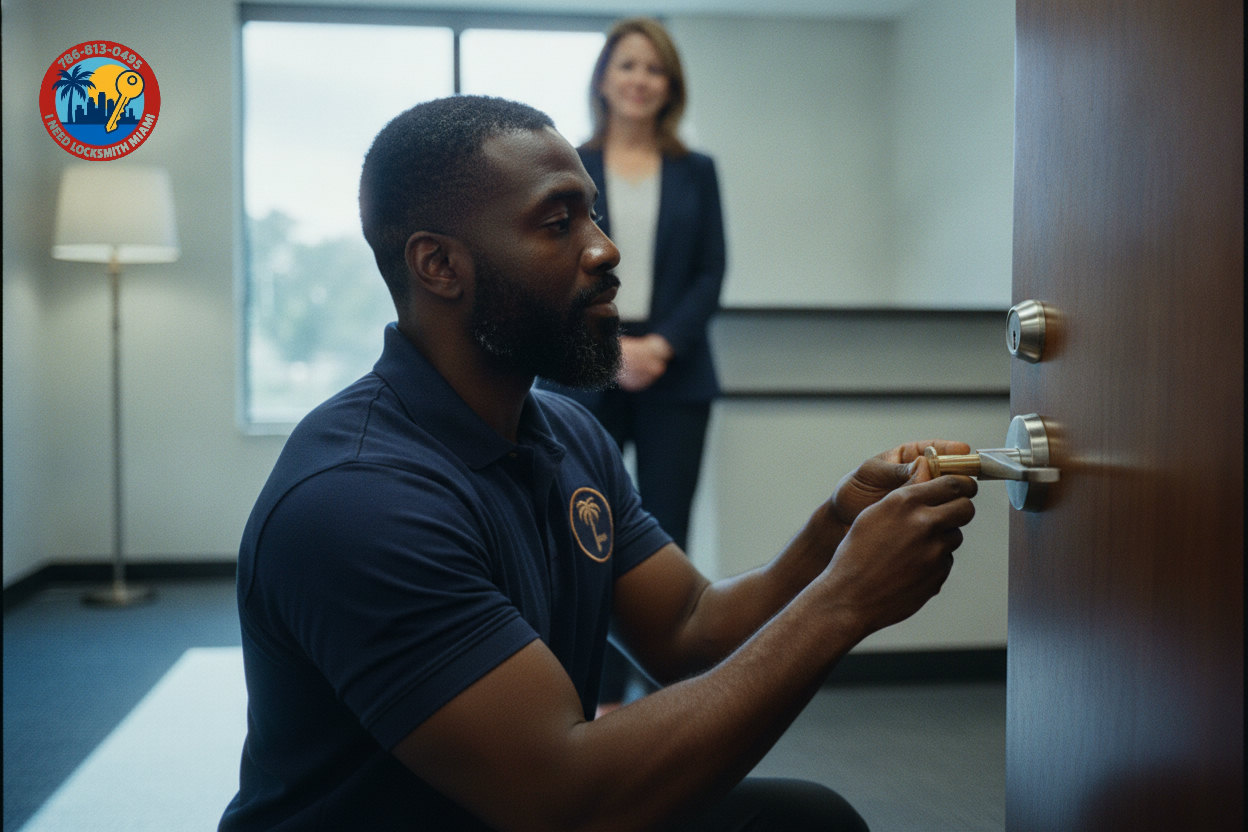
Rekeying a pin-tumbler cylinder means removing the plug, swapping the bottom pins for a new combination, and cutting new keys to match. The lock body, latch and lever never come off the door. To anyone walking past, nothing looks different.
That is why rekeying suits most office turnovers. A Schlage, Yale or Kwikset commercial cylinder in good working order can be rekeyed many times over its life. The limit is mechanical condition, not the number of tenants who have come and gone.
What rekeying does not do is improve the lock. A rekeyed builder-grade cylinder is exactly as pickable and exactly as easy to copy as it was before. It simply answers to a different key.
Why a returned key ring proves nothing
A departing tenant who hands back every key still may not have handed back every copy. Standard keys can be duplicated at many hardware counters, and a “Do Not Duplicate” stamp is a request, not a mechanical barrier. Former employees, cleaning crews, IT contractors and couriers may all have held keys at some point.
This is the counter-intuitive part. The tenant who returned a tidy, labeled key ring is not proof of a clean handback. It only proves they returned the keys they still had. Rekeying is what closes the gap, because it does not depend on anyone’s memory or honesty.
How a master key system changes the job
Rekeying a suite inside a master key system means the new pin combination has to work with both the new tenant’s change key and the building’s existing master key. That requires the system’s key schedule, sometimes called the bitting list. Without it, a locksmith can lock the old tenant out but may also lock out building management.
For a property manager juggling several multi-tenant buildings on one master key system, this matters more than the lock brand. Ask who keeps the key schedule before the locksmith arrives. If nobody can find it, the decision becomes bigger: decode the existing system or design a new one.
There is one harder case. If the departing tenant held a master or sub-master key, rekeying their suite alone does not help. Every door that master opens is exposed, and the honest answer is to rekey the whole system.
Rekeying swaps the pins in an existing cylinder so old keys stop working, and it does not upgrade the lock’s security. In a master key system, the rekey needs the building’s key schedule, and a tenant who held a master key exposes every door that master opens.
High-security cylinders: Medeco, Mul-T-Lock and ASSA Abloy
High-security cylinders from Medeco, Mul-T-Lock and ASSA Abloy add key control on top of pick resistance. Their key blanks are restricted, and duplicates are cut by authorized dealers against an ownership record or key card. That is the feature that actually solves the copied-key problem for a suite that turns over often.
If your building already has these cylinders, a move-out rekey stays inside that controlled system, so ask whoever holds the key records to coordinate. If your building has standard cylinders and the suite holds payroll files, client records or expensive equipment, a turnover is a natural moment to replace just the exterior cylinders with a restricted keyway. Interior doors can stay on rekeyed standard cylinders.
The doors people forget: exit devices, mortise locks, cabinets and keypads
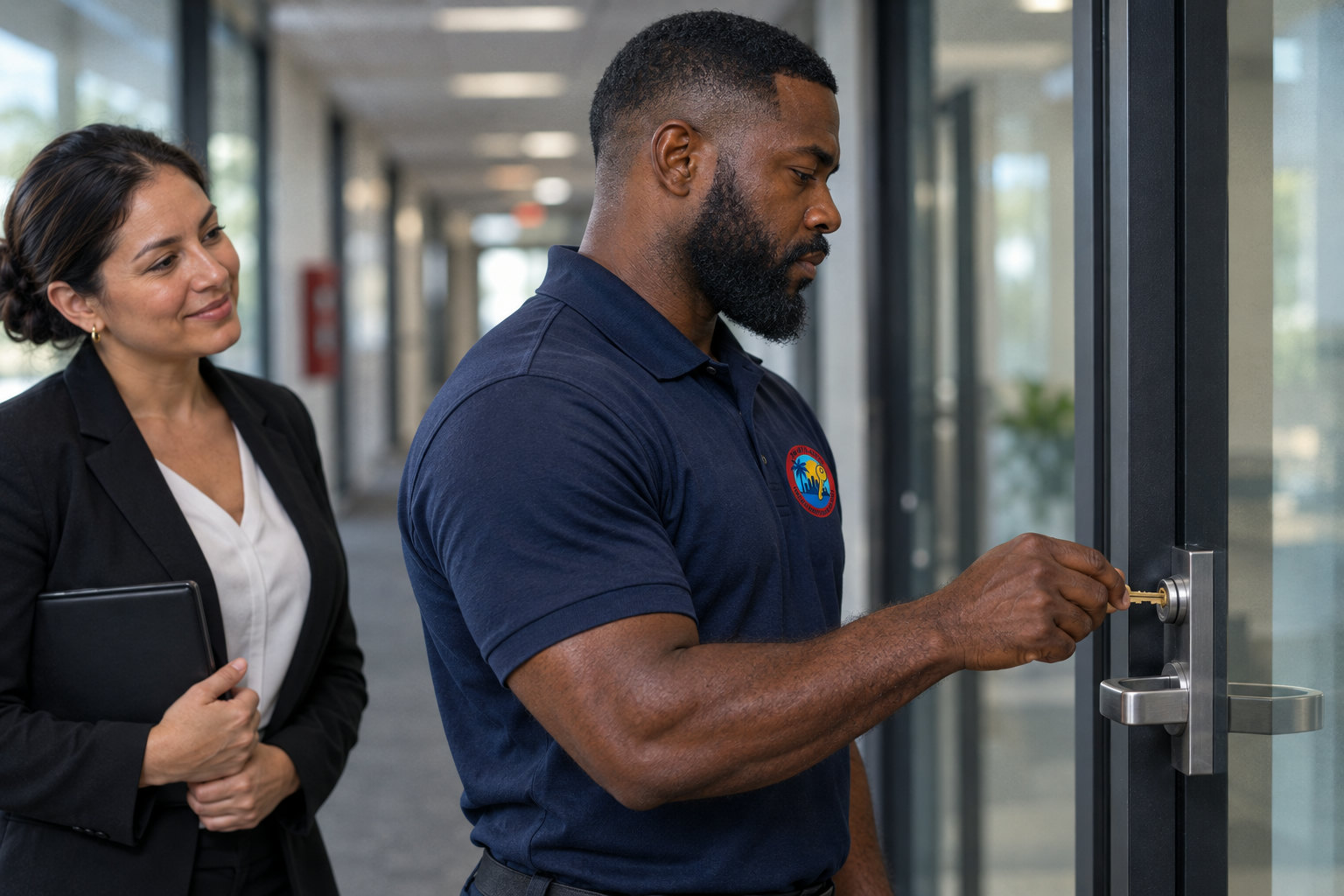
A thorough office move-out rekey covers every lock the old tenant could open, not just the front door. Commonly missed are key-override cylinders on panic bars, mortise cylinders on back-of-house doors, server and storage closets, restroom locks, file cabinets and desk pedestals. Any keypad or card reader on the suite matters too.
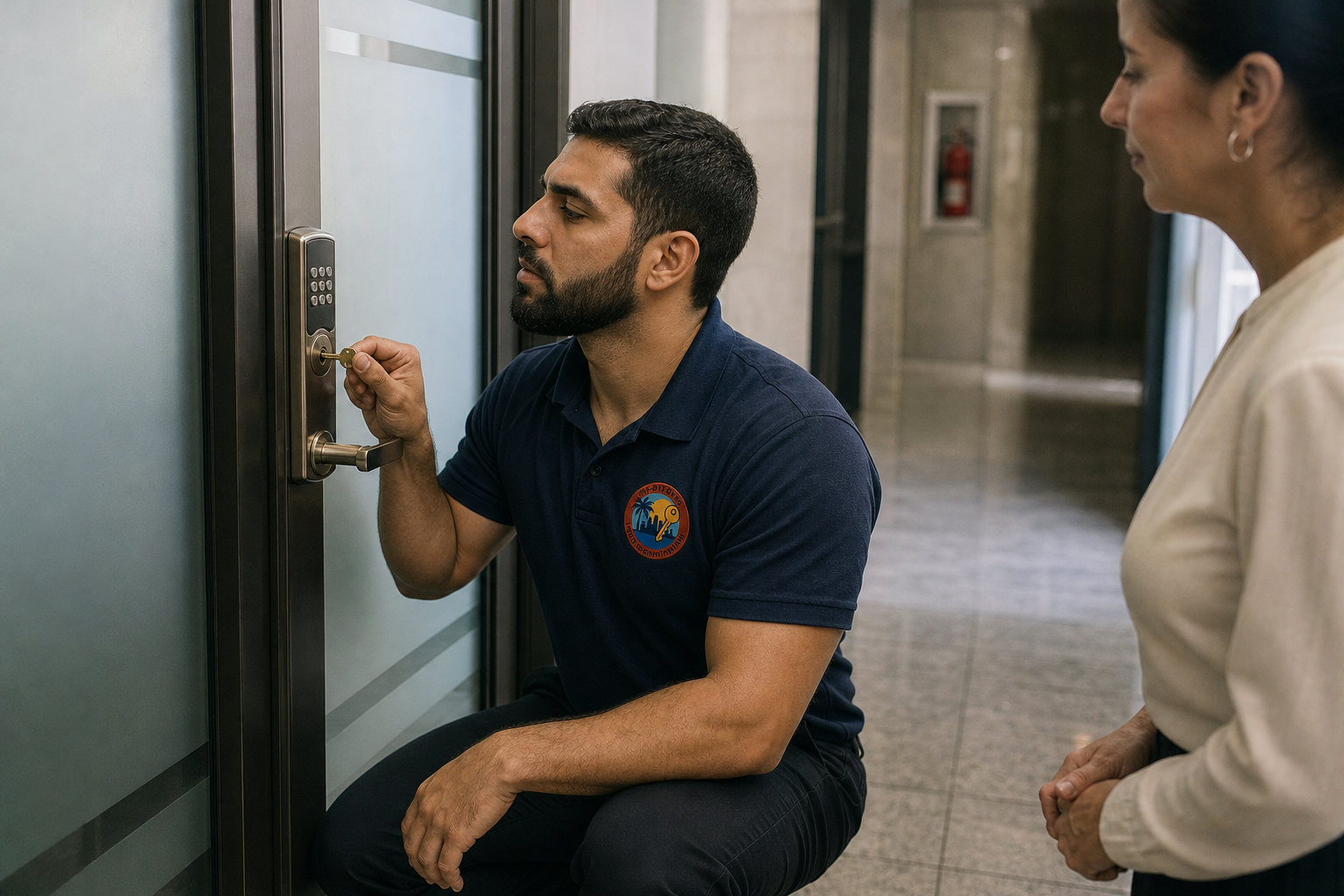
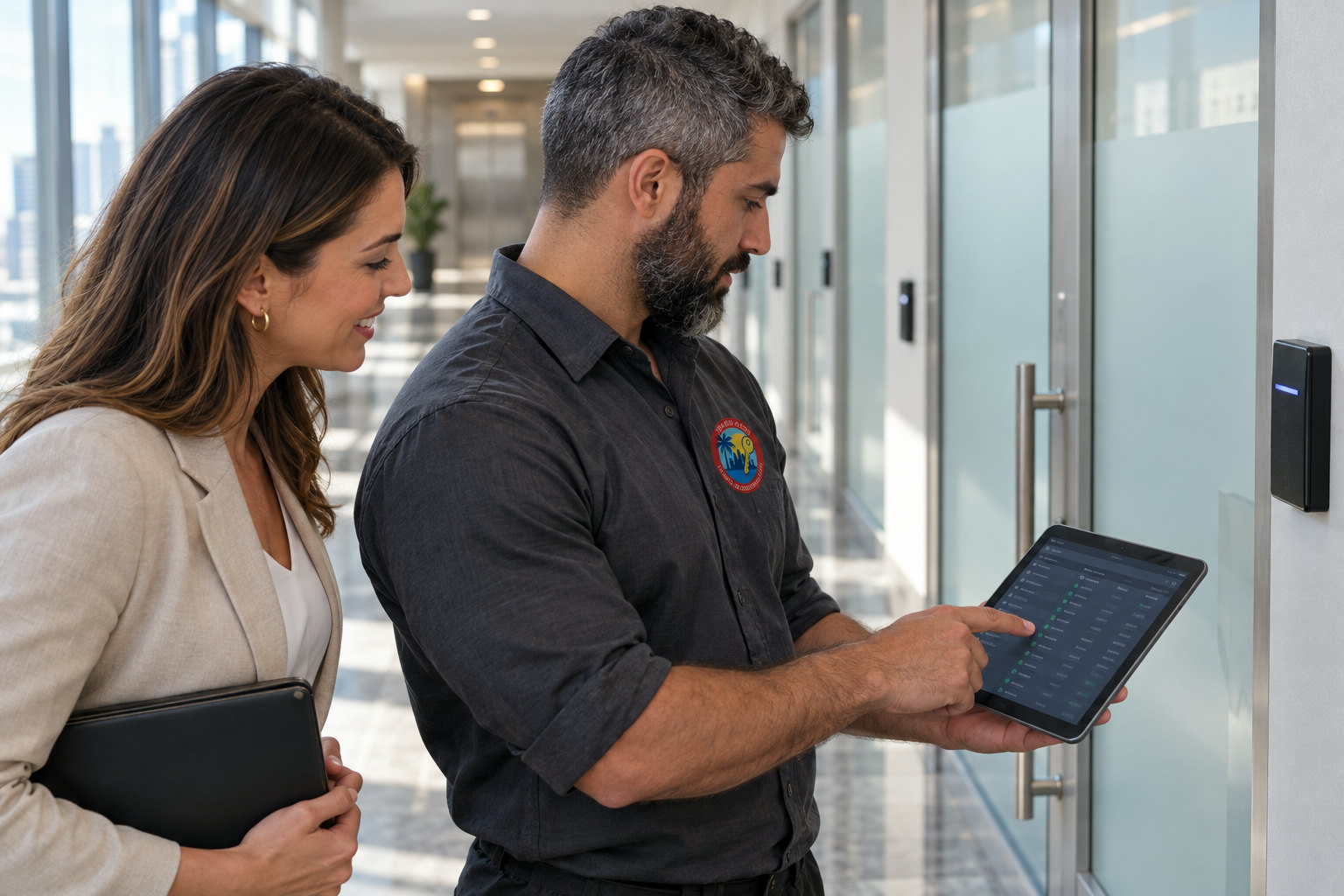
Electronic locks are a two-part job. Delete the old tenant’s codes, cards and cloud user accounts, then rekey the mechanical override cylinder that almost every keypad lock still carries. A deleted code does nothing if the backup key is still on someone’s ring.
A clean turnover follows a predictable order:
Walk the suite with a door list
List every lock: entry, interior offices, closets, exit devices, cabinets and anything with a keypad.
Clear electronic credentials
Remove the old tenant’s keypad codes, cards and cloud users before any mechanical work starts.
Rekey the perimeter first
Suite entry and any exterior or corridor doors come first, matched to the building master if one exists.
Work inward to interior locks
Offices, closets, restrooms and cabinets follow, and any worn cylinder found along the way gets replaced.
Test from both sides
Every new key gets tried, and every exit door is checked to open from the egress side without a key.
Start a signed key log
Issue new keys by name and signature, so the next move-out starts with an accurate list.
Who decides and who pays: the lease
Commercial leases in Florida are mostly governed by their own terms, so the lease usually decides who changes the locks at turnover and who covers the work. Many leases reserve the building master and the exterior doors for the landlord, while the tenant controls interior suite locks. Some make the outgoing tenant responsible for returning keys and paying for a rekey if they cannot.
Read the clause before you book. If you’re the incoming tenant, ask the landlord in writing whether the suite was rekeyed after the last occupant left. If it wasn’t, ask whether you can arrange it yourself without breaking the building’s master key system.
When the Answer Is Different
Replacing office locks instead of rekeying them is the better choice in a handful of specific situations. Each comes down to the hardware’s condition, the code, or the building itself.
The cylinder is worn or corroded. South Florida humidity works its way into lock internals over time. A cylinder that needs jiggling, a key that sticks or a latch that drags is telling you that rekeying would only put new pins into a failing part. Replace it.
Someone forced the door. If the old tenant left without returning keys and someone pried at the door to get in, the lock and possibly the frame are damaged. A common mistake is reaching for a pry bar before calling a locksmith. Forcing a stuck lock usually turns a simple lock job into lock work plus frame or jamb repair, and that bill is bigger than the lockout ever was.
The hardware isn’t accessible. Round knobs on public-facing office doors fall short of the 2010 ADA Standards for Accessible Design, which call for operable parts usable with one hand and no tight grasping, pinching or twisting of the wrist. Door hardware must also be mounted 34 to 48 inches above the finish floor. A turnover is the cleanest time to swap knobs for Schlage or Yale commercial levers.
An exit door locks the wrong way. NFPA 101, the Life Safety Code that Florida adopts through the Florida Fire Prevention Code, generally requires egress-side door hardware to open without a key, tool or special knowledge. If the old tenant added a double-cylinder deadbolt or a chain to an exit door, that hardware needs to come off, not get rekeyed.
The building is historic. Coral Gables has a long-standing historic preservation program, and exterior alterations on locally designated properties generally go through the city’s review. A rekey changes nothing visible, so it sidesteps that question entirely. Replacing an exterior door or its visible hardware on a designated building is worth checking with the city first.
The master key system is lost or compromised. If nobody can produce the key schedule, or a master key walked out with a tenant, rekeying one suite is a patch. A new master key system designed around Medeco, Mul-T-Lock or Schlage restricted cylinders is the real fix.
The tenant took hardware they owned. Some tenants install their own keypad locks or high-security cylinders and remove them at move-out. In that case there is nothing to rekey. The door needs new hardware before the next tenant can secure it.
Our view
Our opinion is that office managers tend to overweight the lock brand and underweight key control. A rekeyed standard cylinder and a brand-new standard cylinder offer the same protection against copied keys: very little. If copies are the worry, the money belongs in a restricted keyway on the perimeter doors, not in shiny new levers throughout the suite.
The second thing that matters more than people expect is paperwork. A signed key log and a known key schedule make the next move-out a fast rekey instead of a guessing game. Rekeying or replacing locks after an office tenant moves out is routine work. Not knowing which keys exist is what turns it into a project.
Our last point: do the work before the new tenant gets keys, not after. A rekey done on handback day costs the same as one done a month later, and it closes the window where two parties could both open the same door.
Frequently Asked Questions
How long does it take to rekey an office suite?
Rekeying an office suite with standard Schlage, Yale or Kwikset cylinders is usually finished in a single visit on the same day. The timeline stretches when the suite sits inside a master key system and the key schedule has to be located first. It also takes longer when high-security Medeco or Mul-T-Lock cylinders are involved, since those keys go through an authorized dealer.
Can a locksmith rekey a lock without the original key?
A commercial locksmith can rekey most pin-tumbler locks without the original key by opening the lock non-destructively, then removing and repinning the cylinder. High-security cylinders from Medeco, Mul-T-Lock and ASSA Abloy are built to resist that. They may need replacement or work through the system’s authorized key records instead.
Do we need to rekey if the tenant returned all their keys?
Rekeying after a tenant returns all their keys is still the safe move, because standard keys can be copied without your knowledge. A “Do Not Duplicate” stamp does not stop a copy from being cut. Changing the pins is the only step that guarantees every outstanding key stops working the day the suite is handed back.
Should the landlord or the new tenant change the locks?
Who changes the locks between commercial tenants is set by the lease, and in Florida commercial leases are largely governed by their own terms. Landlords commonly control the building master and exterior doors, while tenants may handle interior suite locks. Either way, coordinate so the rekey fits the existing master key system rather than breaking it.
Sources
- ADA requirements for door hardware operation and mounting height (2010 ADA Standards, sections 309.4 and 404.2.7) – U.S. Access Board, ADA Accessibility Standards
- Egress door hardware operable without a key, tool or special knowledge – National Fire Protection Association (NFPA 101, Life Safety Code)
- Restricted, patented key control on high-security cylinders – Medeco
- Historic preservation review for designated properties – City of Coral Gables
Have a similar question about your office locks? Whether you’re handing back a suite, taking one over, or managing a whole building in Coral Gables, call (786) 813-0495 and describe your doors, your cylinders and your master key situation. I Need Locksmith Miami runs 24/7 mobile commercial service across Miami-Dade and can tell you, door by door, which locks to rekey and which to replace. Ask for pricing on the call.
I Need Locksmith Miami
I Need Locksmith Miami is a Miami-Dade locksmith and door specialist serving residential, commercial, and automotive customers.
- A Brickell Office Manager Asked a Locksmith in Miami: “Who Should Be Able to View Card Reader Entry Logs in a Multi Tenant Office?”
- A Medley Office Manager Asked a Commercial Locksmith in Miami: “What Type of Lock Is Best for a Multi-Tenant Office When Tenants Keep Copying Shared Keys?”
- A Hialeah Office Manager Asked: “Will Our Multi Tenant Door Unlock During a Power Outage?” What Maglock and Electric Strike Wiring Means for Access Control
- A Wynwood Business Owner Asked: “Can You Rekey My 6 Office Locks Without Replacing the Hardware?” — The Full Answer
- A Bay Harbor Islands Property Manager Asked: ‘Can a Locksmith in Miami Install a Biometric Reader on an Existing Commercial Door Frame?’, A Tech’s Direct Answer