Last updated: August 21, 2026
Published August 21, 2026 · Updated August 21, 2026
An ada compliant door closer installation kendall miami medical office dorma job comes down to two numbers you can measure with a pull gauge and a stopwatch: no more than 5 pounds of opening force on an interior hinged door, and a sweep from 90 degrees down to 12 degrees that takes at least 5 seconds. Everything else – the arm, the mounting plate, the backcheck valve – exists to protect those two numbers. Most failed closers we service in Kendall aren’t broken. They were never tuned.
- ADA’s 2010 Standards cap interior hinged-door opening force at 5 lbf (§404.2.9) and require the closer sweep period from 90° to 12° to take at least 5 seconds (§404.2.8.1).
- The Dorma TS 93 is a cam-action closer with EN size 1-5 adjustability – the cam geometry is why it can hit 5 lbf on a heavy medical-office entry that a rack-and-pinion closer can’t.
- Latch speed and sweep speed are separate valves. Slowing the whole door to fix a slam is the most common misadjustment we correct in Kendall offices.
- ADA does not set a maximum opening force for exterior doors – Florida’s accessibility code and the building official do. In Miami-Dade’s hurricane zone, that changes the hardware conversation.
- Budget realistically: a Grade 1 commercial closer supplied and installed typically lands in the $450 – $750 range in Miami-Dade. If the frame is already torn up, add 30-50% for structural repair.
A note on how this is written: this is a composite walkthrough of the job we run most often in Kendall medical plazas – not a single named client. The hardware, the code numbers, the sequence, and the mistakes are all real and repeatable. The office is typical, not specific.
What We Found
Door closer diagnosis at a Kendall pediatric office starts before anyone touches a screwdriver. We open the door slowly and listen. A tired closer announces itself – a dry gasp on the backcheck, then a hard metallic crack as the latch speed dumps the last 10 degrees. In this case the door made that sound every ninety seconds, all afternoon, with a lobby full of toddlers who flinched every time.
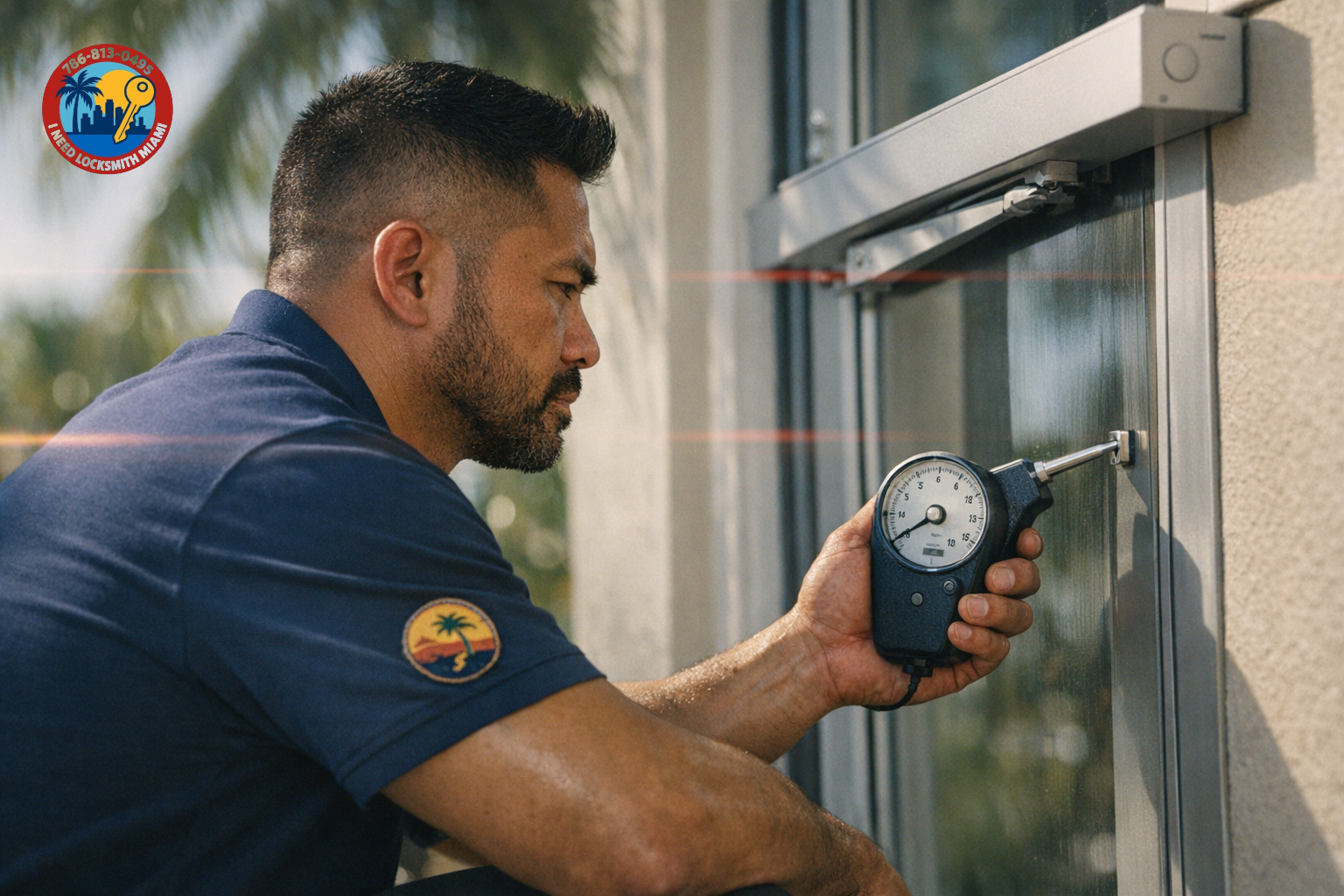
The pull gauge told the rest. Roughly 13 to 14 pounds of force at the pull side – nearly triple the 5 lbf ceiling the 2010 ADA Standards set for interior hinged doors. A parent with a stroller in one hand and a diaper bag in the other simply cannot open that door. Neither can a kid on crutches, which in a pediatric practice is not a hypothetical.
Three findings mattered:
- The closer body was weeping oil. Once a closer seal fails, adjustment is theater. Hydraulic fluid on the door face is a replacement signal, not a service signal.
- The valves had been closed to compensate. Whoever came before us screwed both the sweep and latch valves nearly shut. That doesn’t slow the door – it starves the return and spikes opening resistance.
- The top hinge was sagging. About 3/32″ of drop at the strike edge, enough that the door dragged the frame on the final inch. The closer was fighting friction, not just spring tension.
That last one is the part national blog content misses. If you swap the closer and leave the sag, you get a beautiful new Dorma that still can’t hit 5 lbf, because the door is binding. We’ve seen offices replace a closer twice before someone put a level on the hinge stile.
A door that pulls at 13-14 lbf and still slams is almost never a “closer strength” problem. It’s a failed seal plus over-tightened valves plus geometry. Fix all three or you’ll be back in six weeks.
How We Solved It
The Dorma TS 93 door closer installation on this Kendall medical office entry took a single visit, scheduled between the practice’s morning and afternoon blocks so the waiting room stayed usable. Here’s the exact sequence.
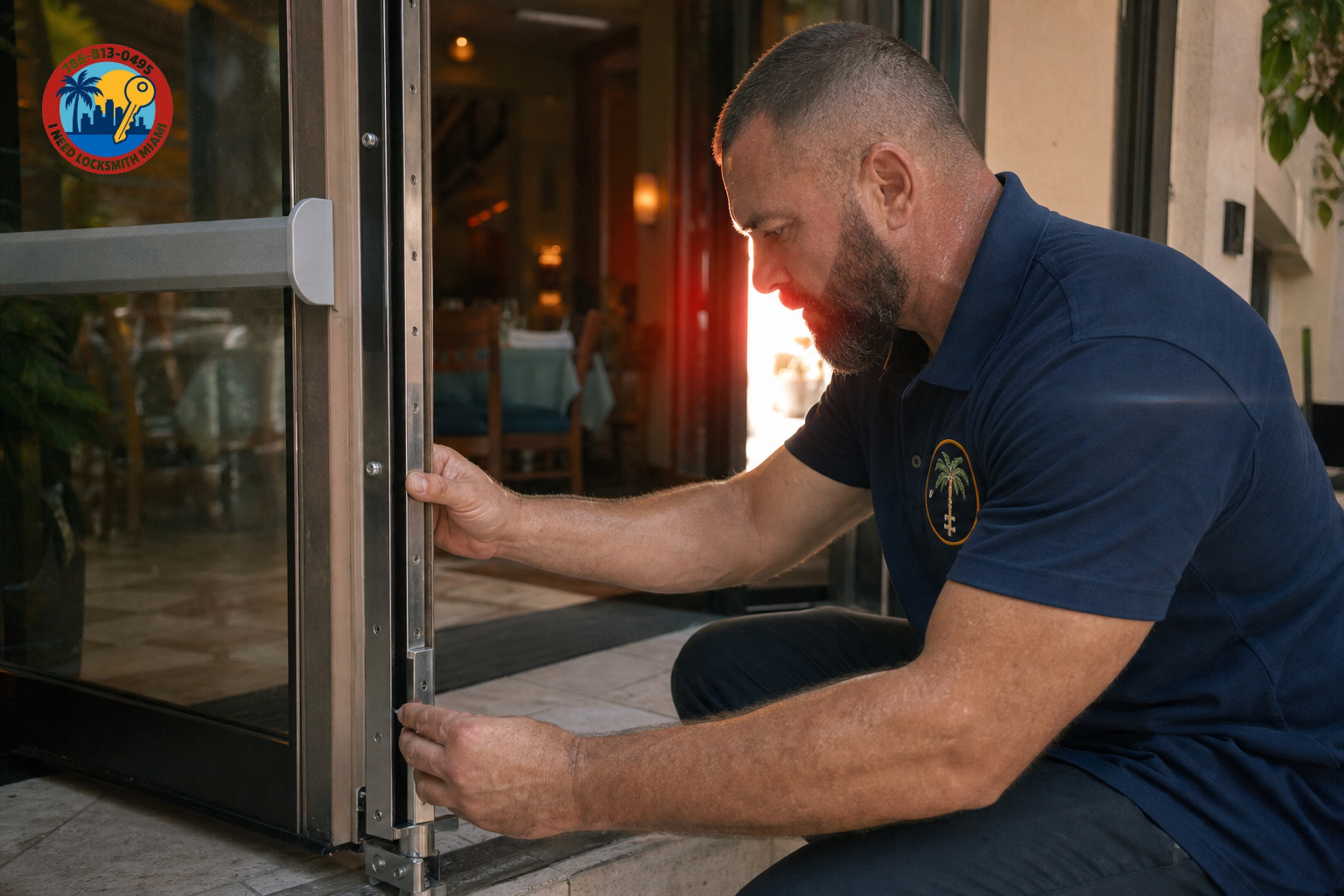
- Corrected the hinge sag first. We reset the top pivot/hinge, replaced two stripped machine screws with longer fasteners biting fresh material in the jamb, and confirmed a consistent 1/8″ gap at the strike edge. The door swung free before any closer went back on.
- Removed the leaking closer and cleaned the mounting area. Old fluid on an aluminum door face doesn’t wipe off with glass cleaner. Degreaser, then a dry pass, so the new closer’s mounting plate seats flat instead of on a film.
- Mounted the Dorma TS 93 in regular-arm configuration on the pull side. The TS 93 is a cam-action closer with EN size 1-5 adjustability – that cam geometry is precisely why it can deliver low opening force at the beginning of the swing while still holding enough closing power at the latch. A conventional rack-and-pinion closer set strong enough to shut this door reliably would blow past 5 lbf on the pull.
- Set the spring size down, not up. Field instinct says “heavier door, bigger spring”. On an interior corridor door with no wind load, we started at the low end of the EN range and only climbed if the door failed to latch. It latched. We left it there.
- Tuned sweep speed and latch speed as separate valves. Sweep controls roughly 90° to 12°. Latch controls the last stretch into the frame. We timed the sweep with a stopwatch against the ADA minimum of 5 seconds and landed comfortably above it, then opened the latch valve just enough to seat the door – firm, not violent.
- Dialed in backcheck. Backcheck cushions the door before it can hit the corridor wall. In a pediatric waiting room where doors get shoved open by a shoulder while both hands are full, this is the setting that saves drywall and fingers.
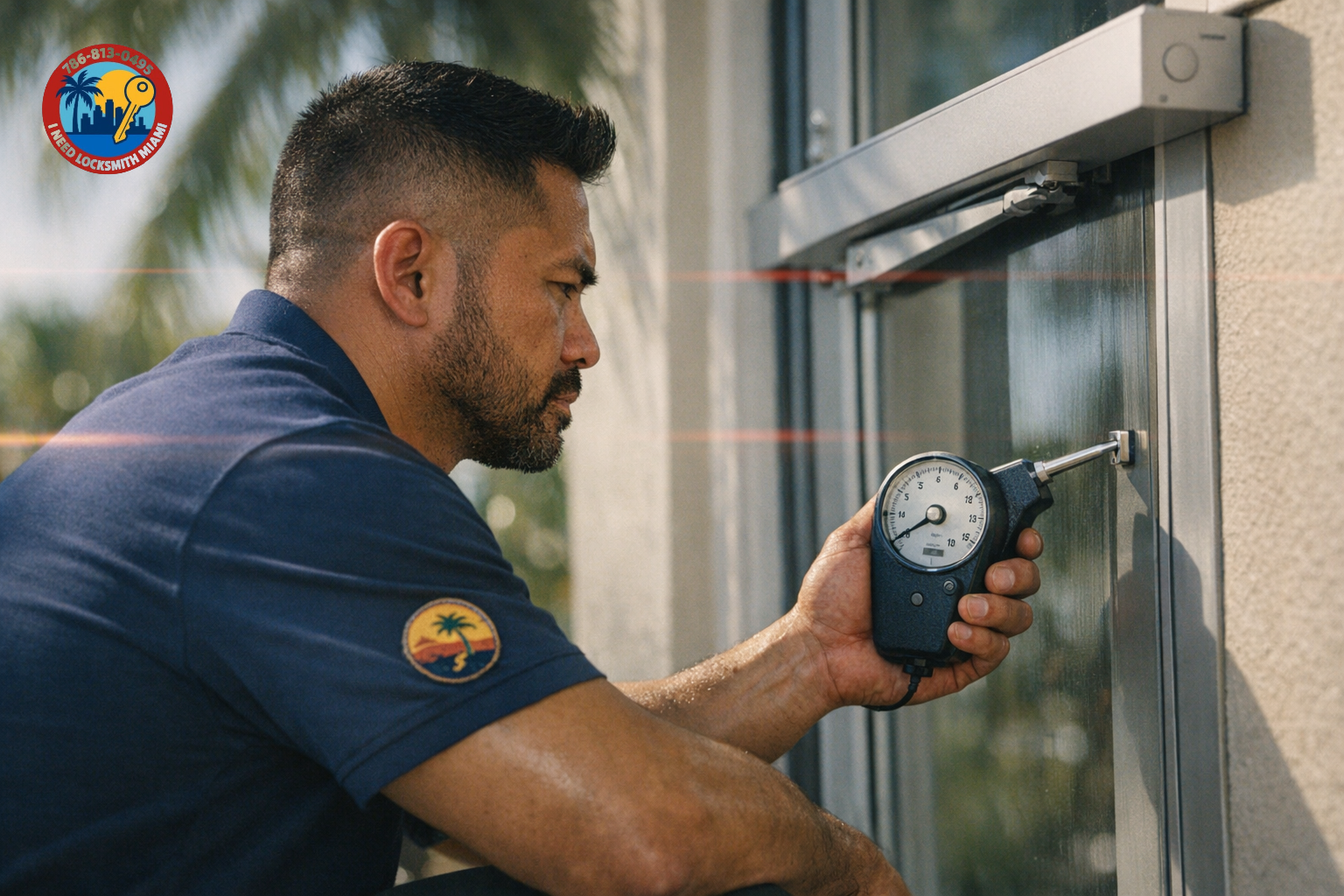
- Verified opening force with a door pressure gauge. Pull side, gauge at the latch edge, measured at the point of maximum resistance. Under 5 lbf, documented for the practice’s file.
- Checked the rest of the ADA hardware chain. Lever operable without tight grasping or wrist twisting, mounted within the 34-48 inch range, plus a clean threshold with no lip to catch a stroller wheel. A code-compliant closer above a non-compliant lever is still a non-compliant door.
“Nine times out of ten, when a medical office tells us their door ‘closes too fast,’ the actual problem is that someone slowed the sweep valve to fix a latch-speed slam. The door now takes eight seconds to drift shut and still bangs. Two valves, two jobs – and a stopwatch settles the argument faster than any opinion does.” – I Need Locksmith Miami Team
The numbers we tune to
| Measurement | Code target | Typical failing reading | After TS 93 install |
|---|---|---|---|
| Opening force, interior hinged door (pull side) | 5 lbf max – ADA §404.2.9 | 12-15 lbf | Under 5 lbf, gauge-verified |
| Sweep period, 90° to 12° | 5 seconds minimum – ADA §404.2.8.1 | 2-3 seconds (or 10+ if over-throttled) | Comfortably above 5 seconds |
| Latch speed | Positive latch, no slam | Hard crack against the stop | Firm seat, audible click only |
| Operable hardware height | 34-48 in. above finished floor – ADA §404.2.7 | Usually compliant, rarely checked | Verified and documented |
| Strike-edge gap / door sag | Even gap, no binding | 1/16-1/8 in. drop, dragging | Reset, free swing |
What This Means for Kendall Medical Offices
If you’re the office manager at a Kendall pediatric, dental, or physical therapy practice and your entry door slams hard enough to startle patients, you are not looking at a cosmetic annoyance – you’re looking at a door that almost certainly fails the 5 lbf opening-force test at the same time. The two symptoms travel together. A closer strong enough to slam is a closer heavy enough to exclude someone with a mobility device.
Second lesson, and this one is specific to Miami-Dade: ADA’s 5 lbf ceiling applies to interior hinged doors. The 2010 Standards deliberately leave exterior door opening force to state and local codes, because wind and weather-sealing make a universal number impractical. Here in the High-Velocity Hurricane Zone, your exterior storefront entry may carry impact-rated hardware and product-approval requirements that shape which closer can legally hang on it. The honest answer for exterior doors is often a low-energy automatic operator rather than a manual closer – it’s the only way to reconcile a heavy impact-rated door with genuine accessibility.
Third: HVAC pressure. Medical suites run positive or negative pressure relative to the shared corridor, and that pressure differential fights your closer all day. A door that latches perfectly at 7 a.m. with the air handlers idling can fail to latch at 2 p.m. We check latch performance with the system running, not with the building asleep. Honestly, we didn’t take this seriously until a callback taught us to – the door had been fine at final walkthrough and stopped latching by mid-morning.
The three mistakes that make this job expensive
Calling after the frame is already damaged
Months of slamming tears out closer anchors and splits jambs. When structural repair has to happen alongside the hardware work, costs jump 30-50% over a straight closer swap. The slam is the warning; the frame damage is the bill.
Buying a heavier closer to “make it shut”
Upsizing the spring is how a compliant door becomes non-compliant. If the door won’t latch, the cause is usually sag, a misaligned strike, or air pressure – not insufficient spring power.
Ignoring hardware turnover when the door gets touched
Practices swap front-desk and clinical staff constantly. If nobody rekeys after turnover, you’ve created a security gap and liability exposure sitting behind a perfectly compliant door. Rekeying while we’re already on site is the cheapest it will ever be.
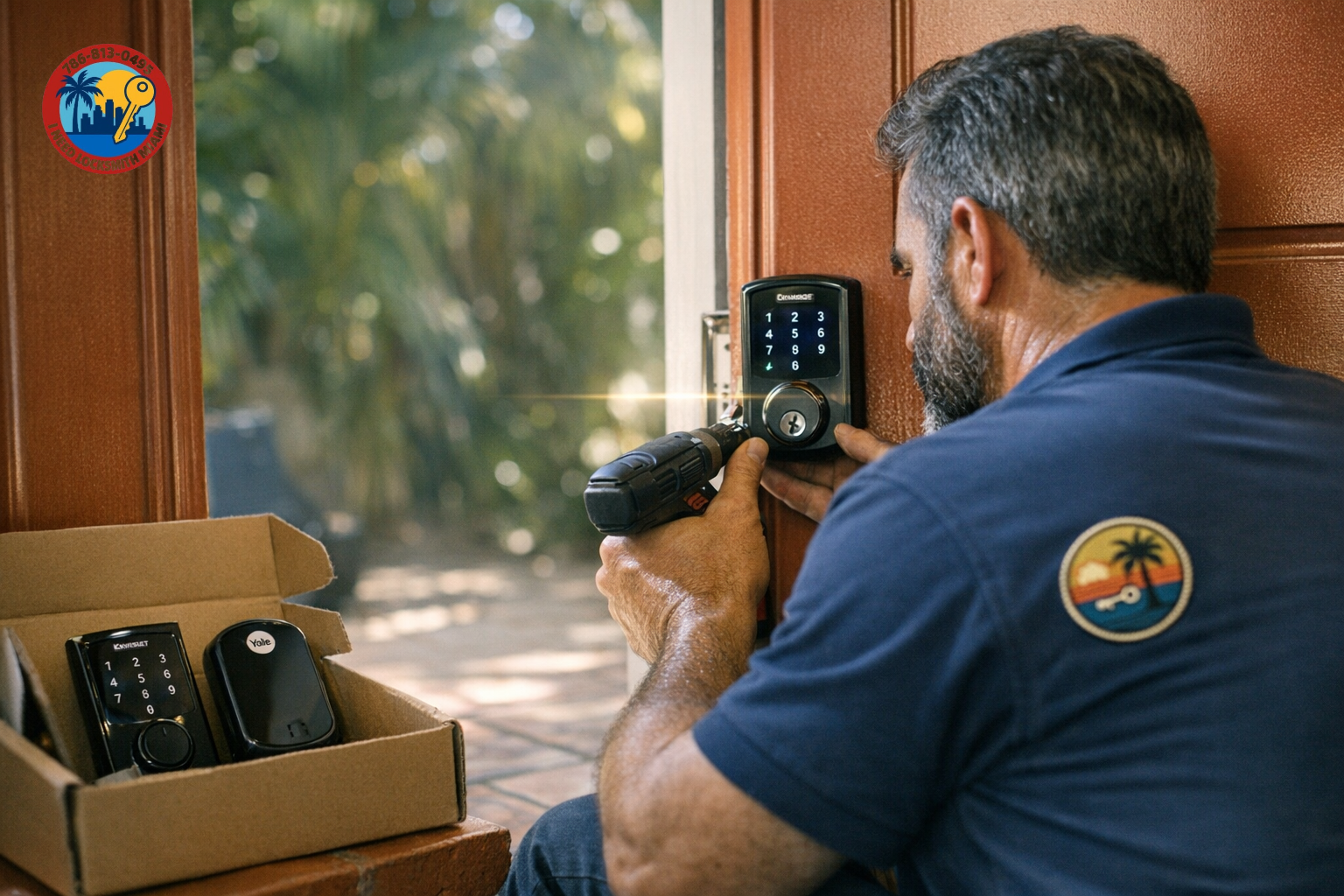
On budget: a Grade 1 commercial surface closer supplied and installed typically runs in the $450 – $750 range in Miami-Dade depending on arm configuration and whether the frame needs prep. Adjacent work often bundled the same visit – a commercial rekey or master key system at $120 – $180 per door, a Schlage or Yale deadbolt at $150 – $220, or a keypad access control unit at $250 – $400 for the staff-only corridor door. One trip, one disruption to your schedule.
And if your practice runs a frameless glass entry rather than aluminum, the closer conversation shifts entirely to floor closers and patch fittings – that’s glass door hardware territory, and the adjustment points live in a different place. Same code numbers, different machine.
Which closer for which door
We install Dorma, LCN, and Norton depending on the opening, and none of them wins every situation. Cam-action closers like the Dorma TS 93 earn their price on doors where low opening force is non-negotiable – accessible interior entries, pediatric and geriatric practices, restrooms. LCN 4040-series units are the workhorse when abuse resistance matters more than a low pull, like a warehouse or a high-traffic back-of-house door. Norton is frequently the right call when you need a specific hold-open or delayed-action behavior on a moderate-traffic opening. Choosing on brand loyalty instead of door behavior is how offices end up paying twice.
FAQ
How slow does an ADA door closer actually have to close?
ADA door closer sweep speed must take a minimum of 5 seconds to travel from an open position of 90 degrees to 12 degrees from the latch, per Section 404.2.8.1 of the 2010 ADA Standards. That’s the sweep range only – the final 12 degrees is governed by the separate latch-speed valve and is allowed to move faster so the door actually seats. We verify it on-site with a stopwatch, not by feel.
Can I just adjust my existing closer instead of replacing it with a Dorma TS 93?
Adjusting an existing closer works when the body is dry and the door swings free – a 15-minute valve tune can bring a door from a slam back into the 5-second sweep window. It does not work once hydraulic fluid is visible on the door face or closer body, because a failed seal means the valves no longer control anything predictably. Oil on the door is a replacement signal, and no amount of dialing fixes it.
Does the 5-pound opening force rule apply to my Kendall office’s exterior storefront door?
The 5 lbf maximum in ADA Section 404.2.9 applies to interior hinged doors, sliding doors, and folding doors – the 2010 Standards do not set a maximum for exterior hinged doors, leaving that to state and local code. In Miami-Dade’s High-Velocity Hurricane Zone, impact-rated exterior doors and weather-sealing frequently make a manual closer impractical for genuine accessibility, which is why a low-energy automatic operator is often the correct specification for a medical office main entrance.
How long does a door closer installation take at a working medical practice?
A straightforward Dorma TS 93 replacement on an existing prepped door in Kendall takes roughly 60 to 90 minutes including gauge verification and sweep timing. Add time if the door is sagging, the frame needs new anchor points, or the closer footprint doesn’t match the old drill pattern. We schedule these between patient blocks so the door stays operable and the waiting room never closes.
Sources
- Opening force (§404.2.9), closing speed (§404.2.8.1), and operable hardware height (§404.2.7) requirements – 2010 ADA Standards for Accessible Design, ADA.gov
- Technical guidance on accessible doors, doorways, and door hardware – U.S. Access Board, Chapter 4: Doors and Gates
- Dorma TS 93 cam-action closer specifications and EN size range – dormakaba Americas
- Service area, pricing ranges, and on-site verification practices – I Need Locksmith Miami
I Need Locksmith Miami
I Need Locksmith Miami is a Miami-Dade locksmith and door specialist serving residential, commercial, and automotive customers. Serving Kendall, Doral, Coral Gables, Brickell, Miami Beach and all of Miami-Dade. Call (786) 813-0495.