Last updated: September 26, 2026
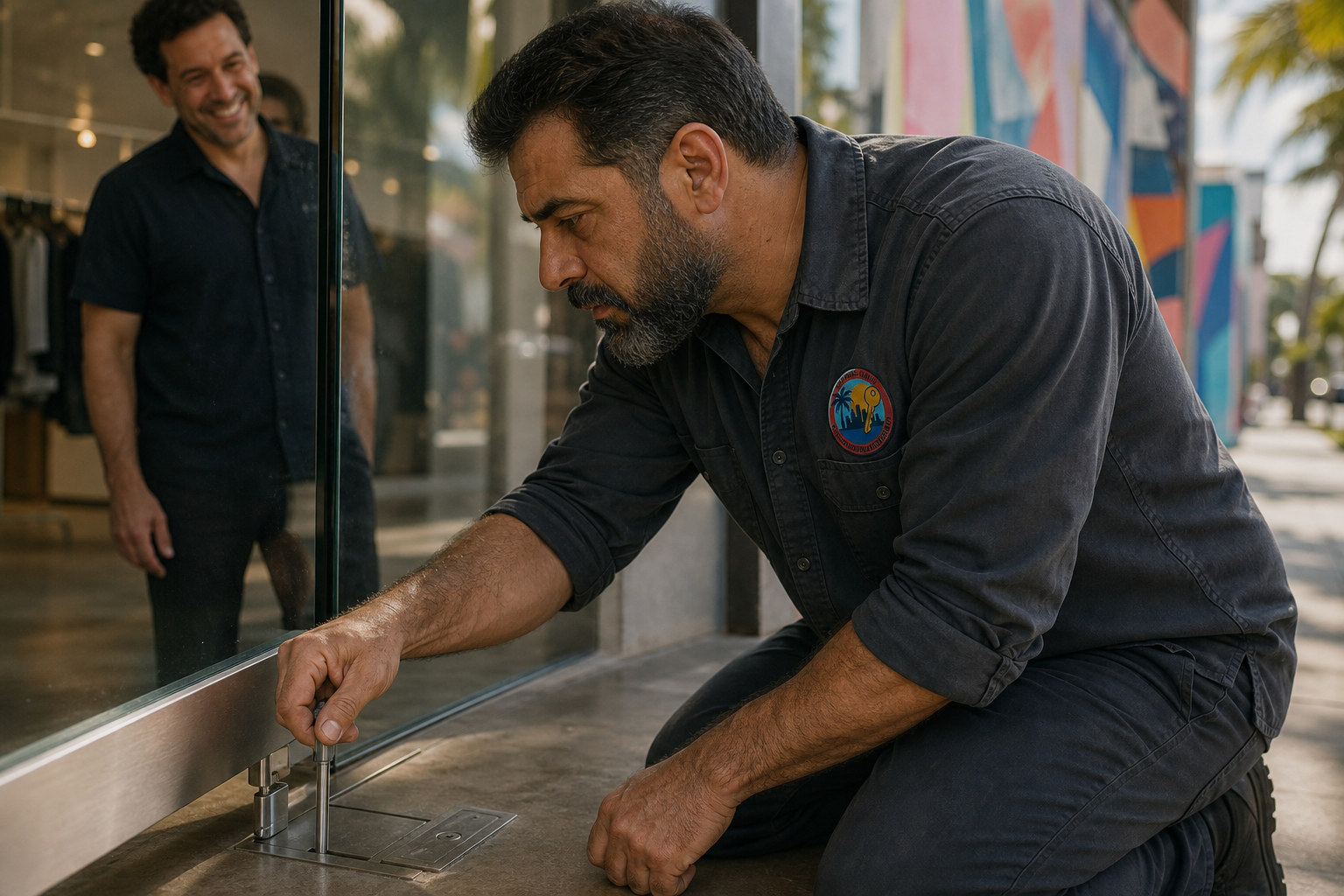
A glass storefront door rail replacement by a locksmith in Miami’s Wynwood, start to finish, typically runs in two stages. The first is a measure-and-inspect visit. The second is an install visit, where the frameless door comes off its floor closer, the old rail is stripped from the 1/2-inch tempered glass, and a matching C.R. Laurence (CRL) or dormakaba rail is clamped on and rehung, usually within a few hours. The surprising part is that the rail is rarely what failed first. In our experience, a floor closer that has lost its hydraulic control is usually what shook the rail loose.
- Tempered glass cannot be cut, drilled or re-edged after tempering, so a rail replacement on a frameless storefront door succeeds only if the original panel’s edges and corners are free of chips.
- A bottom rail that loosens on a Wynwood storefront door is most often a symptom of a failing floor closer, such as a Rixson or dormakaba BTS unit, that lets the door slam.
- Under the 2010 ADA Standards, section 404.2.10, a stileless tempered glass door can skip the 10-inch smooth bottom surface rule only if its bottom rail has a top edge tapered at 60 degrees or more.
- A standard 3-by-7-foot entrance door in 1/2-inch tempered glass weighs well over 100 pounds, which is why removal takes two people and vacuum glass lifters.
- In our field experience, costs jump 30-50% when structural repair is needed alongside the hardware work, which is exactly what happens when a loose rail is left in daily use.
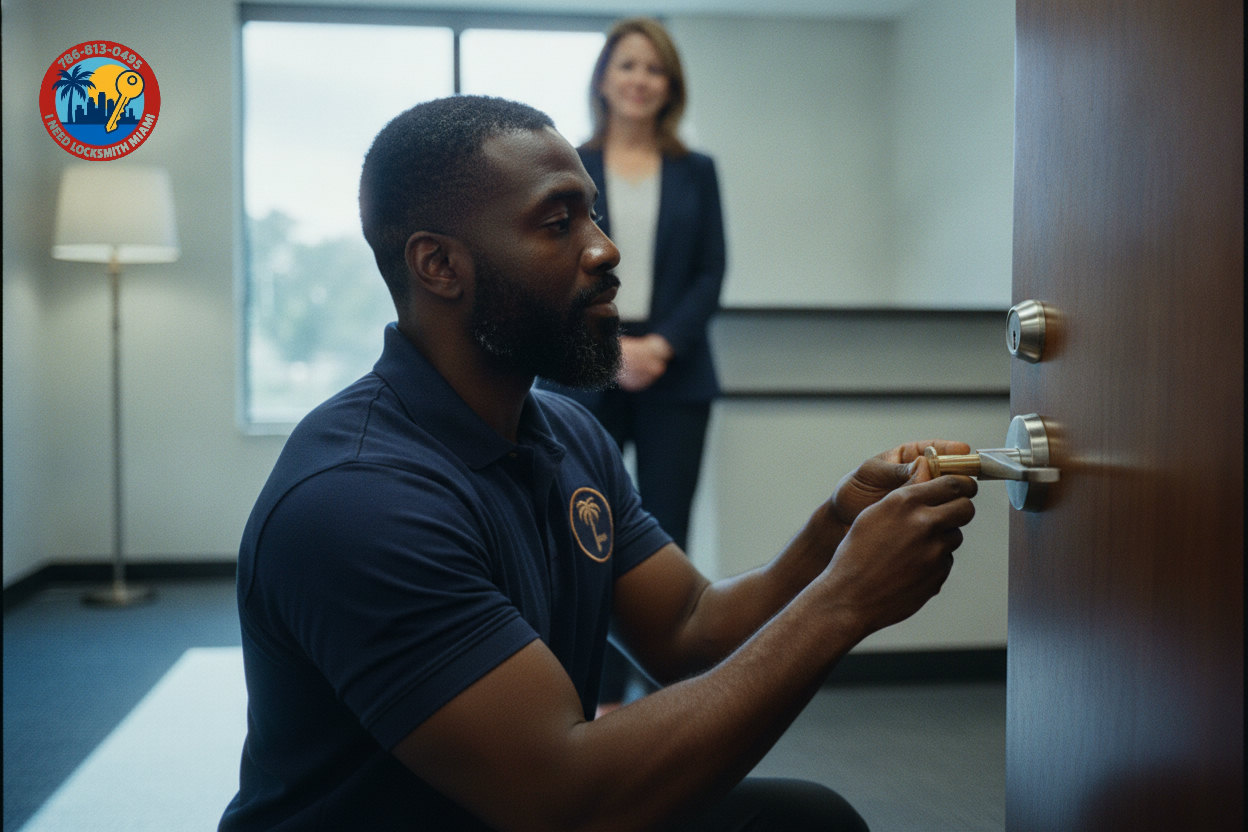
- The new bottom rail is the right moment to fit a Medeco or Mul-T-Lock mortise cylinder and rekey after staff turnover.
The call almost always starts with a sound. A glass door that used to swing shut with a soft hydraulic sigh now lands with a metallic tick at the bottom corner, and the glass seems to lean a hair away from the rail.
If you run a gallery, café or boutique with a frameless glass entrance that has started to drag, tick or sit crooked, this walkthrough is for you. It is not written for owners of aluminum-framed narrow-stile doors. Those fail in different ways and get repaired with different hardware.
No single client appears here. This is a composite of the storefront rail job we see constantly in converted warehouse spaces: the same door type, the same failure pattern, and the same sequence of repairs. The details are typical, not invented history.
What We Found: Inspecting a Glass Storefront Door Rail Replacement Job in Wynwood
The inspection of a loose bottom rail on a frameless storefront door starts at the floor, not at the rail. On a typical job the rail has dropped at the heel end near the pivot. A visible gap opens between the glass and the rail’s inner lip, and the glazing vinyl has been squeezed out, chalky and brittle from years of sun on a south- or west-facing entrance.
Then the closer cover plate comes up. After a wet Miami summer, the floor closer box often holds standing rainwater with an oily sheen on top, and the smell of hydraulic fluid rises out of the recess. A closer that has leaked its oil has no latch speed or backcheck left. Every cycle becomes a slam, and those slams work the rail’s clamp screws loose one vibration at a time.
The glass itself is the critical check. With the door still hanging, we run a flashlight along the exposed bottom edge and both lower corners, looking for shells, which are small conchoidal chips in tempered glass. Tempered glass under the federal safety glazing standard for doors (16 CFR Part 1201) is strong across its face but vulnerable at its edges. A chipped corner clamped into a new rail can shatter the whole panel.
The mistake that shows up before we do
A pattern we see often: someone has already tried to fix the rail. Mallet marks on the anodized finish, a stripped clamp screw or a shim jammed between glass and metal all mean the door was worked on before the call. In our field experience, costs jump 30-50% when structural repair is needed alongside the hardware work. On a glass door, a well-meant tap on the wrong corner can turn a rail job into a glass replacement.
Stop using the door. That is the whole lesson. If the rail has moved, lock the door open or closed, route customers through another entrance if you have one, and call before anyone reaches for a hex key.
How We Solved It
A frameless storefront bottom rail replacement follows a fixed sequence, and skipping a step is how a new rail ends up loose again within months. Here is how the typical job goes, from first measurement to final key handoff.
- Measure and document before ordering. We caliper the glass thickness (usually 1/2 inch, sometimes 3/8 or 3/4), measure door width and rail height, and photograph the finish, whether satin anodized, dark bronze or polished stainless. We also note whether the closer is center-hung or offset-hung, because the new rail’s closer arm or pivot insert must match it exactly.
- Order a matching rail from a real storefront hardware line. CRL and dormakaba both make bottom rails for frameless tempered doors. If the original rail had a bottom deadlock, the replacement is ordered with lock prep for a standard mortise cylinder, and we confirm the profile either provides a 10-inch smooth surface or has the 60-degree tapered top edge allowed under ADA section 404.2.10.
- Remove the door with two people and vacuum lifters. The top pivot pin is retracted, the door is tilted clear of the header, and it is lifted off the floor closer spindle. It then gets laid flat on a padded work surface. By midmorning the glass is often warm to the touch from the sun, so we keep the panel off hot concrete.
- Strip the old rail and clean the glass edge. The clamp screws come out in sequence, the rail slides off, and the old glazing vinyl or tape is peeled and scraped away. The bare edge then gets a second, closer inspection under light for shells, since this is the last chance to catch damage before the glass is clamped again.
- Service or replace the floor closer while the door is off. We pump out standing water, check the spindle for play and look for oil weeping from the body. A leaking closer is replaced with a matching unit, such as a Rixson floor closer (an ASSA ABLOY brand) or a dormakaba BTS 75V, because a new rail on a dead closer is money spent twice.
- Glaze and clamp the new rail. The glass is seated on the rail system’s setting blocks or glazing vinyl, centered, and clamped in the manufacturer’s tightening order so pressure spreads evenly along the edge. We check square from rail to glass before the final turn on each screw.
- Rehang and align. The door goes back onto the closer spindle, and the top pivot is re-engaged and checked for smooth travel. We then confirm even clearance at the threshold from heel to toe, since a door that still drags will chew through the new rail’s finish.
- Tune the closer. Sweep speed, latch speed and backcheck are adjusted so the door closes firmly under control, without drifting open in a gust or slamming into its stop.
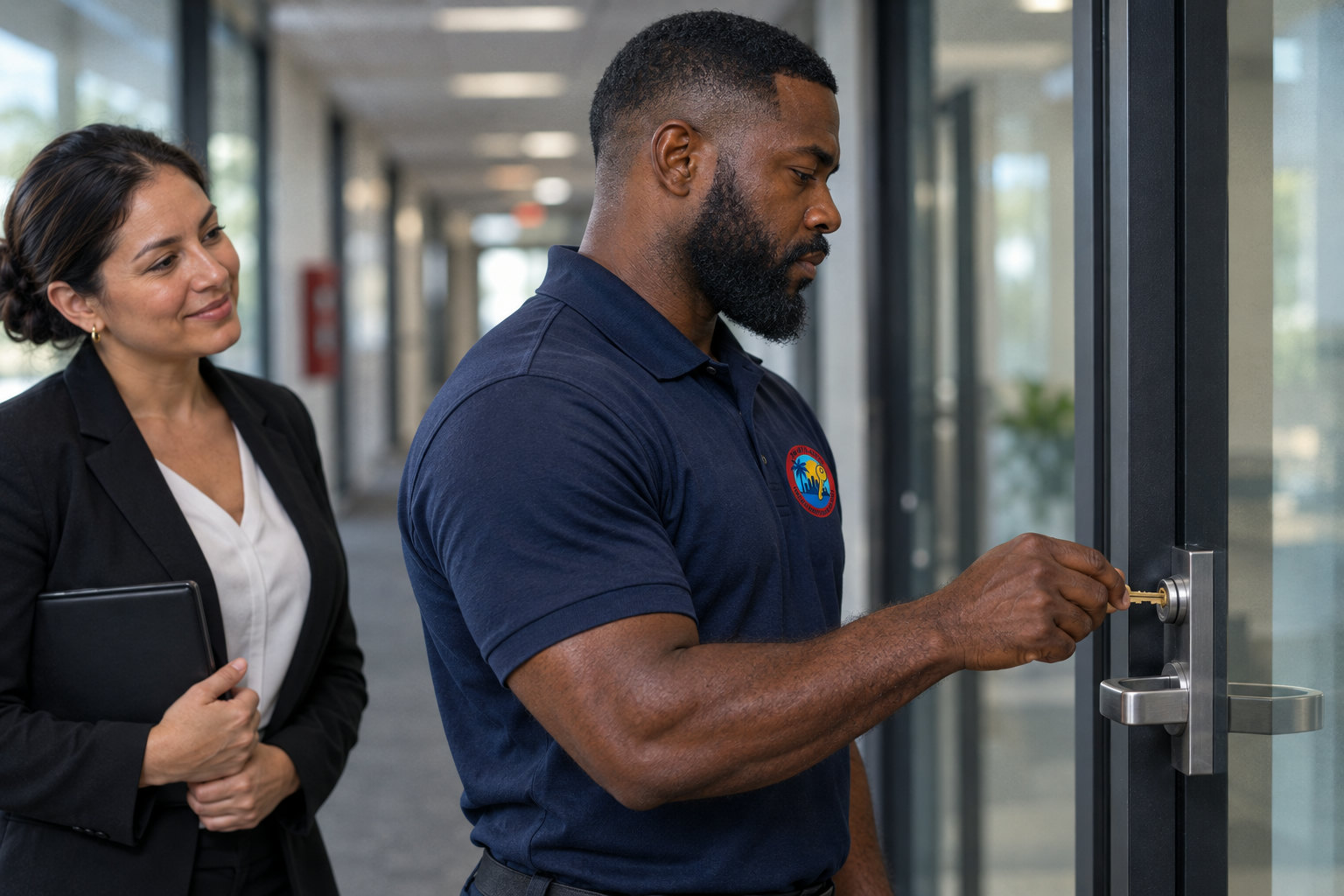
- Fit and key the lock. A new mortise cylinder goes into the bottom rail deadlock, either a Medeco or Mul-T-Lock high-security cylinder, or a Schlage cylinder keyed to the existing system. We then verify the bolt throws fully into the floor keeper and hand over keys.
- Cycle test and walkthrough. The door is opened and closed repeatedly, locked and unlocked, and checked from both sides. The owner sees exactly how it should sound and feel, so a future problem gets noticed early.
A storefront bottom rail replacement means measuring first, removing the door on vacuum lifters, stripping and inspecting the glass edge, and servicing the floor closer before the new CRL or dormakaba rail is clamped on. The door is then rehung, the closer is tuned, and a Medeco, Mul-T-Lock or Schlage mortise cylinder is fitted in the rail lock.
How long does a glass storefront door rail replacement take?
A glass storefront door rail replacement typically takes part of one day on site, because the door comes off only after the matching rail is already in hand. What stretches the calendar is ordering the rail, not the install. Common finishes in stock profiles move quickly, while custom lengths or less common finishes take longer to source.
| Phase | What happens | Effect on your storefront |
|---|---|---|
| Inspect and measure | Glass thickness, rail height, finish, closer type, lock cylinder and edge condition documented | Door stays in service if it can be secured safely |
| Source the rail | Matching CRL or dormakaba profile ordered with lock prep and the correct closer insert | No disruption; timing depends on finish and length |
| Door removal and rail swap | Door lifted off the spindle, old rail stripped, edge inspected, new rail glazed and clamped | Entrance closed; best scheduled before opening or after close |
| Closer service | Water pumped out, spindle checked, closer replaced if leaking | Happens during the same window |
| Rehang, tune and key | Pivot aligned, closer speeds set, mortise cylinder fitted, bolt tested | Door back in service, keys handed over |
Wynwood shops that open late and close late have an advantage here. I Need Locksmith Miami runs 24/7 mobile service, so the door-off window can land in the early morning before gallery crowds arrive.
Should you repair the rail, replace it, or replace the whole glass door?
The choice between repairing a storefront rail, replacing it, or replacing the entire frameless door comes down to the glass edge and the rail’s condition. No single option is right for every door. Each one wins in a specific situation.
| Option | Wins when | Watch out for |
|---|---|---|
| Re-glaze and re-clamp the existing rail | The rail body is straight, clamp threads are intact, and only the glazing vinyl has failed | Stripped screw bosses or a bent rail lip make this a temporary fix |
| Replace the rail (this case study) | The glass edge is clean, but the rail is bent, stripped, pitted, or its lock prep is worn out | The new rail must match the closer type and meet ADA 404.2.10 |
| Replace the full door, glass and rails | The tempered panel has edge chips, cracks, or a delaminated film that cannot be saved | Exterior products in Miami-Dade fall under the Florida Building Code’s High-Velocity Hurricane Zone provisions |
That last row is why we work hard to save a good panel. Replacing a whole storefront door in Miami-Dade raises questions about product approvals and hurricane-zone requirements. A rail swap on a sound panel does not bring that same level of complexity.
Why call a locksmith in Miami for a glass door rail instead of a glazier?
A locksmith in Miami who handles storefront glass hardware covers everything attached to the glass: the rail, the bottom deadlock, the mortise cylinder, the floor closer and the top pivot. A glazier’s core work is the glass itself. When the panel is sound and the failure lives in the hardware, the hardware specialist is the more direct call.
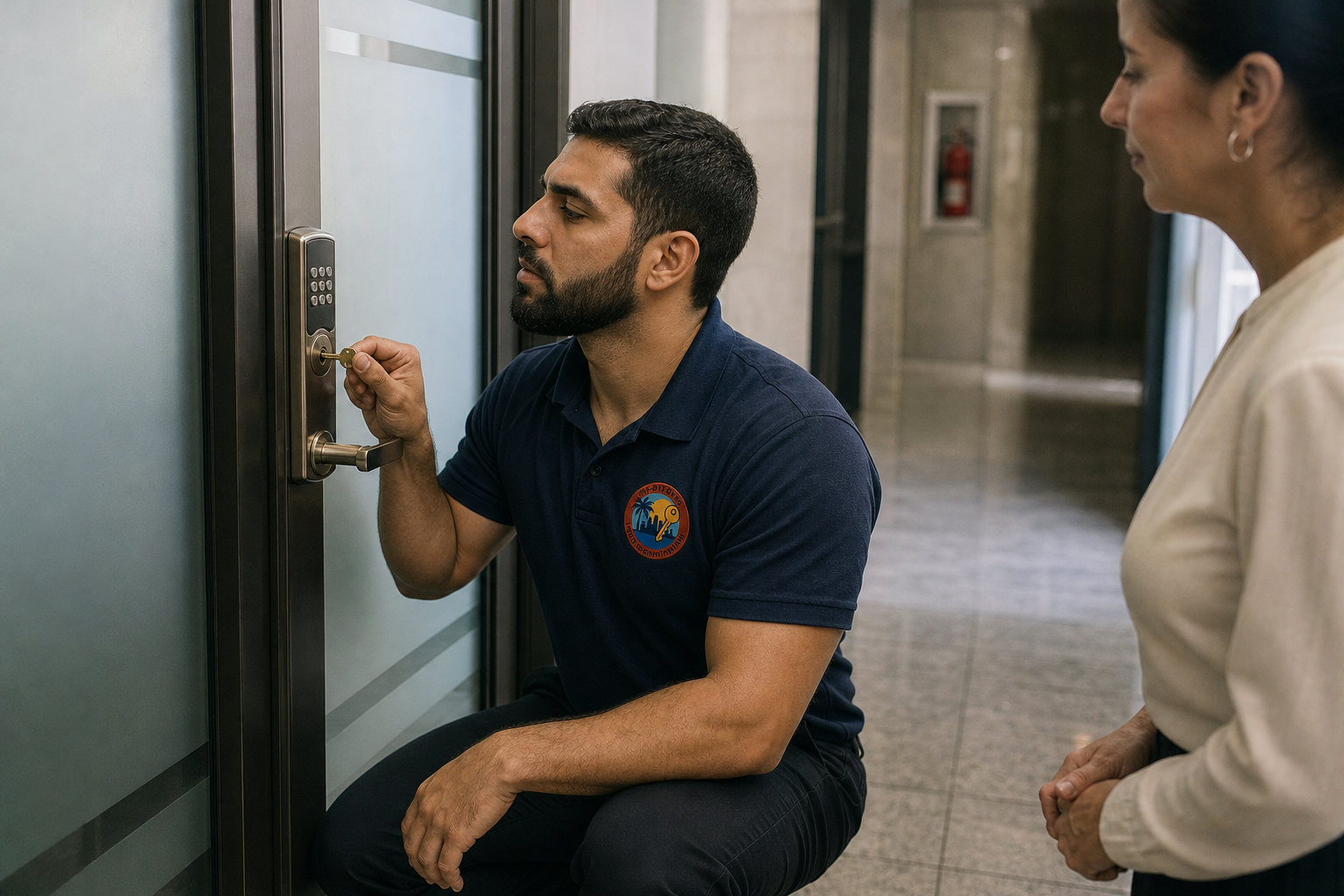
It also matters for what comes next. Owners who want a keypad or card reader on a glass entrance often assume it installs like a smart lock on a wood door. In our field experience, many smart locks require new drilling even on standard doors. On tempered glass, drilling is impossible after tempering, so electronic access has to mount in the rail, the header or the frame. We plan for that during the rail replacement rather than after it.
You can read more about our commercial glass door hardware and locksmith service across Miami-Dade, or go straight to requesting a storefront door inspection if your rail has already moved.
What This Means for Wynwood Storefront Owners
Frameless glass entrances in Wynwood live a hard life: heavy weekend foot traffic, summer downpours that flood floor closer boxes, and full sun on the glazing vinyl. For the property manager juggling several retail bays in one converted warehouse, the lesson from this case is simple. Lift the closer cover plate once a year, especially after rainy season. Water in that box is the earliest warning you will get.
The second lesson is about timing. A rail that has shifted a fraction of an inch is a hardware job. A rail that has been hammered, shimmed and used for another month can become a glass job. The 30-50% cost jump we see when structural damage joins the hardware work is avoidable if the door is taken out of use at the first tick.
The third lesson is about keys. Shops with rotating staff often skip rekeying after turnover, which in our experience creates real security gaps and liability exposure. A new bottom rail already needs a cylinder, so putting in a fresh Medeco or Mul-T-Lock cylinder at that point closes the gap at no extra disruption. Our commercial locksmith and rekeying work covers the rest of the building’s doors as well.
Our take after years of storefront glass door work
Storefront owners tend to focus on the rail, because that is the part that moved. We focus on the closer, because that is usually the part that failed. What surprised us early on was how often the fix for a crooked door sat under the floor, not in the glass.
Finish matching gets more attention than it deserves, and ADA compliance gets less. A slightly different anodized shade fades from notice within a week. A replacement bottom rail with a square top edge and no 10-inch smooth surface is a compliance problem that stays for the life of the door.
If a friend owned the shop, we would tell them one thing. The moment the door sounds different, lock it and call. Tempered glass gives you very little warning, and it does not negotiate.
Frequently Asked Questions
Can a glass storefront door bottom rail be replaced without replacing the glass?
A glass storefront door bottom rail can usually be replaced while keeping the original tempered panel, as long as the edges and corners show no chips or shells under inspection. Tempered glass cannot be cut, drilled or re-edged after tempering, so a damaged edge means the panel must be replaced to size. I Need Locksmith Miami checks every edge with the door laid flat before a new CRL or dormakaba rail goes on.
Why did my Wynwood storefront door rail come loose?
Wynwood storefront door rails usually come loose because the floor closer underneath has lost hydraulic control, so the door slams and gradually works the clamp screws loose. Rainwater sitting in the floor closer box after Miami summer storms, sun-dried glazing vinyl and a door swinging past its stop are the other common causes. Replacing the rail without servicing a Rixson or dormakaba closer usually means the new rail loosens the same way.
How long will my storefront entrance be out of service during a rail replacement?
A storefront entrance is typically out of service for only part of one day during a rail replacement, because the door comes off only after the matching rail has been measured and ordered. The removal, rail swap, closer service and rehang usually fit inside a few hours. I Need Locksmith Miami works 24/7, so the install can be scheduled before opening or after close.
How much does a glass storefront door rail replacement cost in Miami?
Glass storefront door rail replacement cost in Miami depends on the rail profile and height, the finish, the door width, whether the rail carries a bottom deadlock with a Medeco or Mul-T-Lock cylinder, and whether the floor closer needs service or replacement. I Need Locksmith Miami does not publish flat prices because those variables change the job. Call (786) 813-0495 for a quote after a measurement visit.
Ready to get your door looked at? Book a rail inspection and measurement visit and we will tell you honestly whether your panel can be saved.
Sources
- ADA section 404.2.10 (10-inch smooth bottom surface and the 60-degree tapered rail exception for stileless tempered glass doors): U.S. Access Board, ADA Accessibility Standards
- Federal safety glazing requirements for glass in doors: eCFR, 16 CFR Part 1201
- Florida Building Code and High-Velocity Hurricane Zone provisions for Miami-Dade: Florida Building Commission
- Service area, 24/7 mobile availability and contact details: I Need Locksmith Miami
I Need Locksmith Miami
I Need Locksmith Miami is a Miami-Dade locksmith and door specialist serving residential, commercial, and automotive customers.
 Listen to article
- A Wynwood Shop Owner Asked: ‘Can a Locksmith Rekey My Storefront Without Replacing the Whole Mortise Lock?’ — The Full Answer
- The Aventura High-Rise That Had 3 Herculite Glass Door Hinges Fail During Peak Season — How We Fixed All Three Same Day
- A Hialeah Retail Owner Asked: “Is a Maglock or an Electric Strike Better for My Glass Storefront Door?” — The Detailed Breakdown
- Dealer Key Programming vs Mobile Locksmith in Miami: Toyota Smart Key, Ford Transponder, and Who Actually Wins on Price
- How We Cut and Programmed a New Transponder Key for a 2019 Ford F-150 in Little Haiti — After the Original Was Snapped in the Door Lock