Last updated: August 18, 2026
Published August 18, 2026 · Updated August 18, 2026
A master key system installation Schlage Overtown Miami commercial locksmith job on a 9-door community center runs $1,080 to $1,620 at our per-door rate of $120 – $180, and one worn cylinder is almost always what forces the whole rebuild. Not a break-in. Not vandalism. A single plug that’s been turned ten thousand times by a key cut on a machine that drifted out of calibration years ago – and once that cylinder starts accepting keys it shouldn’t, the entire hierarchy above it is compromised.
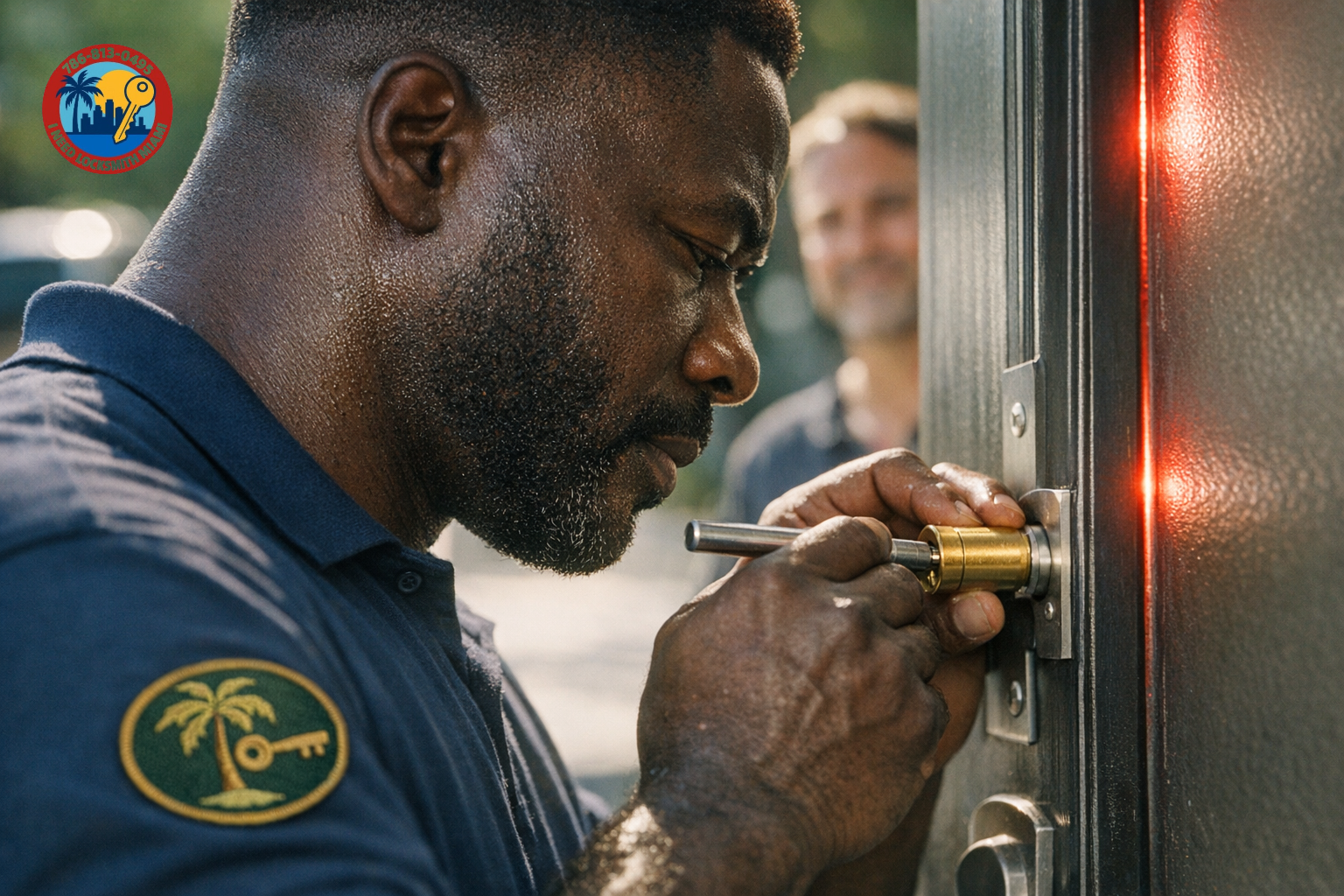
- Master key system installation in Overtown, Miami runs $120 – $180 per door – a 9-door community center lands between $1,080 and $1,620 in cylinder and keying labor.
- One failed cylinder in a master-keyed building is not a one-door problem. Worn plugs and over-stacked master wafers create “ghost keys” that open doors they were never cut for.
- Schlage Everest restricted keyways stop the real security leak at community centers: unauthorized key duplication at a hardware kiosk.
- Our documented Brickell commercial job – 12 doors, 3 suites, ASSA Abloy cylinders, 2 days, zero downtime – came in at $1,850 total. That’s the honest benchmark for what a multi-door retrofit costs in Miami-Dade.
- Skipping a rekey after staff turnover is the single most expensive mistake we see in nonprofit and municipal-adjacent facilities.
A note on honesty before we start: the 9-door community center walkthrough below is a composite of the master key rebuilds we run in Overtown and the surrounding Miami core – the hardware, the pin problems, the sequence, and the pricing are exactly what we do. There is no named client and no invented date. The one fully verified, customer-documented multi-door project we reference by the numbers is our Brickell office retrofit: 12 doors, 3 suites, ASSA Abloy cylinders, completed in 2 days with no downtime, $1,850 total.
The Situation
If you run a community center, a church annex, a charter school building, or a nonprofit program space in Overtown – the kind of facility where fifteen people carry keys and three of them are volunteers who rotate every summer – this walkthrough is written for you. It is not written for a single-tenant office with one front door and one back door. The math and the failure modes are different at nine openings.
The building sits in the shadow of the I-95 overpass. Humid air, salt drift off Biscayne Bay, and doors propped open half the day for after-school programs. Brass hates all three.
What We Found
A master key system in an Overtown community center fails from the bottom up, and the diagnosis starts with pulling one cylinder – not nine. On arrival we pin-gauged every keyed opening and shadowed the existing key ring against a hand-drawn bitting chart the facility had inherited from a previous vendor. The chart was incomplete. Three change keys weren’t on it at all.
The failed office cylinder came apart on the bench and told the story immediately: the plug was ovaled from wear, two master wafers were stacked thin enough to shear at multiple heights, and the original system had been keyed with MACS violations – adjacent cuts too far apart for the key to physically ride the pins. A cylinder like that doesn’t just wear out. It becomes permissive. It starts accepting bittings it was never cut to accept, and every key on the ring becomes a partial master.
Two more findings mattered. First, the keys were on a standard open keyway – the kind any counter with a duplicator can copy in ninety seconds, which means nobody could say how many keys existed. Second, the rear exit’s rim cylinder was mounted in a panic device with corrosion creeping up the tailpiece. Coastal air, propped doors, no lubrication schedule. The lock still worked. It wouldn’t have by next hurricane season.
One worn plug, two over-thin master wafers, MACS violations in the original keying, an unrestricted keyway, and a corroding rim cylinder on the panic device. Nine doors, but the actual root cause was a keying chart that was never maintained and a keyway anyone could duplicate.
How We Solved It
Rebuilding a 9-door Schlage master key system means designing the hierarchy on paper first and touching hardware second. Here is the sequence we ran, in order.
- Interviewed the hierarchy, not the doors. Who must open everything (director, custodial lead)? Who opens a group (program staff: gym + computer lab + offices)? Who opens one thing (kitchen volunteers)? That conversation produced a top master key, three sub-groups, and nine change keys – before a single pin was set.
- Specified a Schlage Everest restricted keyway. The whole system moved onto a restricted, patent-protected keyway so duplicates can’t be cut at a big-box counter. Key control is the entire point of a master system; without it you’re just organizing convenience, not security.
- Built a clean bitting chart with MACS respected. We generated the chart to Schlage’s specification – top master, sub-masters, change keys, with adjacent cut differentials inside allowable limits and master wafer thickness never dropping into shear-risk territory. This is the step the previous vendor skipped.
- Replaced all nine cylinders rather than repinning seven. With one plug already ovaled and the others carrying similar cycle counts, mixing new and worn cylinders inside one hierarchy guarantees a repeat call. New Schlage cylinders across the board: mortise cylinders for the lobby pair and kitchen, cylindrical for the offices, computer lab and gym, a rim cylinder for the panic device at the rear exit, and a keyed mechanical room lock.
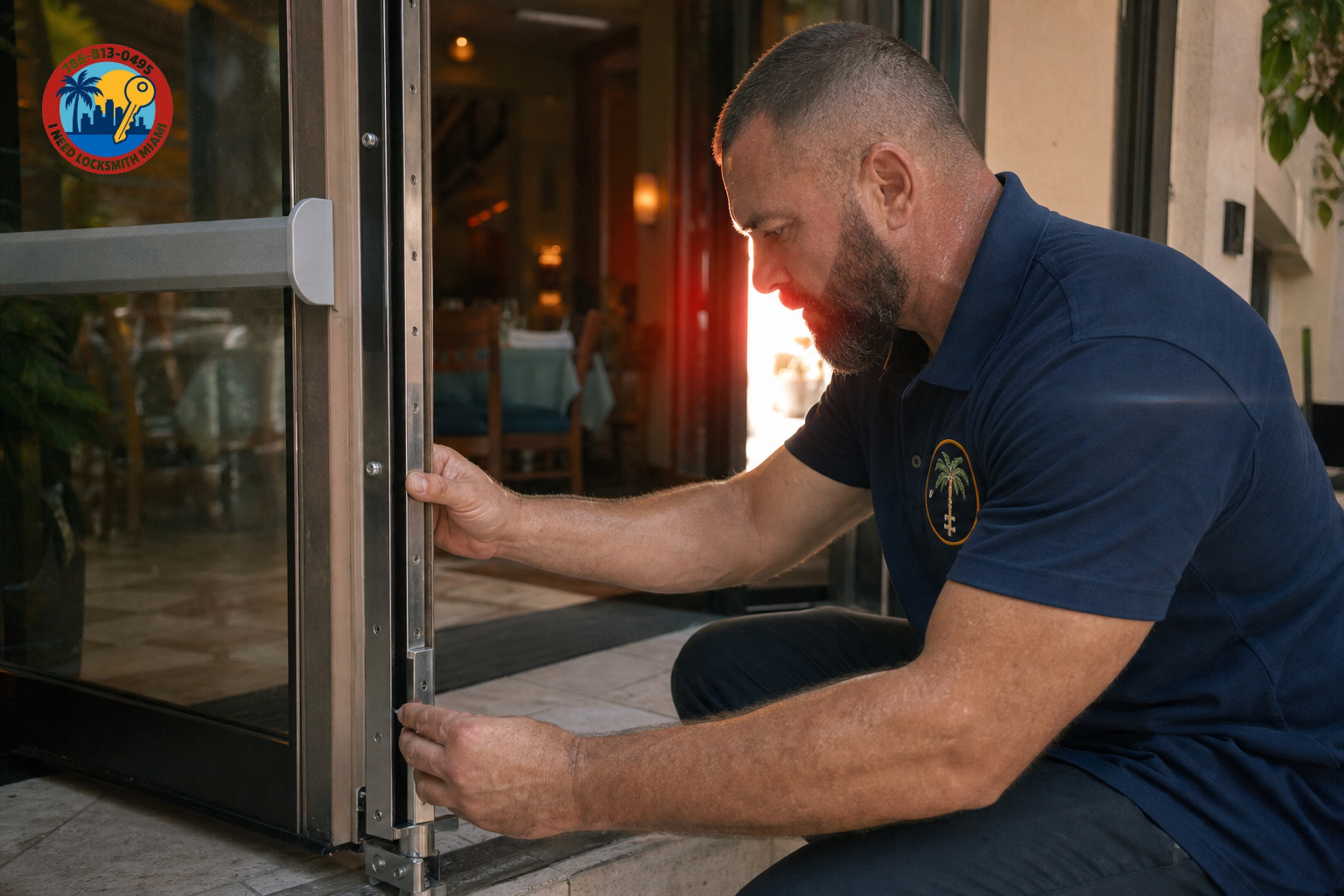
- Serviced the panic device instead of just swapping its cylinder. The rear exit is the life-safety opening. We cleaned the corroded tailpiece area, verified free egress with a single motion from the inside, and confirmed the device latched and dogged correctly. Egress hardware never gets “keyed for security” in a way that traps people inside. Ever.
- Added a keypad on the supply closet. One opening didn’t need a key at all – it needed accountability for who pulls program supplies. A commercial access control keypad runs $250 – $400 installed, and it removed one more key from circulation.
- Stamped, logged, and handed over. Every key stamped with a control designation, a written key-issue log left with the director, and a fifteen-minute walkthrough on who signs for what. The chart lives in our records and theirs.
“The most common thing we correct on an existing master key system isn’t a broken lock – it’s a hierarchy that grew by accident. Somebody added a door, a vendor pinned it to ‘just work’ with the existing keys, and three years later the janitor’s key opens the director’s office. Nobody planned that. The chart did it.” – I Need Locksmith Miami Team
The Result
| Opening | Hardware type | Keyed to |
|---|---|---|
| Lobby double doors | Schlage mortise cylinders (pair) | Top master + staff sub-master |
| Gymnasium | Schlage cylindrical lever | Program sub-master |
| Computer lab | Schlage cylindrical lever | Program sub-master |
| Commercial kitchen | Schlage mortise cylinder | Change key only |
| Janitorial closet | Schlage cylindrical | Custodial sub-master |
| Program office 1 & 2 | Schlage cylindrical (2) | Change keys, top master override |
| Mechanical room | Schlage keyed lock | Top master only |
| Rear exit (panic device) | Schlage rim cylinder in exit device | Top master, free egress inside |
| Supply closet | Access control keypad ($250 – $400) | Code-based, no key |
What This Means for Overtown Facility Managers
Overtown facility managers and nonprofit directors running multi-room buildings should treat a master key system as a document first and hardware second. The nine cylinders in this job were the cheap part. The expensive part – the part nobody budgets for – is reconstructing a hierarchy that was never written down. If your building’s keying chart lives in a former maintenance supervisor’s memory, you don’t have a master key system. You have nine locks that happen to share some pins.
The second lesson is about keyway choice, and it’s where budget pressure does the most damage. A standard keyway saves you a few dollars per cylinder and costs you all key control. Schlage’s restricted Everest platform means a departing volunteer can’t quietly duplicate a gym key at a kiosk on Biscayne Boulevard. For a building where staff turns over each program cycle, that restriction is the actual product you’re buying – the master hierarchy is just how you organize it. We make the same argument for commercial rekeying across Miami-Dade, whether the brand is Schlage, Mul-T-Lock, Medeco, or ASSA Abloy.
Third: not every door deserves a key. Honestly, this surprised the staff more than anything else in the job. Pulling one high-traffic opening off the key system entirely and onto a keypad shrank the ring, killed a recurring “who has the supply closet key” argument, and cost less than two years of replacing lost keys. That’s the same logic behind our access control installations for gyms and multi-tenant buildings across Miami.
Four Mistakes That Turn a $1,400 Job Into a $2,600 One
Forcing the door before calling
When a cylinder seizes, someone always tries a screwdriver or a shoulder. Costs jump 30-50% once frame or jamb repair has to happen alongside the lock work. A stuck lock is a lock problem; a bent frame is a carpentry problem with a locksmith invoice attached.
Assuming a smart lock drops into the existing hole
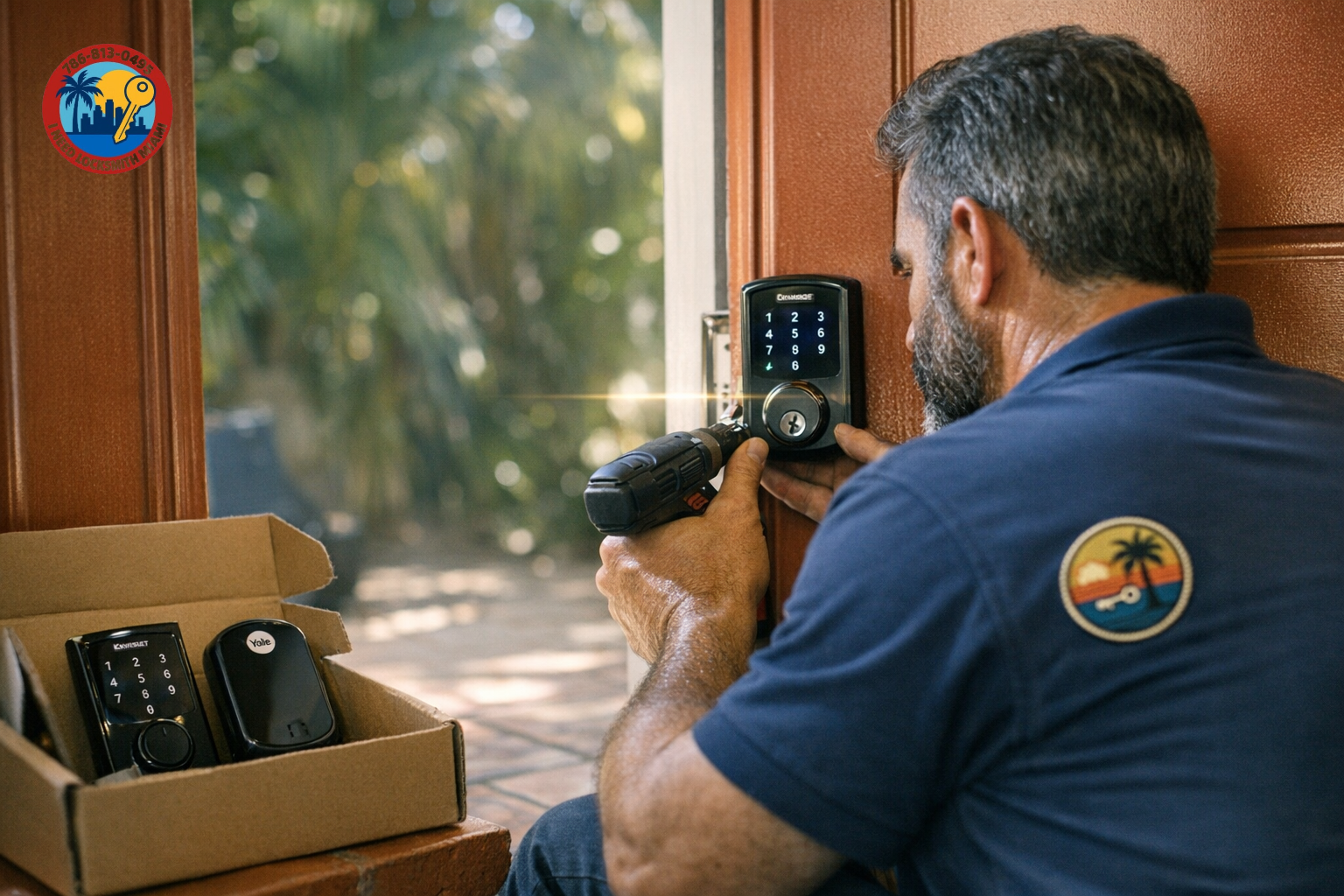
Plenty of electronic locks require a new bore or a different backset on commercial doors. That’s $80 – $150 in added labor, and on a metal door with a mortise pocket it can be more. Verify prep before you buy hardware online.
Not rekeying after turnover
Employee or tenant leaves, keys “get returned,” nobody rekeys. This is the most common security gap we find in Miami commercial buildings and the one with the clearest liability exposure. A change-key rekey costs a fraction of a full system rebuild.
Letting a vendor “add a door” to your system informally
Every opening added without updating the bitting chart pushes the hierarchy toward cross-keying accidents. That’s how a kitchen change key ends up opening an office. Update the chart or don’t add the door.
One more note for the residential side of the same conversation, because facility directors are homeowners too: our Coral Gables emergency call – a family locked out at 11 PM with two young children inside – was an 18-minute arrival, safe entry through the side door, and two new Schlage Century deadbolts with keypads for $340 total. Same discipline, different building. Deadbolt installation for Schlage or Yale hardware runs $150 – $220; an emergency residential lockout is $180 – $240.
FAQ
One cylinder failed. Why did you replace all nine?
Replacing one cylinder in a 9-door master key system leaves eight cylinders carrying the same wear and the same flawed bitting chart that caused the failure. Mixing a new Schlage cylinder into a compromised hierarchy means the “ghost key” problem persists on the other doors – and you pay a second mobilization within months. At $120 – $180 per door, doing all nine at once is cheaper than two partial visits.
Can a master key system be installed without closing the community center?
Yes – multi-door master key work in Miami-Dade is normally staged door by door so the building stays open. Our documented Brickell retrofit covered 12 doors and 3 suites across 2 days with no downtime for the tenants. For a community center, we typically sequence program rooms around class schedules and handle the lobby and rear exit before or after operating hours.
Does a master key on the rear exit panic device violate egress requirements?
A rim cylinder on a panic device controls entry from the outside only – free egress from the inside must remain a single motion with no key, no tool, and no special knowledge. We verify that on every commercial door we touch in Overtown and across Miami-Dade. Any hardware that requires a key to exit is a code problem and gets corrected on the spot.
Is a Schlage restricted keyway worth it over a standard keyway?
A Schlage Everest restricted keyway is worth it for any building with rotating staff, volunteers, or contractors – it prevents casual duplication at retail key counters, which is the leak most master systems actually suffer. A standard keyway is the better call only when key control genuinely doesn’t matter, such as an interior storage cluster inside an already-secured suite. For an Overtown community center with seasonal program staff, restricted wins.
Sources
- Schlage commercial cylinder platforms and restricted keyway information – Schlage (Allegion)
- ANSI/BHMA grading standards for commercial locks and exit devices – Builders Hardware Manufacturers Association
- Life safety and means-of-egress requirements referenced for panic hardware – National Fire Protection Association
- Service pricing, service area, and project details cited in this case study – I Need Locksmith Miami
I Need Locksmith Miami
I Need Locksmith Miami is a Miami-Dade locksmith and door specialist serving residential, commercial, and automotive customers. Master key systems, rekeying, and high-security hardware across Overtown, Downtown Miami, Wynwood, Brickell, and all of Miami-Dade. Call (786) 813-0495.