Last updated: October 16, 2026
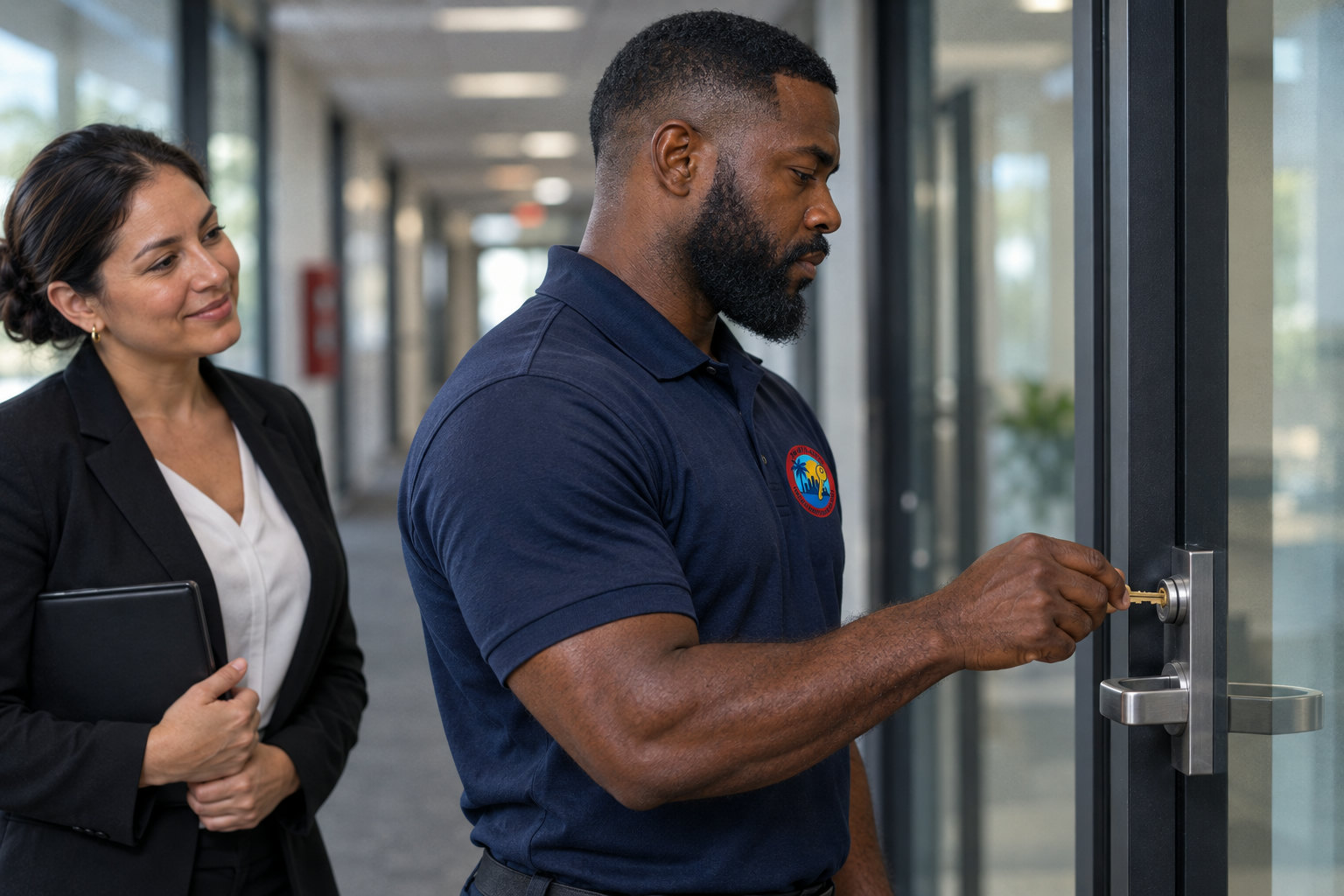
A commercial locksmith in Miami Medley restricted keys project answers the office manager’s question with one recommendation: a patent-protected restricted keyway, such as Medeco or Mul-T-Lock, set up as a master key system for the whole building. Restricted key blanks are sold only through authorized dealers, so a tenant cannot walk into a hardware store or kiosk and walk out with a copy. Each suite keeps its own key, and management holds a master that opens every door it should and no others.
- A restricted keyway uses key blanks that only authorized dealers can buy, so a copy of a Medeco or Mul-T-Lock key requires the building’s registered authorization.
- A Do Not Duplicate stamp has no mechanical effect: a key cut on a standard Schlage SC1 or Kwikset KW1 blank can still be copied on common key-cutting machines.
- Medeco retrofit cylinders fit many existing Schlage and Yale commercial locksets, so a restricted-key upgrade rarely requires replacing every lock in the building.
- A master key system gives each suite its own change key while management holds a master, so one suite can be rekeyed after a tenant leaves without touching the rest of the building.
- The Florida Fire Prevention Code, which adopts NFPA 101, requires egress doors to open from the inside without a key, so restricted cylinders go on the entry side of exit doors only.
- I Need Locksmith Miami provides 24/7 mobile commercial service across Miami-Dade County at (786) 813-0495.
- Why a restricted keyway stops copying when a stamped Schlage or Kwikset key does not.
- The eight steps of a typical restricted-key changeover, from door survey to key handoff.
- Which option fits which door: Medeco, Mul-T-Lock, Schlage Everest 29 or card access.
- Where these jobs go wrong: mixed hardware, ghost keys and fire egress rules.
- The questions to ask before any cylinder is ordered.
Why a Commercial Locksmith in Miami Medley Restricted Keys System Stops Key Copying
The most common advice for shared office keys is to stamp them Do Not Duplicate. That advice fails for a simple reason: the stamp is printed text, and the blank underneath it is ordinary. Most shared keys are cut on standard blanks such as the Schlage SC1 or Kwikset KW1, which hardware stores, home centers and self-serve kiosks keep in stock.
The stamp has no effect on the key machine. It also carries no legal force by itself, so plenty of key counters will cut the key anyway. The lock cannot tell an issued key from a copy.
A restricted keyway changes the blank itself. Manufacturers such as Medeco, Mul-T-Lock and Schlage, with its Everest 29 line, control who can buy their restricted blanks, and duplicates are cut only by an authorized dealer against the building’s registered signature or key card. No blank, no copy.
If you’re an office manager in a multi-tenant building where one shared key opens the lobby, the corridor and the restrooms, and keys keep turning up that nobody issued, the fix is a different cylinder, not another memo to tenants. Policy asks people to behave. A restricted cylinder removes the option.
Medley is a small incorporated town in northwest Miami-Dade County where industrial, warehouse and flex office buildings make up most of the built environment. That building mix matters for key control. Flex buildings often put several businesses behind one shared entry, plus rear service doors and electrical rooms, so a single uncontrolled key can reach far more space than one tenant’s suite.
Patent protection is what makes the restriction hold. While a keyway’s utility patent is in force, an unauthorized company cannot legally manufacture compatible blanks, which is why a patented restricted system holds up far better than a standard keyway with a warning stamp.
The Process, Step by Step
Every commercial locksmith in Miami restricted keys job follows a similar sequence, whether the building has a handful of doors or several floors of suites. The order matters. The hardware choice depends on the survey, and the master key design depends on who actually needs which door.
- Door-by-door survey. The technician lists every opening: main entry, suite doors, shared restrooms, electrical and mechanical rooms, and rear service doors. Each door is recorded by lockset type (mortise lock, cylindrical lever, or rim cylinder on a panic bar) and by brand, such as Yale, Schlage or Kwikset. This list decides which cylinders can be retrofitted and which locks must be replaced.
- Key audit and access matrix. Next comes a written key schedule: which people or groups need which doors. A tenant typically needs its own suite plus the shared entry and restrooms, while a cleaning crew may need common areas only. The matrix becomes the blueprint for the master key system.
- Keyway and brand selection. The restricted keyway is matched to the existing hardware and the risk level. Medeco offers retrofit cylinders for many Schlage and Yale locksets, Mul-T-Lock adds telescopic-pin high-security cylinders, and Schlage Everest 29 suits buildings already built on Schlage hardware.
- Master key system design. The designer builds the hierarchy: a master for management, sometimes sub-masters for floors or wings, and individual change keys for each suite. Fewer levels mean fewer pin combinations that can open unintended doors, so a good design uses only the levels the access matrix truly requires.
- Authorization setup. The building owner or property manager signs the authorization record that the dealer keeps on file. Medeco and Mul-T-Lock both tie duplication to that registration, so only named people can order new keys. The bitting list, which records every cut, is stored separately from the keys.
- Cylinder pinning and installation. Cylinders are pinned to the bitting list and installed with the correct cam for each mortise lock or the correct tailpiece for each lever. Rim cylinders go on panic bars at exit doors. Then every key is tested against every door it should open, and against doors it should not.
- Egress check. Every exit door is checked to confirm it still opens freely from the inside with one motion. The Florida Fire Prevention Code requires egress without a key, tool or special knowledge, so a restricted cylinder never turns an exit into a locked trap.
- Key handoff and logging. Keys are stamped with a key symbol and a serial number, never the actual bitting. Each holder signs a key log, and the return process at move-out is agreed in writing before the first key leaves management’s hands.
Tools and hardware on a typical restricted-key job
A restricted-key changeover relies on a short list of specialized tools and parts. Each item below has one job in the sequence.
| Tool or part | What it does on the job |
|---|---|
| Plug follower and pinning kit | Holds the springs and top pins in place while the plug is out, so cylinders can be pinned to the master key bitting. |
| Key code cutting machine | Cuts keys from the bitting code instead of copying an original, which keeps new keys accurate to the system design. |
| Medeco or Mul-T-Lock retrofit cylinders | Replace the cylinder inside existing Schlage or Yale hardware, adding a restricted keyway without new locksets. |
| Mortise cams and lever tailpieces | Match each new cylinder to the specific lock body, so the key actually throws the bolt or retracts the latch. |
| Bitting list and key control log | Record every cut and every key holder, which is what makes later rekeys and audits possible. |
Which restricted keyway fits which kind of office door?
The right restricted keyway depends on the existing hardware and how much attack resistance the doors need. Medeco and Mul-T-Lock lead on high security, Schlage Everest 29 fits Schlage-heavy buildings, and a standard keyway with a stamp only suits low-risk spaces. No single option wins everywhere.
| Option | How copies are controlled | Wins when |
|---|---|---|
| Standard keyway (Schlage SC1, Kwikset KW1) with stamp | Not controlled; the blank is sold everywhere | A single-tenant space with very low turnover where the lowest-cost option matters most |
| Schlage Everest 29 | Patented restricted blanks through Schlage’s authorized channel | The building already runs Schlage hardware and wants restricted keys and interchangeable cores without a high-security tier |
| Mul-T-Lock (MT5+) | Telescopic pins; duplicates require the owner’s key card | Street-facing entries need pick and drill resistance plus card-controlled duplication |
| Medeco (M3, X4) | Angled, rotating pins and a sidebar; dealer-registered key control | Mixed Schlage and Yale hardware needs one high-security system through retrofit cylinders |
| Card reader or keypad access | No physical key; credentials are deleted centrally | Tenants change often and the owner wants an entry log for every door |
UL 437, the Underwriters Laboratories standard for high-security key locks, is a useful line between the tiers. Both the Medeco and Mul-T-Lock lineups include UL 437 listed cylinders, while Schlage Everest 29 in its standard form is a restricted keyway rather than a high-security cylinder. Confirm the listing for the exact model ordered.
Mortise entry doors deserve a closer look before choosing. This comparison of Schlage AD, Yale AU and Mul-T-Lock Interactive options for office master key systems covers how those platforms differ. For buildings leaning toward electronic entry instead, the trade-offs of maglocks versus electric strikes for multi-tenant office access control are worth reading first.
Where It Gets Tricky
The hardest part of a commercial locksmith in Miami restricted keys job is rarely the cylinder itself. It is the mix of hardware already on the doors: a Yale mortise lock on the main entry, Schlage cylindrical levers on suite doors, a rim cylinder on a panic bar at the rear, and a residential Kwikset lever someone installed on a storage room. Each takes a different cylinder format, cam or tailpiece, and residential-grade levers are usually better replaced with a commercial-grade Schlage or Yale lockset before a restricted cylinder goes in.
Master key design is the second trap. Every added master level adds pin positions that can line up in more than one way, and a careless bitting layout can create ghost keys: cuts nobody planned that happen to open doors outside their group. A careful designer follows the manufacturer’s master keying rules and tests each change key against the doors it must not open, not only the ones it should.
Fire egress is the third. The Florida Fire Prevention Code, which adopts NFPA 101, requires egress doors to open from the inside without a key, tool or special knowledge, so restricted cylinders belong on the outside of exit doors and panic devices only. A cylinder that fits physically can still create a code problem, which is why training in both lock mechanics and egress rules matters on this kind of work.
Restricted-key jobs go wrong in three places: mixed Yale, Schlage and Kwikset hardware that needs different cylinders, master key layouts that create unintended ghost keys, and exit doors that must still open from inside under the Florida Fire Prevention Code. The cylinder brand is the easy part.
What This Means for You as the Customer
A restricted-key changeover means a customer should expect a door survey, a written key schedule and an authorization record before any cylinder is ordered. A quote given without a survey is guessing at the hardware. Ask to see the door list.
Before booking a commercial locksmith in Miami restricted keys consultation, it helps to have these questions ready:
- Which restricted keyway is proposed, Medeco, Mul-T-Lock or Schlage Everest 29, and why does it fit these specific doors?
- Can the existing Schlage or Yale locksets take retrofit cylinders, or do some locks need replacing?
- Who will be named on the authorization record, and how are duplicates ordered later?
- Who keeps the bitting list, and where is it stored?
- How will exit doors and panic bars stay compliant with egress rules?
For a property manager juggling several tenant suites in one flex building, the authorization record is the piece to protect. If a tenant’s office manager ends up as the named signer, key control quietly moves out of management’s hands. Keep that name on the owner’s side of the lease.
A common mistake is skipping the rekey after a tenant moves out or an employee leaves. Every unreturned or copied key is a security gap and a liability question. With a well-designed master key system, only that suite’s cylinders need new pins, and the master and every other suite keep working; this guide to rekeying office locks without replacing the hardware explains how that works.
Another costly mistake is calling a locksmith only after someone has already pried, drilled or forced a door. Once the frame or strike is damaged, the job becomes structural repair plus lock work, which takes longer and costs more than the lock work alone. Miami-Dade County also requires locksmith businesses to hold a county license, so asking for it before work starts is reasonable.
Our view
Our opinion: restricted-key buyers overweigh the cylinder brand and underweigh the paperwork. Medeco, Mul-T-Lock and Schlage Everest 29 all restrict their blanks. What actually keeps copies out of circulation is who holds the authorization record, whether the key schedule is current, and whether a suite is rekeyed before the next tenant moves in.
We would also push back on adding master levels for convenience. A simpler hierarchy is easier to audit and less likely to produce unintended keys. Simple wins.
Finally, keys are not always the answer. In buildings where tenants change constantly, card readers or keypads may serve better, because a credential can be deleted in seconds. Restricted mechanical keys win where doors must work without power or a network, and where the owner wants a system that does not depend on software.
Frequently Asked Questions
Can tenants copy a restricted key at a hardware store or kiosk?
Restricted keys from Medeco, Mul-T-Lock or Schlage Everest 29 cannot be copied at a typical hardware store or kiosk, because those counters cannot buy the patented blanks. Duplicates come only from an authorized dealer, who checks each request against the building’s registered signature or key card.
Do all the existing locks have to be replaced?
Existing commercial locks usually stay in place during a restricted-key upgrade. Medeco sells retrofit cylinders for many Schlage and Yale locksets, and standard 1-5/32 inch mortise cylinders swap out with the correct cam. Residential-grade levers, such as many Kwikset models on storage or office doors, are the common exception.
Who should hold the authorization record in a shared building?
The authorization record for a restricted key system should be held by the building owner or property manager, not by a tenant. Naming two authorized signers covers vacations and staff changes. The bitting list should be stored separately from the keys and the key log.
What happens to the key system when a tenant moves out?
A tenant move-out in a master-keyed building means only that suite’s cylinders get rekeyed to a new change key, ideally before the next tenant receives keys. The master and every other suite keep working unchanged. With Medeco or Mul-T-Lock cylinders, the new keys still require the building’s authorization to duplicate.
Sources
- Medeco high-security cylinders, retrofit options and dealer-based key control: Medeco
- Mul-T-Lock telescopic-pin cylinders and key card duplication control: Mul-T-Lock
- Florida Fire Prevention Code and egress requirements: Florida Division of State Fire Marshal
- County licensing of locksmith businesses and local government information: Miami-Dade County
I Need Locksmith Miami
I Need Locksmith Miami is a Miami-Dade locksmith and door specialist serving residential, commercial, and automotive customers.
 Listen to this articleAudio version
- A Hialeah Office Manager Asked: “Will Our Multi Tenant Door Unlock During a Power Outage?” What Maglock and Electric Strike Wiring Means for Access Control
- A Bay Harbor Islands Property Manager Asked: ‘Can a Locksmith in Miami Install a Biometric Reader on an Existing Commercial Door Frame?’, A Tech’s Direct Answer
- A North Miami Homeowner Asked: “Why Does My Kwikset SmartKey Deadbolt Keep Jamming in Summer Heat?” — A Locksmith’s Diagnosis
- A Westchester Homeowner Asked: “Can You Replace Just the Ignition Cylinder on My 2018 Chevy Silverado Without Losing My Key Programming?”
- A Wynwood Shop Owner Asked: ‘Can a Locksmith Rekey My Storefront Without Replacing the Whole Mortise Lock?’ — The Full Answer

3 Responses