Last updated: October 6, 2026
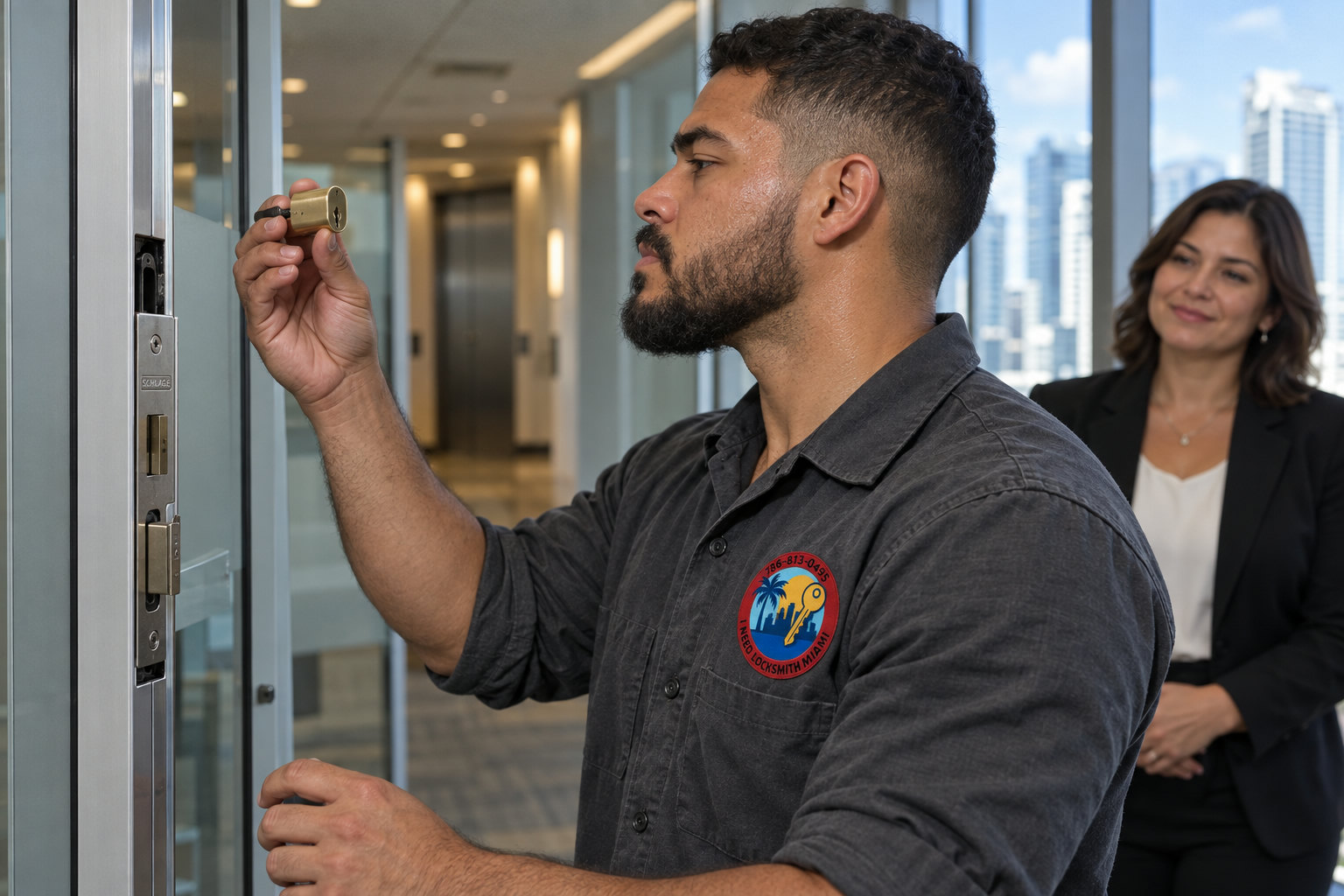
As a locksmith in Miami serving Brickell offices, we check the master key system keyway before anyone orders a mortise cylinder for a Schlage AD-Series lock, a Yale AU-Series lever set or a Mul-T-Lock Interactive+ upgrade. The brand stamped on the lock body or the lever trim says nothing about which key the cylinder will accept. The right choice depends on context: Schlage wins when the building already runs a Schlage keyway, Yale wins on floors standardized on a Yale keyway, and Mul-T-Lock Interactive+ wins when key control matters more than speed or budget.
- A standard US mortise cylinder uses a 1-5/32 inch housing with 32 threads per inch, so Schlage, Yale and Mul-T-Lock cylinders will usually thread into the same mortise lock body, which is exactly why the wrong one gets installed without anyone noticing.
- The keyway, not the brand on the lock body, decides whether a new mortise cylinder joins an existing office master key system.
- Schlage AD-Series electronic locks (AD-200, AD-300 and AD-400) still carry a mechanical override cylinder that must be keyed into the building master system.
- In Yale’s commercial catalog, the AU code identifies the Augusta lever design, not the cylinder or its keyway.
- Mul-T-Lock Interactive+ uses a patented, restricted key profile with registered key control, so duplicates are cut only through authorized dealers against the system’s records.
- Skipping a rekey after employee turnover or a tenant move-out leaves unreturned keys working and creates real security gaps and liability exposure.
If you’re an office manager or facilities lead in a Brickell tower about to replace a suite-door cylinder that still has to open with the building master key, this comparison is for you. It is not for a homeowner swapping a front-door deadbolt. The stakes are different when one wrong part breaks a system that dozens of keys depend on.
Which mortise cylinder keyway should a locksmith in Miami check first on a Brickell master key system?
The keyway of the existing master key system is the first thing to check on any Brickell office mortise cylinder job, ahead of brand, finish or lever style. A keyway is the shaped channel in the cylinder face that only one family of key blanks fits. If the new cylinder’s keyway differs from the system’s, the master key physically cannot enter it.
Here is the trap. US mortise cylinders share a common threaded housing, 1-5/32 inch in diameter with 32 threads per inch, so a Schlage, Yale or Mul-T-Lock cylinder will usually spin right into the same mortise lock body. It looks finished. Then the master key stops at the cylinder face.
After the keyway, two more details decide fit: the cam on the back of the cylinder, which has to match the lock body, and the cylinder length, which depends on door thickness and trim. Common mortise cylinder lengths include 1 inch, 1-1/8 inch and 1-1/4 inch, with spacer rings taking up small differences.
| Attribute | Schlage (AD-Series / L-Series cylinders) | Yale (AU-Series trim / 8800FL mortise) | Mul-T-Lock Interactive+ |
|---|---|---|---|
| What the model code tells you | AD-200, AD-300, AD-400 name the electronic lock type, not the keyway | AU names the Augusta lever design, not the keyway | Interactive+ names the key platform itself |
| Keyway options | Open Classic keyways or restricted Everest 29 | Yale keyway families, open or restricted | Patented, restricted profile only |
| Mortise cylinder fit | Standard 1-5/32 in., 32 TPI housing; Schlage-compatible cam | Standard 1-5/32 in., 32 TPI housing; Yale-compatible cam | Standard US mortise housing; cam matched to the Schlage or Yale lock body |
| Key duplication control | Weak on open keyways; strong on Everest 29 through authorized dealers | Depends entirely on the keyway chosen | Registered key card; authorized dealers only |
| Joins an existing system when | The building already runs that Schlage keyway | The floor is standardized on that Yale keyway | The suite or whole system converts to Interactive+ |
| Cost tier | Standard commercial tier; Everest 29 a step up | Standard commercial tier | Premium high-security tier |
| Best fit | Buildings already on Schlage, offices pairing keys with AD-Series access control | Older build-outs standardized on Yale mortise hardware | Suites where copied keys are the main risk |
Schlage, Yale and Mul-T-Lock mortise cylinders share a 1-5/32 inch, 32 TPI housing, so physical fit proves nothing. The keyway decides whether the cylinder joins the master key system, then the cam and length decide whether it works in that specific door.
How does Schlage, including the AD-Series, handle mortise cylinders in a master key system?
Schlage mortise cylinders join a master key system cleanly as long as the building already runs a Schlage keyway, and that is the brand’s biggest strength in Miami office towers. Schlage L-Series mortise locks are everywhere in commercial build-outs. Parts in common Classic keyways are easy to source, which keeps turnaround short.
The Schlage AD-Series is where offices get caught. The AD-200 runs standalone, the AD-300 is hardwired to an access system and the AD-400 is wireless, yet every one of them still has a mechanical key override cylinder. That cylinder needs to be keyed into the master system, or master key holders are locked out the day a battery dies or a reader goes offline.
The weakness is key control on open keyways. A Schlage Classic key can be copied at almost any hardware counter. Schlage’s restricted Everest 29 platform, with patent protection Schlage says runs to 2029, fixes that, but only if the system was built on it from the start.
Short version: Schlage is the easy match. It is not automatically the secure one.
What does the Yale AU-Series code actually tell you about a mortise cylinder?
The Yale AU code tells you the lever design, Augusta, and nothing about the cylinder or keyway behind it. This is the single most misread line on an office hardware schedule. Someone sees a part number like an AU-prefixed Yale 8800FL mortise lock, searches it, and orders a matching Yale cylinder.
Yale’s strength is solid commercial mortise hardware with a long service life, and Yale, an ASSA ABLOY brand, offers its own keyway families for master keying. Floors that were standardized on Yale during a build-out tend to stay serviceable for years. A replacement Yale cylinder in the correct Yale keyway drops in and runs.
The weakness is history. Multi-tenant towers go through tenant improvements, and each contractor brings their own hardware preferences. What surprises most office managers is how often a Yale lock body is holding a Schlage cylinder, or the reverse, because a previous locksmith matched the building system rather than the lock brand.
So the faceplate says Yale. The keyway may not. Pull the cylinder and read it before ordering anything.
Is Mul-T-Lock Interactive+ worth it for a Brickell office suite?
Mul-T-Lock Interactive+ is worth it for a Brickell office suite when copied keys are the real risk, such as a wealth-management office, a law firm records room or a suite with frequent staff changes. It is a high-security key platform built on Mul-T-Lock’s telescopic pin design and a patented key profile with an added interactive element that ordinary blanks cannot reproduce.
Key control is the headline feature. Duplicates are cut only by authorized Mul-T-Lock dealers against a registered key card, so a departing employee cannot walk a key down to a kiosk. Interactive+ mortise cylinders come in the standard US housing size, and with the right cam they retrofit into existing Schlage or Yale mortise lock bodies without replacing the lock itself.
The weakness is that Interactive+ cannot be mixed into a Schlage or Yale master system. One Interactive+ cylinder on an otherwise Schlage floor will not open with the building master key. It sits in the premium high-security tier, and controlled duplication adds a step when the office needs a new key the same afternoon.
Worth it, yes. As a one-off patch, no.
What happens when an office orders the mortise cylinder before checking the keyway?
Ordering a mortise cylinder before checking the keyway usually ends with a cylinder that threads in perfectly and refuses the master key. The pattern we see most goes like this: the office manager who inherited a ring of unlabeled keys reads the brand off the faceplate, orders online, and hands the box to a handyman.
The cylinder spins in with that soft brass-on-brass hiss. The change key that came in the box works. Then building security tries the master key during an after-hours walk, and it stops dead at the face of the cylinder.
The worse version is when the cam binds and someone forces it with pliers, or overdrives the faceplate set screw and chews the mortise case threads. Once the door edge or frame is damaged, the job is no longer just lock work. In our field experience, costs jump 30-50% when structural repair is needed alongside lock work.
Here is the check we run on every suite door before a single part is ordered. Honestly, it’s the slow part of the job. It’s also the part that prevents a second visit.
Read the key bow
Look for a brand mark, a restricted-keyway stamp and a key-coding stamp such as AA1, which in standard key coding points to the master levels above that change key.
Pull one cylinder
Loosen the set screw behind the mortise lock faceplate, unthread the cylinder and record its keyway, cam style and length.
Find the system records
Ask building management or the original locksmith for the bitting chart, so the new cylinder is pinned inside the existing hierarchy instead of beside it.
Match cam and length to the door
Confirm the cam suits the Schlage or Yale lock body, and that the length plus any spacer ring sits flush with the trim.
Test every level, then log it
Run the change key, master and grand master before leaving, then update the key log so the next replacement starts from facts.
One local detail national guides skip: doors facing the bay or the parking levels breathe warm, salty, humid air most of the year, and cylinders there gum up faster. We finish those with a dry lubricant rather than oil, which attracts the grit that makes a key drag. For the full range of office work, see our commercial locksmith services in Miami.
When should an office choose Schlage, Yale or Mul-T-Lock for a mortise cylinder?
Choosing between Schlage, Yale and Mul-T-Lock mortise cylinders comes down to what the master key system already runs and how much key control the suite needs. Match the use case first, then the brand.
- Choose Schlage when the building master key system already uses a Schlage keyway, or when the suite runs Schlage AD-Series access control and the override cylinders need to match the mechanical system.
- Choose Yale when the floor was standardized on Yale 8800FL mortise hardware and the pulled cylinders confirm a Yale keyway, not just a Yale faceplate.
- Choose Mul-T-Lock Interactive+ when copied keys are the main threat and the office is ready to convert the whole suite to one restricted platform at once.
- Choose none yet if nobody can produce the bitting records. Identify the system first, or you risk buying a cylinder that belongs to no system at all.
Offices pairing keys with card readers or keypads should also look at our access control installation in Miami, since electronic trim and the mechanical master system have to be planned together.
Our Verdict
For most Brickell office suites replacing one or two mortise cylinders, the winner is whichever brand matches the existing keyway, and in Miami’s commercial towers that is very often Schlage. Matching beats upgrading when the goal is getting one door back into the system today.
For the facilities lead whose floor is standardized on Yale mortise hardware, stay with Yale, but only after a pulled cylinder confirms the keyway. The AU lever code on the hardware schedule is not evidence.
For the managing partner who worries about who still holds keys, Mul-T-Lock Interactive+ is the strongest choice of the three, as a planned full-suite conversion. Medeco, another ASSA ABLOY high-security line, belongs in the same conversation if the building already uses it. Never install one restricted cylinder into an open system and call it secure.
Our take after years of commercial locksmith work in Miami
Commercial customers in Miami overweigh the brand name and the finish. They spend real thought on satin chrome versus dark bronze and almost none on who holds the bitting chart. In our view, the bitting chart is the master key system. The cylinders are just where it lives.
What actually matters is boring: a keyway that matches, a key log someone updates, and a rekey whenever keys walk out the door. Not rekeying after a tenant move-out or employee turnover is one of the mistakes we flag most, because it leaves working keys in unknown hands and puts the liability on the business. You can read how we handle that on our office rekeying service page.
The one thing we would tell a friend: photograph the key bow and the cylinder face before you buy anything. That photo answers most of the questions a matching order depends on. It takes thirty seconds and saves a return shipment.
Frequently asked questions about mortise cylinder keyways
Can a Mul-T-Lock Interactive+ mortise cylinder replace a Schlage or Yale cylinder in the same lock?
A Mul-T-Lock Interactive+ mortise cylinder can usually thread into a Schlage or Yale mortise lock body, because US mortise cylinders share a standard 1-5/32 inch, 32-threads-per-inch housing. The cam and length still have to match the lock body and trim. It will not open with the existing Schlage or Yale master key, so it only makes sense when the suite or whole system is converting to Interactive+.
How do I find out which keyway my Brickell office master key system uses?
The keyway of a Brickell office master key system is usually identified from the key bow stamp, the cylinder face, and the bitting records held by building management or the original locksmith. If those records are missing, a locksmith can pull one mortise cylinder on site, read the keyway, cam and length, and confirm it against your master and change keys. Do this before ordering any Schlage, Yale or Mul-T-Lock part.
Does a Schlage AD-Series electronic lock still need a keyed cylinder in the master key system?
A Schlage AD-Series lock, whether an AD-200, AD-300 or AD-400, still carries a mechanical key override cylinder. That cylinder should be keyed into the building master key system so master key holders can open the door if a credential, battery or network fails. Leaving it on a factory key is a gap we find regularly on access-controlled suite doors.
Should an office rekey its mortise cylinders after an employee leaves?
An office should rekey affected mortise cylinders after employee turnover or a tenant move-out, because unreturned keys create security gaps and liability exposure. Within a Schlage, Yale or Mul-T-Lock master key system, rekeying usually means repinning the change-key level so the master keys keep working. Restricted keyways such as Schlage Everest 29 or Mul-T-Lock Interactive+ also limit how easily departing staff could have copied keys.
Before you order a cylinder for that suite door, have a technician read the keyway first. Call I Need Locksmith Miami at (786) 813-0495, available 24/7 across Miami-Dade, and ask about pricing for an on-site keyway check, cylinder matching or a full Mul-T-Lock conversion.
Sources
- Schlage AD-Series electronic locks, L-Series mortise locks and the Everest 29 restricted keyway (Schlage is an Allegion brand) – Allegion
- Yale, Mul-T-Lock and Medeco as ASSA ABLOY brands – ASSA ABLOY
- Mul-T-Lock Interactive+ key platform, telescopic pins and registered key control – Mul-T-Lock
- I Need Locksmith Miami service area and 24/7 mobile commercial service – I Need Locksmith Miami
I Need Locksmith Miami
I Need Locksmith Miami is a Miami-Dade locksmith and door specialist serving residential, commercial, and automotive customers.
 Listen to article
- The Overtown Community Center Whose Master Key System Covered 9 Doors and One Failed Cylinder — How We Rebuilt It with Schlage
- Schlage B-Series vs Master Lock Pro Series vs Yale Superior: Which Deadbolt Holds Up for a Miami Shores Rental Property
- ASSA Abloy Aperio vs Schlage AD-Series vs Yale Real Living: Which Wireless Lock Works for a Wynwood Co-Working Space
- Schlage Encode vs Mul-T-Lock MT5+: Which High-Security Lock Fits a Brickell Condo Door
- Mul-T-Lock Hercular vs Medeco Maxum: Which Double-Cylinder Deadbolt Fits a Coral Way Duplex

3 Responses