Last updated: November 1, 2026
Published November 1, 2026 · Updated November 1, 2026
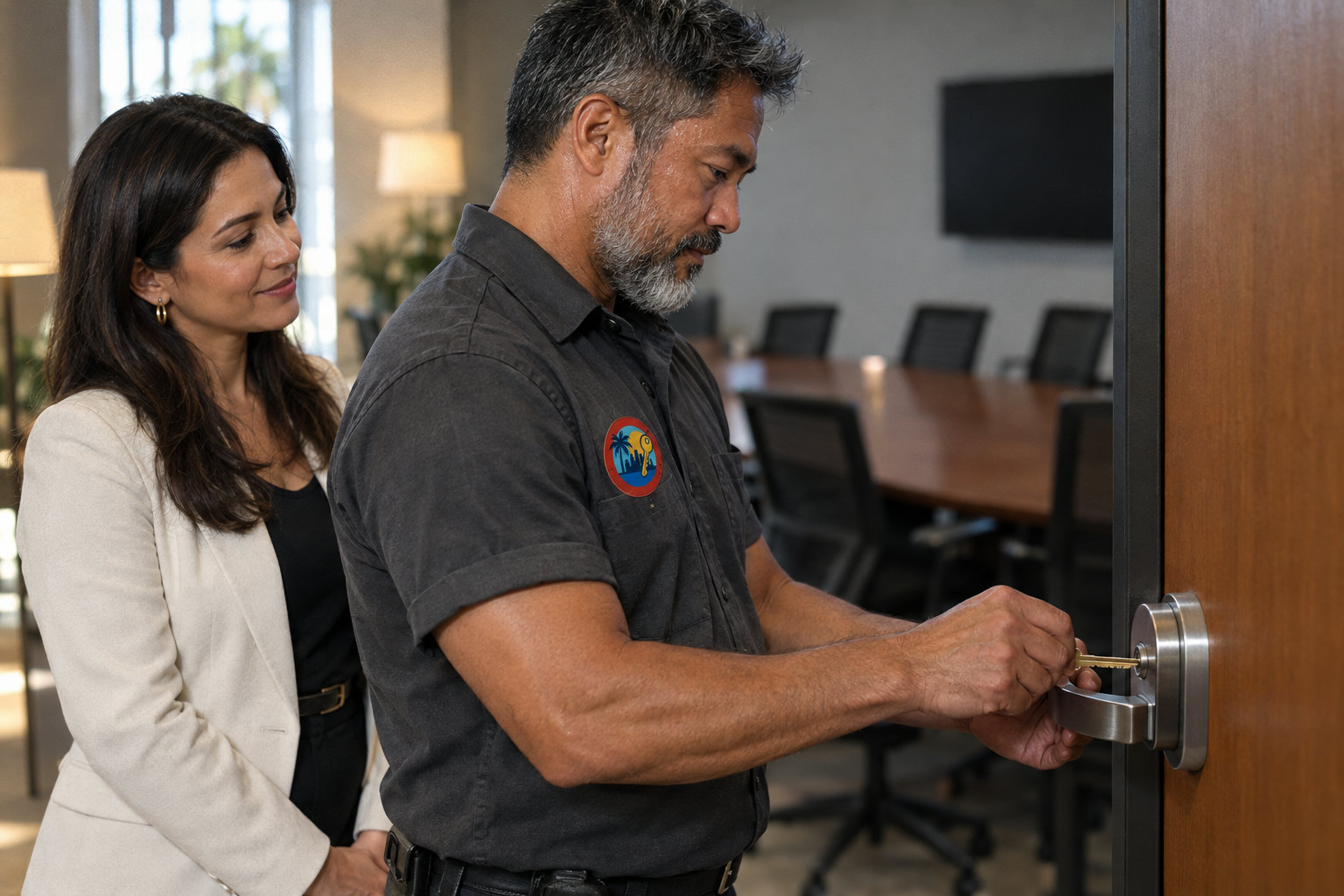
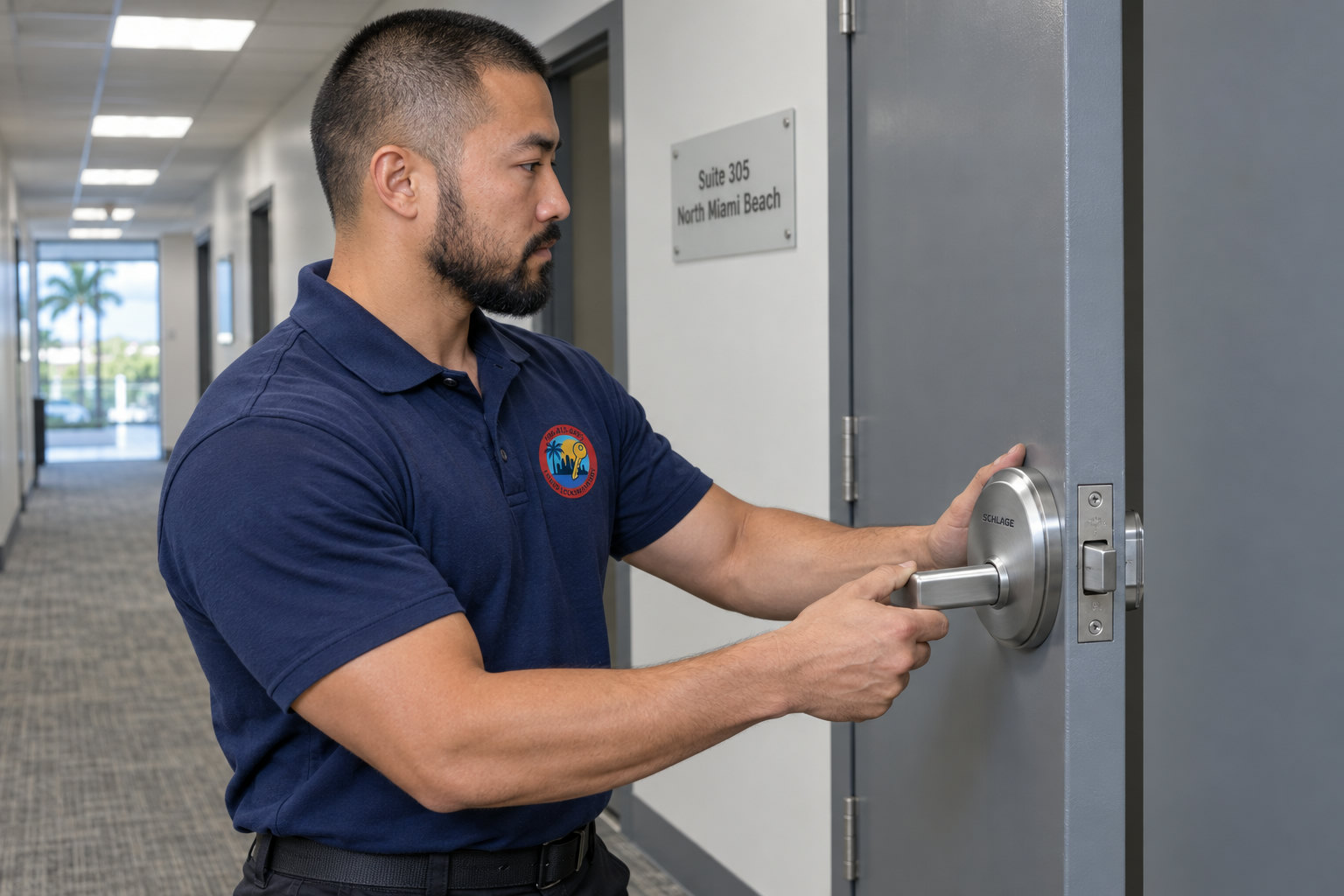
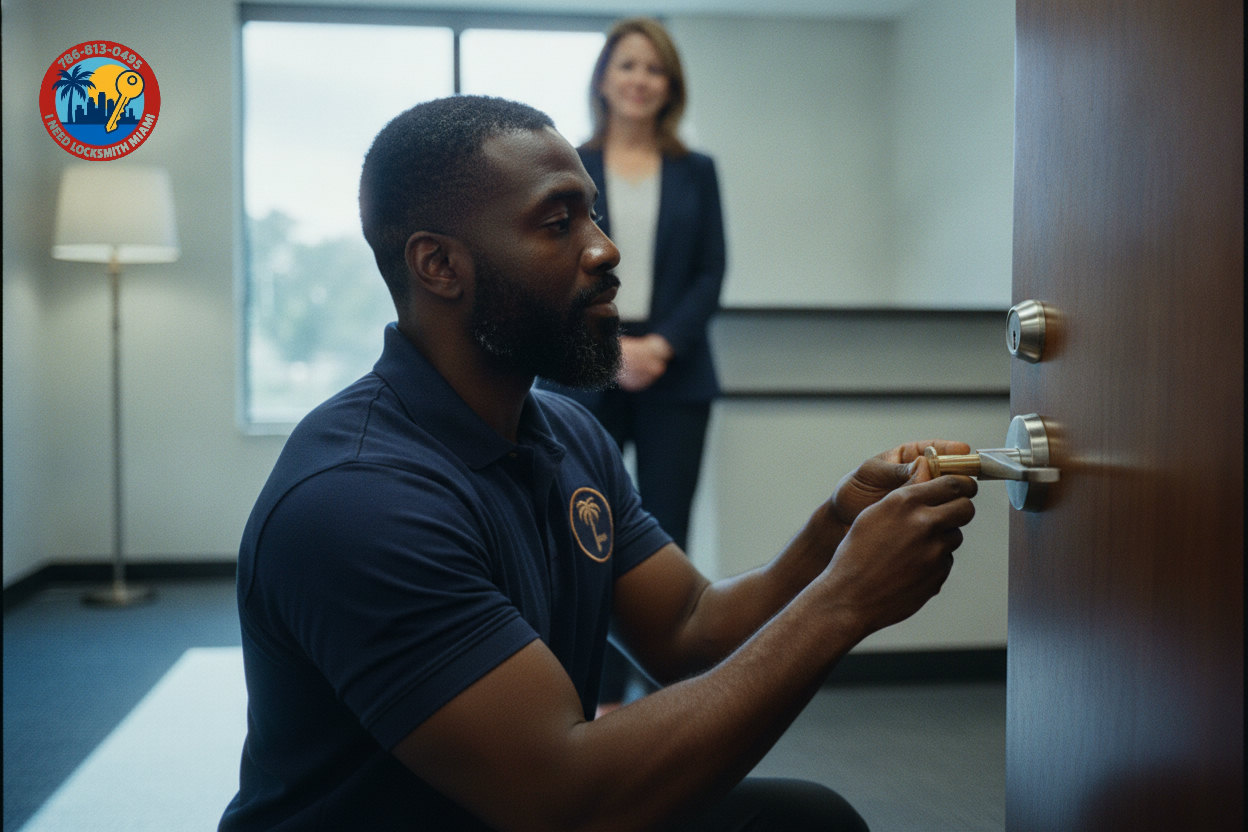
A commercial locksmith in Miami can set up a South Miami multi-tenant office shared conference room lock so a meeting can lock the door from inside without ever locking out the next tenant. The hardware that does this is an entrance/office-function lever, such as the Schlage ND50 in the ND Series. An inside push-button locks the outside lever, and turning the inside lever to walk out releases it automatically.
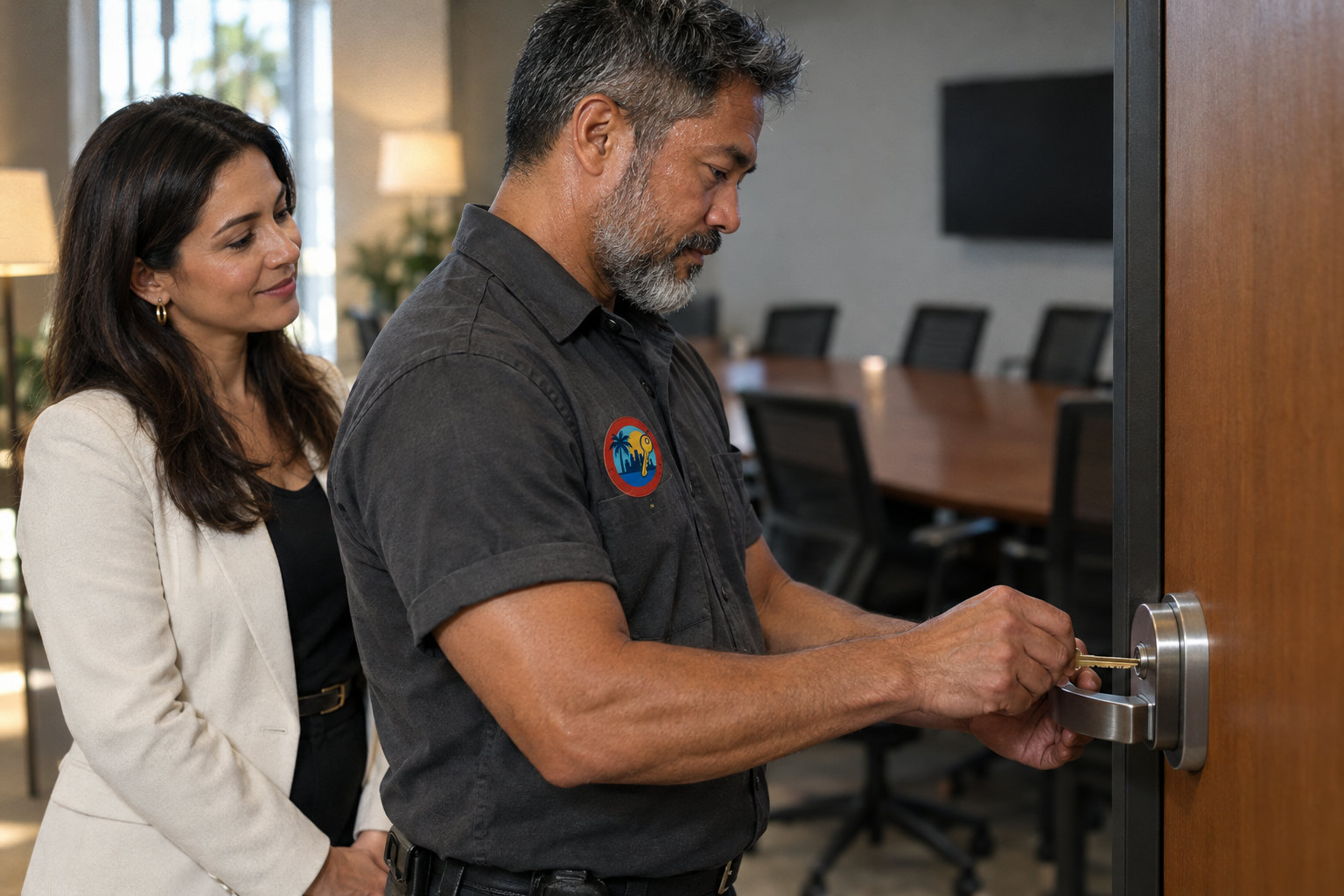
The city is its own municipality, set between Coral Gables and Pinecrest, with a compact commercial core along Sunset Drive and US-1. Many of its low-rise office buildings divide floors among small professional tenants. That layout often puts one conference room behind a door that several businesses share, and the lock on that door has to work for every one of them and still meet the fire code.
This guide is for two people. The first is the office manager in a shared-floor building where the conference room key sits in a front-desk drawer. The second is the property manager who gets the phone call when a meeting finds the door locked. For both of them, the lock’s function matters more than the brand on the lever.
- The entrance/office function (Schlage ND50 in the ND Series) locks the outside lever with an inside push-button. It releases as soon as anyone turns the inside lever, so a shared conference room unlocks itself when the meeting walks out.
- A storeroom function (Schlage ND80) keeps the outside lever locked at all times. Every tenant who arrives without a key is locked out every time.
- NFPA 101, the Life Safety Code, is adopted in Florida through the Florida Fire Prevention Code. It generally requires an egress door to open from inside without a key, tool or special knowledge, which rules out add-on slide bolts on meeting room doors.
- The 2010 ADA Standards require door hardware that works without tight grasping, pinching or twisting of the wrist, mounted 34 to 48 inches above the finished floor.
- A shared conference room key belongs on its own common-area level of the master key system, ideally on a restricted keyway such as Medeco M4 or Mul-T-Lock. Cross-keying the room to every tenant’s suite key is the weaker choice.
- It is an incorporated city with its own city hall and building department, separate from the City of Miami and Coral Gables next door.
- A Metrorail station sits at Sunset Drive and US-1, on the edge of the main commercial district.
- The business core along Sunset Drive mixes low-rise offices, retail storefronts and medical suites.
- A Baptist Health hospital campus is inside city limits, which draws medical and professional office tenants to the surrounding blocks.
- The climate is humid and subtropical, and Atlantic hurricane season runs June 1 through November 30 every year.
What makes South Miami different for a commercial locksmith in Miami working on shared conference rooms?
Shared conference rooms here usually sit inside small low-rise office buildings rather than high-rise towers, and that changes both the hardware choice and who controls the keys. Many smaller buildings have no staffed lobby desk. When a conference room is locked, the room often stays locked until whoever holds the building master key drives over.
That one fact changes the priorities. In a tower with round-the-clock security, a wrong lock function is an inconvenience. On a two-story office floor with an off-site landlord, a storeroom lever on the conference room can cancel a client meeting.
The tenant mix raises the privacy stakes
The blocks around the hospital campus and the Sunset Drive corridor attract tenants who hold confidential conversations, from therapy practices to small law and accounting firms. These tenants have a legitimate reason to want the conference room door locked during a meeting. A passage lever that anyone can open from the hallway does not meet that need.
The other tenants on the floor need the opposite. They must be able to walk up to the same door an hour later and use the room. The right lock function has to serve both groups.
Humidity and storm season affect the hardware
Interior wood doors absorb moisture in a humid subtropical climate. A latch that lined up perfectly in the dry months can drag on the strike plate by late summer. Atlantic hurricane season runs June 1 through November 30, and power outages during that window are a known local risk.
A mechanical lever has nothing to fail when the power goes out. The Schlage ND Series, for example, is a mechanical cylindrical lock certified to ANSI/BHMA A156.2 Grade 1, and it needs no power to lock or unlock. Mechanical lever locks remain the simplest choice for a conference room door that has to keep working through an outage.
Which lock function lets a meeting lock the door without locking out the next tenant?
The entrance/office function lets a meeting lock a shared conference room door without locking out the next tenant, because the lock releases itself when someone turns the inside lever to leave. Lock functions are defined by the hardware industry’s standards: ANSI/BHMA A156.2 covers bored (cylindrical) locks and A156.13 covers mortise locks. The same lock body can usually be ordered in several functions, so the function, not the brand, decides how the door behaves.
A commercial locksmith in Miami fitting a multi-tenant office shared conference room lock should start with the manufacturer’s function chart. The table below compares the common functions on a Schlage ND Series lever, with a mortise note at the end.
| Function | How the outside lever locks | How it unlocks | Effect on the next tenant |
|---|---|---|---|
| Passage (Schlage ND10) | Never locks | Always free both sides | No lockouts, but no privacy for a meeting |
| Entrance/office, push-button (Schlage ND50) | Inside push-button locks it | Turning the inside lever, or a key outside | Room unlocks as the meeting exits. Best fit for a shared room. |
| Privacy | Inside button locks it | Turning the inside lever, or an emergency release tool outside | Works for single-user rooms. There is no keyed cylinder, so there is no key control. |
| Classroom (Schlage ND70) | Key from the outside only | Key from the outside only | Whoever key-locks it last strands everyone without a key |
| Storeroom (Schlage ND80) | Always locked | Key only, every time | Every tenant without a key is locked out on every visit |
| Mortise office/entry (Schlage L9000 and similar) | Inside thumbturn or button | Varies by function code | Some versions stay locked after exit. Check the chart before ordering. |
Why the self-releasing push-button solves the problem
The entrance/office push-button links the lock to the act of leaving. Nobody has to remember to unlock the room, because the person who opens the door from inside resets it. The tenant arriving next finds the outside lever free.
There is one caveat. Someone can press the button while standing in the doorway and then pull the door shut from the hallway, which leaves the room locked. Every tenant with rights to the room therefore still needs a key that operates the cylinder, so the keying plan matters as much as the function.
Indicators and accessible operation
Occupied/vacant indicators help on a shared room. Several mortise lock lines, including the Schlage L9000 Series, offer indicator options that show from the hallway whether the room is locked, which cuts down on knocking and on tenants assuming the room is broken.
Accessibility also affects the inside trim. The 2010 ADA Standards call for operable parts that work without tight grasping, pinching or twisting of the wrist. A lever with a push-button is usually easier to meet that standard with than a small thumbturn.
The entrance/office function (Schlage ND50) is the standard answer for a shared conference room: the push-button locks the outside lever and turning the inside lever releases it. Classroom (ND70) and storeroom (ND80) functions are the usual causes of next-tenant lockouts. Mortise office functions vary by code, so confirm the release behavior on the manufacturer’s chart.
What problems do shared conference room doors in multi-tenant offices run into?
Shared conference room doors in multi-tenant offices usually fail in four ways: the wrong lock function, keys that outlasted a tenant, a latch that drags in the humidity, and improvised locks that break egress rules. Each one has a clear cause and a contained fix. None of them requires replacing the door if it is caught early.
1. A storeroom lever on a room everyone shares
Storeroom-function levers often end up on conference room doors because the same function was ordered for the electrical closet and the file room during a build-out. A storeroom lever such as the Schlage ND80 is always locked from outside, so the room behaves like a closet. The property manager then becomes a full-time door attendant.
The fix is usually a function change on the same door prep, not a new door. The differences between those two lever functions are covered in this comparison of storeroom vs classroom lever locks for commercial doors.
2. Conference room keys that walked out with a former tenant
Conference room keys spread faster than suite keys, because every tenant gets one and copies get handed to new hires. A common mistake is not rekeying after a tenant moves out or an employee leaves. That leaves a working key in the hands of people who no longer belong on the floor, which is a real security gap and a liability exposure for the landlord.
Rekeying the conference room cylinder is a pin change, and the lever stays on the door. The full turnover checklist for a shared building is laid out in this guide to multi-tenant office lock changes at tenant turnover with Schlage ND hardware.
3. A latch that drags when the door swells
Wood conference room doors in a humid climate can swell enough that the latch rubs the strike or fails to drop into it. When that happens, the push-button may not hold, or the door looks closed but swings open mid-meeting. A door closer slamming the door harder to compensate makes the wear worse.
A common mistake is calling a locksmith only after someone has pried at the lever or kicked the frame. At that point a simple strike adjustment turns into frame or jamb repair added to the lock work. If the latch starts dragging, stop forcing it and have the strike and hinges checked.
4. Slide bolts, hotel latches and taped strikes
For the tenant who runs confidential client meetings and keeps a doorstop wedged against the conference room door, the fix is a function change, not a second lock. Surface slide bolts and hotel-style swing latches add a second releasing motion to the egress side. NFPA 101, which Florida enforces through the Florida Fire Prevention Code, generally limits egress doors to a single releasing operation that needs no key, tool or special knowledge.
The opposite workaround is just as common. Tape over the latch keeps the room open for everyone and secures it for no one. Both workarounds point to the same issue: the installed function does not match how the room is used.
How should a shared conference room lock be keyed and installed?
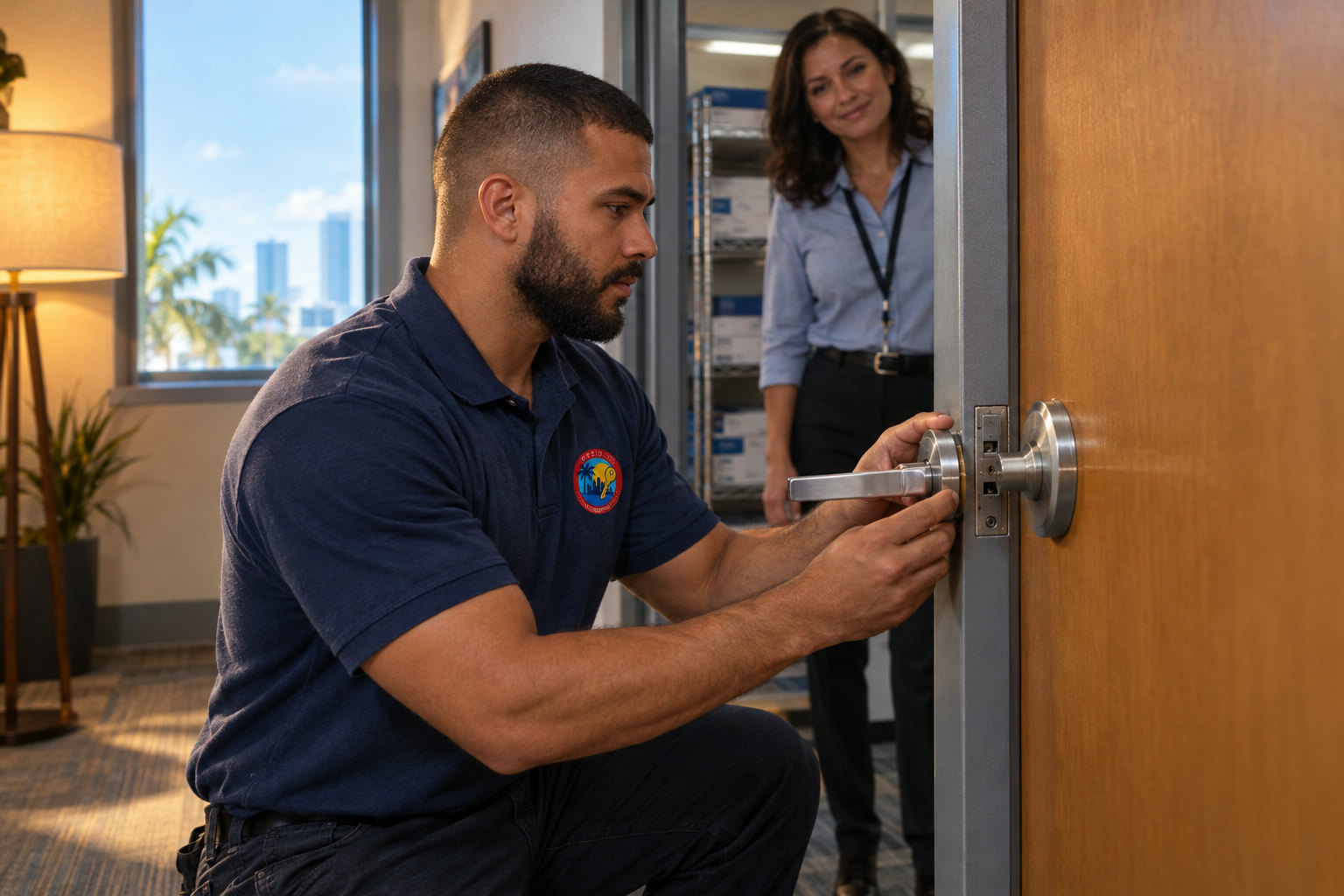
A shared conference room lock should be installed as an entrance/office-function lever on a standard commercial door prep and keyed to a common-area level of the building’s master key system. Most commercial interior doors are 1-3/4 inches thick, and Grade 1 cylindrical levers such as the Schlage ND Series are built around a 2-3/4 inch standard backset. When the existing door matches, the swap usually needs no new drilling.
Survey the door and frame
Confirm door thickness, backset, bored or mortise prep, hinge condition and any fire-rating label on the door edge or frame. A labeled fire door needs listed hardware, and frame changes should be checked with the city’s building department.
Match the function to the chart
Choose entrance/office push-button for a bored lock, or confirm on the Schlage, Yale or ASSA Abloy mortise chart that turning the inside lever releases the lock.
Pick the cylinder and keyway
For a room many people hold keys to, a restricted keyway such as Medeco M4 or Mul-T-Lock keeps copies from being cut at a hardware counter.
Key it as a common-area level
Give the conference room its own common key under the building master, so one tenant’s departure never forces a repin of every suite.
Set the latch, strike and closer
Align the strike so the latch drops cleanly in humid months, and adjust any closer so the door latches without slamming.
Hand over a written key schedule
Record which tenants hold conference room keys, so the next rekey covers exactly the right people.
Common-area key vs cross-keying every tenant
Cross-keying means pinning the conference room cylinder so each tenant’s own suite key also opens it. It is convenient, and it is the weaker design. Every added key adds shear points inside the cylinder, which loosens the system’s key control, and every tenant turnover then means repinning a shared cylinder.
A dedicated common-area key costs each tenant one extra key on the ring. In return, the building owner can rekey one cylinder when one tenant leaves. On a high-security platform such as Medeco M4, which is covered in this look at Medeco M4 locks for multi-tenant offices, key duplication is also controlled through an authorized dealer.
Finishes and brands that hold up in humid air
Hardware finish matters in a humid climate. BHMA finish 626 (satin chrome) and 630 (satin stainless steel) generally hold up better than polished brass on a high-touch lever. Schlage, Yale and ASSA Abloy all list Grade 1 commercial levers in these finishes.
Electronic scheduling is a different job. If the room is booked by time slot, shared by many tenants, or needs a record of who opened it, a keypad or card reader may fit better than any mechanical lever. The trade-offs are explained in this comparison of offline keypads vs cloud card readers for multi-tenant offices.
Our view
This is opinion, plainly labeled. Office managers tend to overweight the brand and the technology, and to underweight the function code. A Schlage, Yale or ASSA Abloy Grade 1 lever in the wrong function will strand tenants exactly as a cheaper one would.
For most shared meeting rooms in low-rise office buildings, the strongest combination is a mechanical entrance/office lever, a restricted common-area key and a rekey at every tenant turnover. It is not the newest option. It works during a power outage, meets single-motion egress, and leaves the next tenant with an unlocked door.
Electronic access earns its place when the room needs scheduling or an audit trail. Without either of those needs, it adds batteries, codes and a management login to a problem that one function change already solves.
Frequently asked questions
Can a conference room lock unlock automatically when the meeting leaves?
A conference room lock can unlock automatically when it uses the entrance/office push-button function, such as the Schlage ND50. Turning the inside lever to exit releases the button, so the outside lever is free for the next tenant. A key outside also unlocks it if someone pushed the button and pulled the door shut.
Can we add a slide bolt or deadbolt to a shared conference room door?
A slide bolt or separate deadbolt on a shared conference room door usually adds a second releasing motion on the egress side. NFPA 101, enforced in Florida through the Florida Fire Prevention Code, generally requires a single releasing operation with no key, tool or special knowledge. Changing the lever to an entrance/office function provides privacy without that conflict.
Should every tenant’s suite key open the shared conference room?
Every tenant’s suite key can be cross-keyed to open the conference room, but a dedicated common-area key is the stronger master key design. Cross-keying adds shear points that weaken key control and forces a repin of the shared cylinder at every turnover. A restricted keyway such as Medeco M4 or Mul-T-Lock adds control over who can copy the common key.
Does the conference room need rekeying when a tenant moves out?
The conference room cylinder should be rekeyed whenever a tenant moves out or an employee with a key leaves, because every common-area key stays a working key until the pins change. Rekeying keeps the existing Schlage, Yale or other lever on the door and replaces only the internal pinning. New common keys then go only to the tenants on the current key schedule.
If the shared conference room in your South Miami office building has a storeroom lever, a slide bolt or keys nobody can account for, call I Need Locksmith Miami at (786) 813-0495. As a commercial locksmith in Miami with 24/7 mobile service across Miami-Dade, the team can survey the door, recommend the right function and keying level, and give you pricing for the hardware and labor directly.
Sources
- Egress door requirements (no key, tool or special knowledge; single releasing operation): NFPA 101, Life Safety Code
- Operable parts and door hardware mounting height of 34 to 48 inches: 2010 ADA Standards for Accessible Design, U.S. Department of Justice
- Atlantic hurricane season dates of June 1 through November 30: National Hurricane Center, NOAA
- ANSI/BHMA standards for bored and mortise locks and finish designations: Builders Hardware Manufacturers Association
I Need Locksmith Miami
I Need Locksmith Miami is a Miami-Dade locksmith and door specialist serving residential, commercial, and automotive customers.
 Listen to this articleAudio version
- A Miami Edgewater Office Manager Asked a Commercial Locksmith: “Why Does Our Shared Supply Room Stay Unlocked After Someone Uses a Key?”
- A Medley Office Manager Asked a Commercial Locksmith in Miami: “What Type of Lock Is Best for a Multi-Tenant Office When Tenants Keep Copying Shared Keys?”
- A Hialeah Office Manager Asked: “Will Our Multi Tenant Door Unlock During a Power Outage?” What Maglock and Electric Strike Wiring Means for Access Control
- A Coral Gables Office Manager Asked a Commercial Locksmith in Miami: “When a Tenant Moves Out, Should We Rekey or Replace the Office Locks?”
- An Allapattah Manager Asked a Commercial Locksmith in Miami: “Who Should Hold the Schlage ND Interchangeable Core Control Key When a Tenant Moves Out?”