Last updated: September 29, 2026
Published September 29, 2026 · Updated September 29, 2026
Every locksmith in Miami Hialeah multi tenant office door maglock electric strike power outage access control question comes down to one rule of physics. A maglock unlocks the instant power drops, a fail-safe electric strike unlocks too, and a fail-secure electric strike stays locked from the outside while everyone inside can still walk out through the lever. If your shared entrance is held by a magnet, expect it to swing free during an outage unless a battery backup is carrying it.
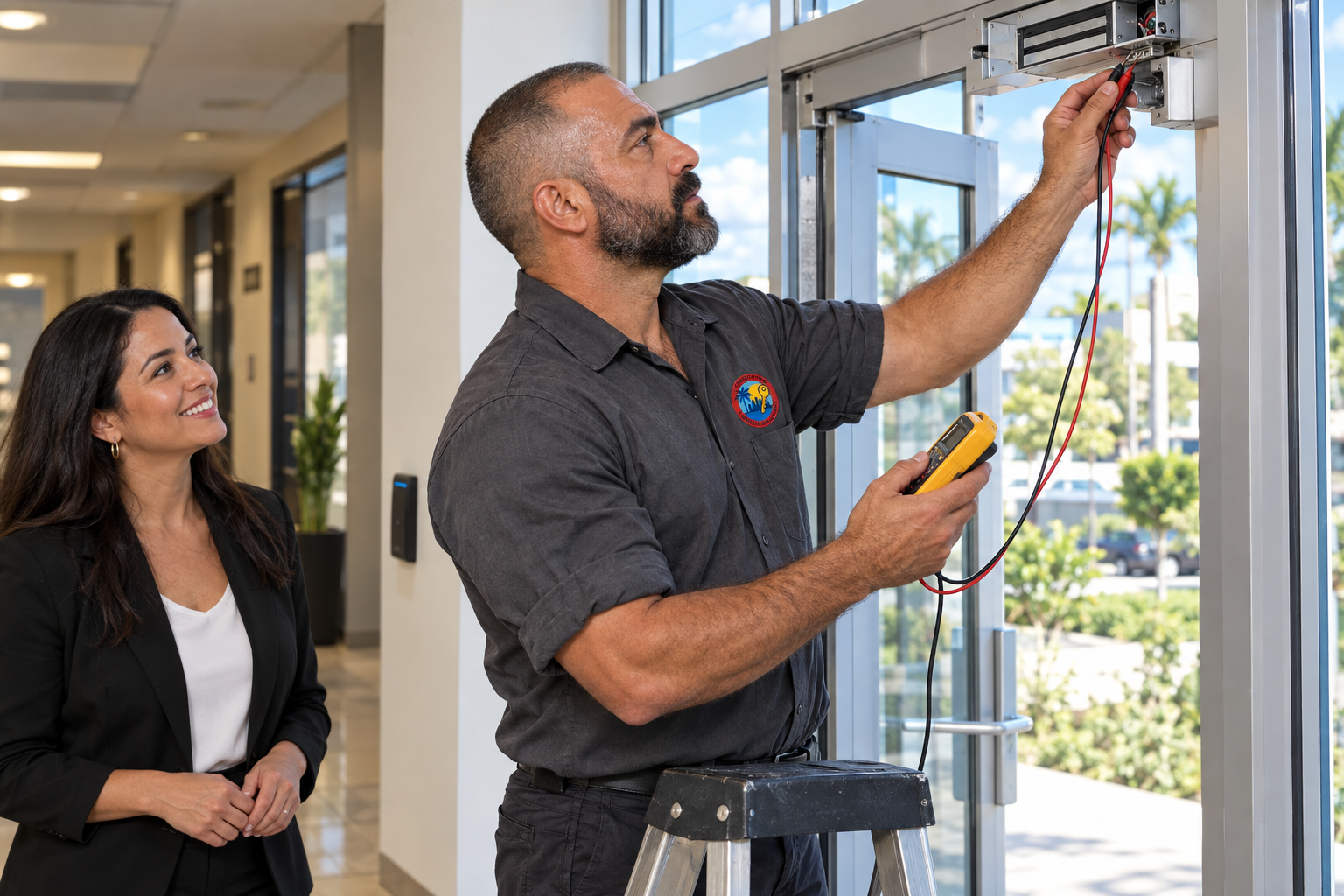
- A maglock such as the ASSA ABLOY Securitron M62 holds only while it has current; when power is cut, the door releases in both directions almost instantly.
- A fail-secure electric strike such as the ASSA ABLOY HES 1006 stays locked from the outside during an outage, while the inside lever or exit device still opens the door mechanically.
- Fail-safe electric strikes are not used on fire-rated doors, because a fire door must stay positively latched during a fire.
- Under the IBC-based Florida Building Code and NFPA 101, a maglock on an egress door generally needs a motion sensor plus a manual release button mounted 40-48 inches above the floor, within 5 feet of the door, that unlocks it for at least 30 seconds.
- The Atlantic hurricane season runs June 1 through November 30, the stretch when Miami-Dade offices find out whether their access control batteries still hold a charge.
- Rekeying the mechanical override after a tenant moves out matters as much as deleting their card, because the key cylinder is the only way in when a fail-secure door has no power.
This comparison covers three options: a magnetic lock (maglock), a fail-safe electric strike, and a fail-secure electric strike. No single option wins on every door. For the typical perimeter and suite entry doors in a multi-tenant office, the fail-secure electric strike wins on security, battery life, and fire-door compliance. The maglock earns its place where the door or frame gives a strike nowhere to go.
If you manage a low-rise office building with one shared lobby door, several tenant suites on a single card system, and a power supply closet nobody has opened since installation, this guide is for you. It is not for a homeowner choosing a Wi-Fi deadbolt. It is for the person who gets the phone call when the lights go out and the front door does something unexpected.
- What gets checked first on a multi tenant office door
- How a maglock behaves in an outage
- How a fail-safe electric strike behaves
- How a fail-secure electric strike behaves
- What to do before the next outage
- When to choose which
- Why South Florida outages change the math
- Our verdict
- Our take after years of access control work
- Frequently asked questions
- Sources
What Does a Locksmith in Miami Check First on a Hialeah Multi Tenant Office Door During a Power Outage?
An access control technician checking a multi-tenant office door for outage behavior looks at three things first. The first is the type of electrified lock. The second is whether that lock is set fail-safe or fail-secure. The third is whether a charged battery sits behind the power supply.
The hardware tells most of the story before anyone touches a meter. A rectangular magnet bolted to the door header, with a steel plate on the door, is a maglock. A cutout in the frame where the latch lands, often with a thin wire running up the jamb, is an electric strike.
Whether a strike is fail-safe or fail-secure is not visible from the lobby. Many strikes, including the HES 1006 series, are field-selectable, so the setting depends on how the installer configured it. That is why the label and the wiring matter more than a guess.
| Attribute | Maglock (e.g., Securitron M62) | Fail-Safe Electric Strike | Fail-Secure Electric Strike (e.g., HES 1006) |
|---|---|---|---|
| Outside entry during outage | Unlocked; door opens for anyone | Unlocked; keeper swings free | Locked; mechanical key override only |
| Inside egress during outage | Free (magnet released) | Free | Free through inside lever or exit device |
| Extra egress devices required | Motion sensor plus push button 40-48 in. high, within 5 ft, 30-second release | Normally none beyond fire alarm tie-in where required | None; egress is mechanical |
| Fire-rated doors | Confirm with the fire marshal first | Not used | Used, with a strike listed for fire doors |
| Power draw | Continuous, 24 hours a day | Continuous while locked | Only during the unlock pulse |
| Frame work at install | Surface mounted on the header | Strike pocket cut into the frame | Strike pocket cut into the frame |
| Best fit | Doors with no room for a strike, such as narrow-stile aluminum | Non-rated interior doors that may open freely in an outage | Perimeter and tenant suite entry doors |
How Does a Maglock Behave When the Power Goes Out?
A maglock releases completely the moment it loses power, so an office door held by a magnet opens freely in both directions during an outage unless a battery backup keeps the coil energized. There is no in-between state. The magnet either holds or it does not.
The Securitron M62, an ASSA ABLOY product in the 1,200-pound holding-force class, is a typical example. It has no moving parts inside the lock. That simplicity is why maglocks rarely wear out mechanically, and it is also why they cannot stay locked without current.
Maglock strengths: they mount on the surface of the header, they work on doors where a strike cannot be cut in, and they release instantly on fire alarm. On narrow-stile aluminum doors, a maglock is often the only practical electrified option.
Maglock weaknesses: on an egress door, the IBC-based Florida Building Code and NFPA 101 generally expect a motion sensor on the inside, a push-to-exit button 40-48 inches above the floor within 5 feet of the door that cuts lock power for at least 30 seconds, and automatic release on fire alarm and loss of power. That is more devices to install, test, and maintain.
Maglocks also draw current around the clock. On a humid August afternoon you can put a palm on the magnet housing and feel it running warm. In a quiet lobby you can sometimes hear the faint hum.
Some installers put maglocks on battery backup to keep a lobby locked through an outage. Whether that is acceptable on an egress door is a question for the fire official who inspects your building, not for the installer to settle alone. A maglock is honest hardware. It just picks safety over security every time.
How Does a Fail-Safe Electric Strike Behave in an Outage?
A fail-safe electric strike unlocks when power is lost, so the outside of the door opens for anyone during an outage. The difference from a maglock is that the door keeps its normal mechanical latch and lever.
Inside the frame, the strike’s keeper is held rigid by power. When power drops, the keeper is free to swing, and the latchbolt passes through as the door is pulled. The latch still catches the door when it closes, so the door stays shut against wind and air-conditioning pressure even while it is unlocked, as long as the closer is doing its job. If yours is not, a door closer adjustment and repair visit should come before any access control work.
Fail-safe strike strengths: it suits non-rated interior doors, such as a shared conference room or an amenity room, where free access during an outage or fire alarm is acceptable. It avoids the motion sensor and push-button package a maglock usually needs on egress doors.
Fail-safe strike weaknesses: it is not used on fire-rated doors, because a rated door must remain positively latched during a fire. It draws current continuously, like a maglock, and it requires cutting a pocket in the frame.
Here is an insider detail. Stairwell doors that must unlock for re-entry during a fire alarm are usually fire-rated, so they typically get a fail-safe electrified lockset rather than a fail-safe strike. The outside lever frees up while the latch keeps holding the door closed. The fail-safe strike is the least common of the three on office perimeters, and for good reason.
How Does a Fail-Secure Electric Strike Behave in an Outage?
A fail-secure electric strike stays locked from the outside when power is lost, while people inside still exit freely because the inside lever or exit device retracts the latch mechanically. This is the point most office managers miss. The strike never controls egress. The lockset does.
A typical pairing is a Schlage ND-series or Yale cylindrical lever in storeroom function, where the outside lever is always locked and the inside lever always opens. On doors with panic hardware, a rim exit device paired with an HES 9600-series surface strike does the same job. In both cases, egress works with or without electricity.
Fail-secure strike strengths: the building stays secure during an outage. The strike draws power only for the second or two it takes to release, so the same battery lasts far longer than it would on a maglock. It is also the correct choice on fire-rated doors when the strike is listed for fire door use.
Fail-secure strike weaknesses: card holders cannot get in during an outage without a key, so the mechanical override cylinder becomes the only way in. That makes key control part of your access control plan. It also means frame prep: hollow metal and aluminum frames often need cutting or a new strike box, because a strike rarely drops into the existing latch opening.
You can hear a well-adjusted fail-secure strike working: a sharp click at the card swipe, then silence. Nobody gets trapped inside. Nobody walks in uninvited.
A fail-secure electric strike such as the HES 1006 keeps a multi-tenant office door locked from outside during a power outage while the storeroom-function lever or exit device keeps egress free. It draws power only during the unlock pulse, which makes battery backup last much longer than on a maglock.
What Should an Office Manager Do Before the Next Outage?
An office manager can learn how every card-reader door in a multi-tenant building will behave in a blackout with one afternoon walkthrough and a controlled power test. Coordinate the test with the building owner and the fire alarm company first. Doors tied to the fire panel should never be tested without them.
Label every electrified door
Walk each card-reader and keypad door and note whether it has a header magnet or a frame strike. Write it down per door, not per floor.
Open the power supply cabinet
Check whether batteries are present and when they were installed. A missing date sticker is a warning sign.
Run a controlled power test
With permission, cut AC power to the access control supply and record what each door does from both sides. Then restore power and confirm every reader comes back online.
Confirm the egress side of maglock doors
Look for the motion sensor and a push button within 5 feet of the door, 40-48 inches off the floor. If either is missing, that door needs attention before anything else.
Audit cards and override keys together
Delete credentials for departed tenants and employees, then rekey the override cylinders they may hold keys to. One without the other leaves a gap.
The key and credential audit usually overlaps with mechanical key work. If your override cylinders are part of a larger building keying scheme, our commercial rekeying and master key systems page explains how the two fit together.
Which Lock Fits Which Door in a Multi-Tenant Office?
The right lock for a multi-tenant office door depends on whether the door is fire-rated, whether it is an exterior or interior door, and whether a strike can physically fit in the frame. Match the hardware to the door, not the door to a favorite product.
- Choose a fail-secure electric strike for the main lobby door, tenant suite entry doors, and any fire-rated door, paired with a Schlage or Yale storeroom-function lever or an exit device.
- Choose a maglock when the door is narrow-stile aluminum or otherwise has no room for a strike, and accept the motion sensor, push button, and fire alarm release that come with it.
- Choose a fail-safe electric strike for non-rated interior doors, like a shared conference room, where unlocking during an outage is acceptable.
- Choose a fail-safe electrified lockset instead of a strike for fire-rated stairwell doors that must allow re-entry on fire alarm.
Why Do South Florida Outages Change the Access Control Math?
South Florida office buildings lose power to summer thunderstorms and to storms during the Atlantic hurricane season, which the National Hurricane Center defines as June 1 through November 30. Battery standby time on an access control power supply is not a theoretical spec here. It is the difference between a locked lobby and an open one.
For a Hialeah office building with one shared entrance and suites behind it, that entrance decides everything. If it is a maglock with a tired battery, every suite behind it depends on its own interior door lock through the night.
Access control power supplies from makers like Altronix and LifeSafety Power typically charge sealed lead-acid batteries. Heat shortens the life of those batteries, and many supply cabinets sit in electrical closets with no air conditioning. Open one in September and you get a wave of warm air and that faint smell of hot electronics.
Honestly, the most common surprise on these walkthroughs is not the lock at all. It is a battery that has been sitting in the cabinet long past its useful life. The door worked every day on building power, so nobody knew.
Load matters just as much as age. A maglock pulls current nonstop, so its battery drains steadily through an outage. A fail-secure strike pulls current only at each unlock, so the same battery can carry the controller and readers much longer.
Two more checks round it out. If the building has a generator, confirm the access control circuit is actually on it. If you run a cloud-managed platform such as Brivo or Avigilon Alta, ask your installer how the door controllers behave when the internet connection drops along with the power. Our access control installation and repair in Miami service covers power supply sizing, battery replacement, and fire alarm tie-ins as part of the same visit.
Our Verdict
For most multi-tenant office perimeter and suite doors, a fail-secure electric strike paired with a storeroom-function lever or exit device is the best choice. It keeps the building locked during an outage, keeps egress free, is the correct choice on fire-rated doors, and goes easiest on batteries.
The Hialeah property manager with a shared lobby and several suites: put fail-secure strikes on the lobby and suite doors, make sure every override cylinder is on a controlled key, and rekey at every tenant turnover.
The building with narrow-stile aluminum entry doors: a maglock is often the realistic option. Do it to code, with the motion sensor, push button, and fire alarm release, and settle the battery backup question with your fire official before installation, not after.
The office with shared interior rooms: a fail-safe strike is fine on non-rated interior doors. Keep it off fire-rated doors entirely. That rule is not flexible.
Our Take After Years of Access Control Work
In our experience, office managers overweigh holding force. They ask whether a 1,200-pound maglock is stronger than a 600-pound one, when the real question is what that door does the second the power disappears. A strong magnet with no power holds nothing.
What actually matters is the whole chain: the door and frame, the closer, the lockset function, the power supply, the battery, and the key override. We would rather see a modest strike on a well-hung door with a fresh battery than premium hardware on a sagging frame with a dead one.
If a friend managed an office building, we would tell them one thing. Before signing off on any access control install, ask the installer to show you, door by door, what happens when the breaker flips. If they cannot answer clearly, keep looking.
Frequently Asked Questions
Will a maglock door stay locked during a power outage?
A maglock door does not stay locked during a power outage unless a battery backup keeps the magnet energized, because an electromagnet such as the Securitron M62 only holds while current flows. NFPA 101 and the IBC-based Florida Building Code also generally require maglocks on egress doors to release on loss of power and on fire alarm, so ask your fire official before relying on battery backup.
Can an electric strike be used on a fire-rated office door?
An electric strike on a fire-rated office door must be a fail-secure model listed for fire door use, such as a fire-rated version of the HES 1006 series. Fail-safe strikes are not used on fire-rated doors because the door must stay positively latched during a fire.
Does a fail-secure electric strike trap people inside during an outage?
A fail-secure electric strike does not trap people inside during an outage, because the inside lever or exit device retracts the latch mechanically without any power. With a Schlage or Yale storeroom-function lever, anyone inside can leave at any time, while outside entry requires the mechanical override key until power returns.
How long will a battery backup keep an access control door working?
Battery backup runtime on an access control door depends on the lock’s power draw, the battery’s age, and the heat in the closet where the power supply sits. Maglocks draw current continuously while fail-secure strikes draw only during each unlock, so the same Altronix or LifeSafety Power battery lasts far longer on strikes. For Hialeah office buildings, a load calculation and battery check before hurricane season, which starts June 1, is the reliable way to know.
Sources
- Atlantic hurricane season dates (June 1 through November 30): National Hurricane Center, NOAA
- Florida Building Code, based on the International Building Code: Florida Building Commission
- Access-controlled egress door and electrically locked door provisions: International Code Council Digital Codes
- NFPA 101 Life Safety Code, adopted through the Florida Fire Prevention Code: National Fire Protection Association
Not sure which of the three is on your doors right now? Call (786) 813-0495, available 24/7 across Miami-Dade, or request an on-site outage walkthrough, and we will label every electrified door, test the power supply, and tell you exactly what each one does when the lights go out. Pricing is quoted per building after we see the doors.
I Need Locksmith Miami
I Need Locksmith Miami is a Miami-Dade locksmith and door specialist serving residential, commercial, and automotive customers.
Book a Maglock and Electric Strike Outage Check for Your Office →
 Listen to article
- A Hialeah Retail Owner Asked: “Is a Maglock or an Electric Strike Better for My Glass Storefront Door?” — The Detailed Breakdown
- A Doral Condo Manager Asked: “How Long Does It Take to Install a Card-Reader Access System for 40 Units?” — A Tech’s Honest Timeline
- A Bal Harbour Boutique Manager Asked: “How Do We Give Temporary Access to Contractors Without Changing Our Main Lock Code?”
- The Aventura High-Rise That Had 3 Herculite Glass Door Hinges Fail During Peak Season — How We Fixed All Three Same Day
- A Fisher Island Condo Owner Asked: “Do I Need a Separate Cloud Access System or Can My Existing Schlage Encode Plus Handle Multiple Unit Doors?”, A Tech’s Direct Answer




2 Responses