Last updated: October 25, 2026
Published October 25, 2026 · Updated October 25, 2026
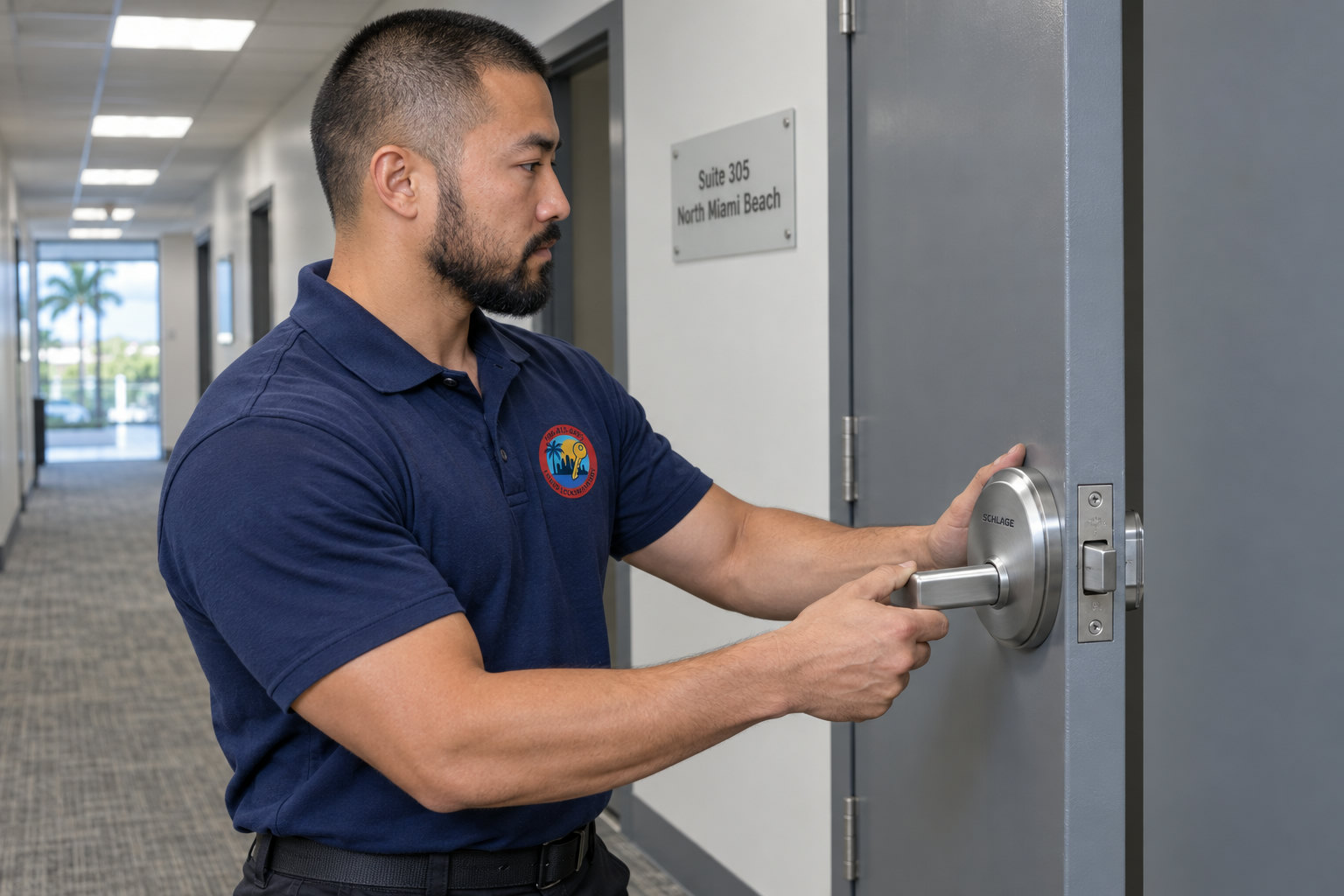
A commercial locksmith in Miami North Miami Beach can usually give a fire-rated office suite door deadbolt-level security, but rarely by drilling a new 2-1/8-inch hole, because NFPA 80 limits job-site changes to labeled fire doors and an unapproved bore can void the label. The code-safe routes are a fire-listed lock with a deadbolt function that retracts with the inside lever, a door that comes factory-prepped for the hardware, or a field modification approved by the labeling agency. The question tends to come up right after a break-in elsewhere in the building or after an employee leaves with a key, which is exactly when a rushed drill job does the most damage.
- NFPA 80 allows only a short list of job-site changes to a labeled fire door, such as holes for surface-applied hardware and function holes for mortise locks; a new 2-1/8-inch cylindrical deadbolt bore is not on that list.
- Positive latching is mandatory on fire doors: the door must close and latch on its own every time, which a separately thrown deadbolt cannot do.
- One releasing operation: NFPA 101, the life safety code behind the Florida Fire Prevention Code, generally requires an egress door to open from the inside with a single motion and no key, tool or special knowledge.
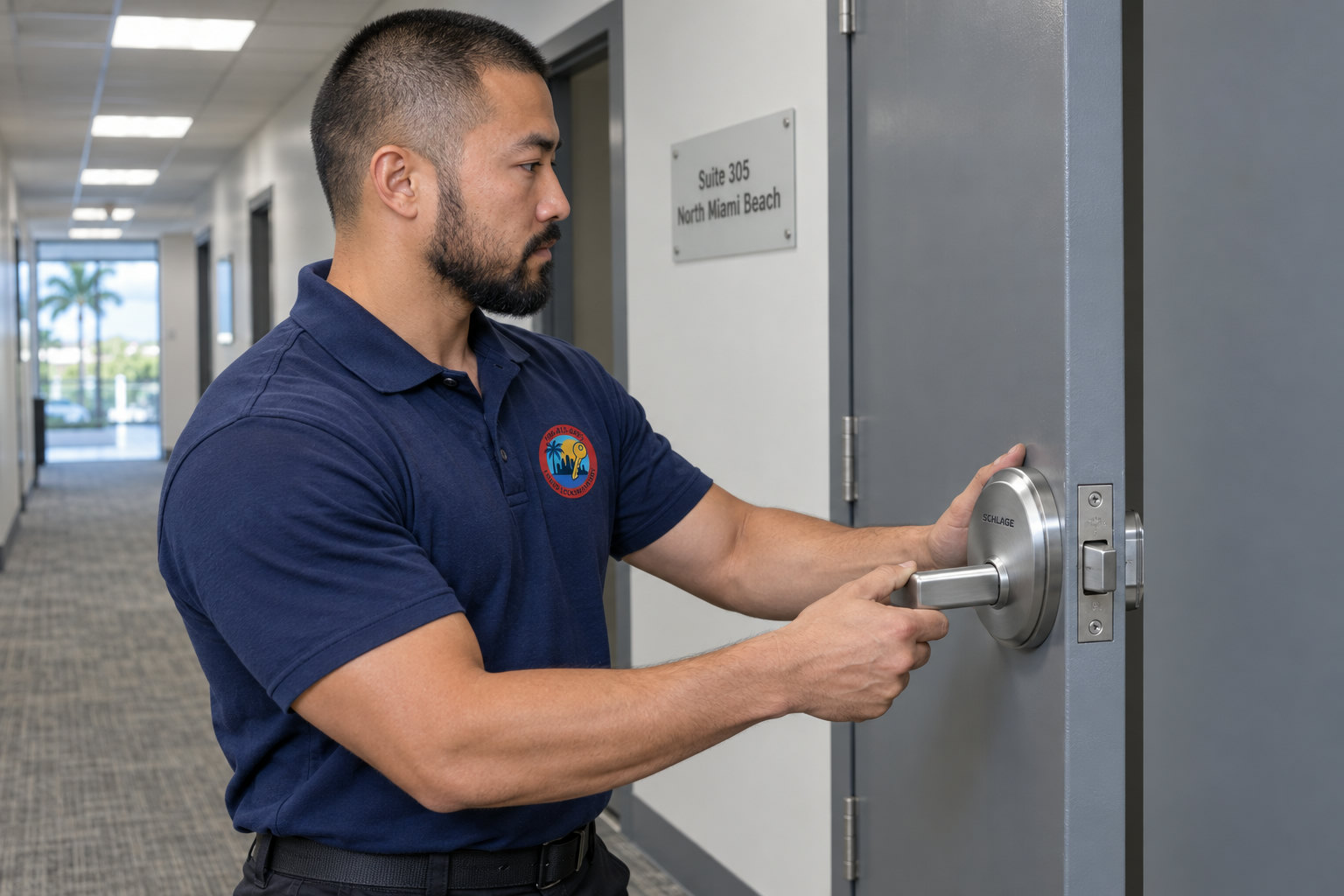
- Deadbolt-function mortise locks such as the Schlage L9000 series retract the latch and the deadbolt together when the inside lever is turned, which keeps egress to one motion.
- Annual inspection: NFPA 80 requires fire door assemblies to be inspected and tested at least once a year, so an improper lock change tends to surface at the next inspection.
- Where the fire label sits on a suite door and frame, and why it gets read before any tool comes out.
- Why a standard bored deadbolt usually fails two separate code tests on a corridor door, not just one.
- Five realistic ways to make a rated door harder to defeat, and the situation where each one wins.
- How a new cylinder gets keyed into a building’s existing master key system without breaking landlord or emergency access.
What a Commercial Locksmith in Miami North Miami Beach Checks Before Touching a Fire-Rated Suite Door
Adding a deadbolt to a fire-rated office suite door is a code question before it is a hardware question. The door, frame, hinges, closer and lock were tested and labeled as one assembly, and NFPA 80 treats any change to that assembly as something that has to stay within the listing.
This is for tenants and property managers in multi-tenant office buildings whose suite door opens onto a shared corridor or stairwell. It is not aimed at the owner of a standalone storefront with an unrated door, where a deadbolt is a much simpler job.
Two separate tests apply. The first is the fire door test from NFPA 80: the door must stay self-closing and positive-latching, and its label must remain valid. The second is the egress test from NFPA 101 and the Florida Fire Prevention Code: people inside must be able to get out with one releasing motion, without a key.
A typical bored deadbolt added above an existing lever can fail both tests at once. It needs a new hole the field may not cut, and it adds a second motion to get out. That is why the answer is rarely a flat yes and rarely a flat no.
The Process, Step by Step
The process for securing a labeled office suite door follows the same order every time, because each step decides what the next one is allowed to be. Skipping ahead to the drill is the expensive shortcut.
- Read the label on the door and the frame. Fire door labels are typically found on the hinge edge of the door, and frame labels on the hinge jamb or head. The label states the rating (20, 45, 60, 90 minutes or 3 hours) and the agency that listed it, such as UL or Intertek. A painted-over or missing label changes the whole job, so it gets photographed before anything else.
- Identify the existing lock preparation. A door prepped for a cylindrical lever lock (the common ANSI 161 bore) and a door prepped for a mortise lock (an 86-style edge prep) allow very different upgrades. A door that already carries a factory deadbolt prep, sometimes covered with a blank plate, opens options a plain door does not.
- Test egress from the inside. The technician checks how many motions it takes to open the door from the suite side. If the answer would become two after an upgrade (lever plus thumbturn), that design is off the table for most business occupancies unless the fire marshal approves an exception.
- Match the upgrade to the prep. On a mortise-prepped door, a deadbolt-function mortise body such as a Schlage L9000 series lock can go into the existing pocket, with the inside lever retracting latch and bolt together. On a cylindrical-prepped door, the realistic paths are a high-security cylinder from Medeco or Mul-T-Lock, a factory-prepped replacement door, or a labeling-agency field modification.
- Confirm every new part is listed for fire doors. Lock bodies, strikes and any electrified hardware must carry a listing for use on fire-rated openings. Brands like Schlage, Yale and ASSA Abloy publish which models are fire-listed, and that documentation goes into the job file.
- Install, then retest closing and latching. After installation, the door is released from full open and must close and latch on its own with no push. NFPA 80 also sets clearances for steel doors, commonly 1/8 inch at the head and jambs and no more than 3/4 inch at the bottom, and a gauge confirms them.
- Key the cylinder into the building’s system and document it. The new cylinder is pinned to fit the existing master key system, whether that is Schlage, Medeco or Mul-T-Lock, so the landlord and building management keep access. The tenant gets a written note of the make, model and listing for the next annual inspection.
Tools We Use
The tools for a fire-rated suite door job lean more toward inspection and verification than cutting. Most of the work is confirming what the door already is.
| Tool or product | What it does on this job |
|---|---|
| Inspection mirror and raking-light flashlight | Reads embossed or painted-over labels on the hinge edge and frame without removing the door. |
| Door clearance gauge | Checks the 1/8-inch head and jamb gaps and the 3/4-inch maximum undercut NFPA 80 sets for steel fire doors. |
| Schlage L9000 series mortise lock | A Grade 1 mortise lock with deadbolt functions in which the inside lever retracts latch and bolt in one motion. |
| Medeco or Mul-T-Lock high-security cylinder | Adds pick and bump resistance plus restricted key control through the existing prep, with no new hole. |
| Pinning kit and master key system chart | Keys the new cylinder to the building’s master hierarchy so management and emergency access are preserved. |
For a closer look at how different mortise cylinders behave inside a master key system, see this comparison of Schlage AD, Yale AU and Mul-T-Lock Interactive mortise cylinders for office master key systems.
Which Option Fits Which Suite Door?
Securing a rated corridor door comes down to five realistic options, and none of them wins everywhere. The right one depends on the existing prep, the lease, and how much disruption the tenant can absorb.
| Option | Wins when | Trade-off |
|---|---|---|
| High-security cylinder (Medeco, Mul-T-Lock) | The worry is copied keys or picking, and the door has a cylindrical lever lock. | No longer bolt throw; the latch is still the only bolt. |
| Deadbolt-function mortise lock (Schlage L9000 series) | The door is already mortise-prepped and the goal is a true throw bolt. | Needs the right function and a listed lock body; not possible on a bored-only door. |
| Factory-prepped replacement door | The current door is damaged, has illegal holes, or the tenant plans a long lease. | Most disruptive; lead time and landlord approval required. |
| Labeling-agency field modification | The door is sound and the owner wants to keep it with new prep. | Requires a certified program through the listing agency and paperwork. |
| Fail-secure electrified lock or strike | The building wants audit trails and schedule-based locking. | Crosses into access control; must stay latched in a fire, so it must be fail-secure. |
The electrified route raises its own questions about which hardware is allowed on which door. This breakdown of maglock vs electric strike in a multi-tenant office building covers the trade-offs in more depth.
Where It Gets Tricky
Fire-rated door lock upgrades go wrong most often at the label. Labels get painted over during tenant buildouts, and a label that cannot be read cannot prove the rating to an inspector. UL and Intertek both offer inspection-based relabeling services in some cases, but that is a process, not a fix a locksmith can do with a scraper.
The second trap is the previous tenant’s work. A suite door may already carry an abandoned deadbolt bore or extra screw holes from old hardware. NFPA 80 requires unused holes to be filled, typically with steel fasteners or the same material as the door, and small screw holes are straightforward. A large abandoned bore is a question for the labeling agency, and sometimes the honest answer is a new door.
A common mistake is trying a quick fix first and calling a locksmith after the door or frame is already damaged. On an ordinary door that means extra repair work. On a labeled fire door it can mean the door no longer qualifies at all, which turns a lock job into a door replacement.
Master key systems create the third trap. An off-system deadbolt that only the tenant can open locks out building management and can slow emergency responders. Many leases require landlord access to every suite, so the new cylinder has to be pinned into the existing Schlage, Medeco or Mul-T-Lock hierarchy rather than sold as a standalone key.
Then there is Miami-Dade’s climate. Humidity and salt air corrode steel frames, hinges and door bottoms, and a door that sags even slightly may stop latching on its own. A perfect lock on a door that no longer closes fully still fails the positive-latching test, so the closer and hinges get checked too. This guide to a Dorma TS93 door closer on an ADA-compliant office entry shows how closer adjustment affects latching.
Fire door lock jobs fail at three points: an unreadable label, holes left by earlier hardware, and a new cylinder that breaks the building’s master key system. Training matters because telling a 161 cylindrical prep from an 86 mortise prep, and a listed lock from an unlisted one, decides whether the door passes its annual NFPA 80 inspection.
What This Means for You as the Customer
For an office manager or a property manager juggling several suites along NE 163rd Street, the practical takeaway is simple: a deadbolt on a labeled office door is a decision with three parties, not one. The tenant wants security, the landlord controls the door and the keys, and the fire marshal enforces the code at inspection.
Expect a careful commercial locksmith in Miami to ask questions before quoting a part. Expect photos of the label, a look at both sides of the door, and a recommendation that may be a better cylinder instead of a new bolt. A technician who reaches straight for a hole saw on a corridor door is skipping the steps that protect you.
Photograph the hinge edge first
Open the door and photograph the hinge edge and the frame. A clear picture of the label speeds up every later step.
Ask building management about the master key system
Find out which brand the building runs (Schlage, Medeco, Mul-T-Lock) and whether the lease requires landlord access.
Ask whether the proposed part is fire-listed
Every lock body and strike on a rated door should have a manufacturer listing for fire doors. Ask for the model number in writing.
Ask how many motions it takes to get out
The answer should be one. If an upgrade adds a thumbturn on top of a lever, ask how it meets the single-release rule.
Keep the paperwork for inspection
NFPA 80 requires fire door assemblies to be inspected at least once a year. A short record of what was installed answers the inspector’s questions.
One more point for tenants. A common mistake is skipping a rekey after an employee leaves or a previous tenant moves out, which leaves working keys in unknown hands and creates real liability exposure. For many suites, rekeying or moving to a restricted high-security cylinder solves the actual problem that prompted the deadbolt request in the first place.
Our view
This section is opinion. Most people asking about adding a deadbolt to a fire door are really asking how to stop someone with an old key or a cheap pick from walking in. The bolt gets the attention, but key control usually matters more.
A restricted Medeco or Mul-T-Lock cylinder on a door that closes and latches every single time is, in our opinion, a stronger everyday setup than a long-throw bolt on a door with a tired closer and unknown key copies in circulation. Where a true deadbolt is wanted, a listed mortise lock with a lever-retracted bolt, such as the Schlage L9000 series, is the cleanest way to get it without adding a second motion at the exit.
What readers tend to underweight is the paperwork. A lock that is legal but undocumented still causes friction at inspection, while a one-page record of model numbers and listings makes the annual check routine.
Frequently Asked Questions
How do I find out whether my suite door is actually fire-rated?
A suite door’s fire rating is shown on a label, usually on the hinge edge of the door, with a matching label on the frame. The label lists the rating, such as 20, 45 or 60 minutes, and the listing agency, often UL or Intertek. If the label is painted over or missing, building management or the fire marshal’s office can say how the opening is classified.
What happens to the fire label if someone already drilled a hole?
A fire label on a door with an unapproved hole may no longer be valid, because NFPA 80 permits only a short list of job-site modifications. Small unused screw holes can typically be filled with steel fasteners, while a large 2-1/8-inch bore usually needs a decision from the labeling agency. In some cases a factory-prepped replacement door is the only clean fix.
Does swapping to a high-security cylinder count as modifying the door?
Swapping to a high-security cylinder generally uses the existing lock preparation, so no new hole is cut in the door. Medeco and Mul-T-Lock both make cylinders built for existing commercial lock bodies, and the lock itself must remain one listed for fire doors. That makes a cylinder upgrade one of the least disruptive ways to tighten security on a rated opening.
Who has to approve a lock change on a corridor door?
A lock change on a corridor door normally needs the landlord’s approval first, since most leases treat the door and master key system as building property. The fire marshal enforces NFPA 80 and the Florida Fire Prevention Code at the annual fire door inspection. Any change beyond NFPA 80’s permitted job-site work also needs the labeling agency’s approval.
If your suite door in North Miami Beach needs more security and you are not sure what the label allows, I Need Locksmith Miami offers 24/7 mobile commercial service across Miami-Dade. Call (786) 813-0495 with a photo of the hinge edge ready, and a technician can talk through which option fits before the visit.
Sources
- Fire door assembly rules, permitted job-site modifications, clearances and annual inspection: NFPA 80, Standard for Fire Doors and Other Opening Protectives
- Egress door releasing operations and locking requirements: NFPA 101, Life Safety Code
- Adoption and enforcement of the Florida Fire Prevention Code: Florida Division of State Fire Marshal
I Need Locksmith Miami
I Need Locksmith Miami is a Miami-Dade locksmith and door specialist serving residential, commercial, and automotive customers.
 Listen to this articleAudio version
- A North Miami Homeowner Asked: “Why Does My Kwikset SmartKey Deadbolt Keep Jamming in Summer Heat?” — A Locksmith’s Diagnosis
- A Hialeah Office Manager Asked: “Will Our Multi Tenant Door Unlock During a Power Outage?” What Maglock and Electric Strike Wiring Means for Access Control
- A Bay Harbor Islands Property Manager Asked: ‘Can a Locksmith in Miami Install a Biometric Reader on an Existing Commercial Door Frame?’, A Tech’s Direct Answer
- A Medley Office Manager Asked a Commercial Locksmith in Miami: “What Type of Lock Is Best for a Multi-Tenant Office When Tenants Keep Copying Shared Keys?”
- A Coral Gables Office Manager Asked a Commercial Locksmith in Miami: “When a Tenant Moves Out, Should We Rekey or Replace the Office Locks?”

One Response